 Whalesbook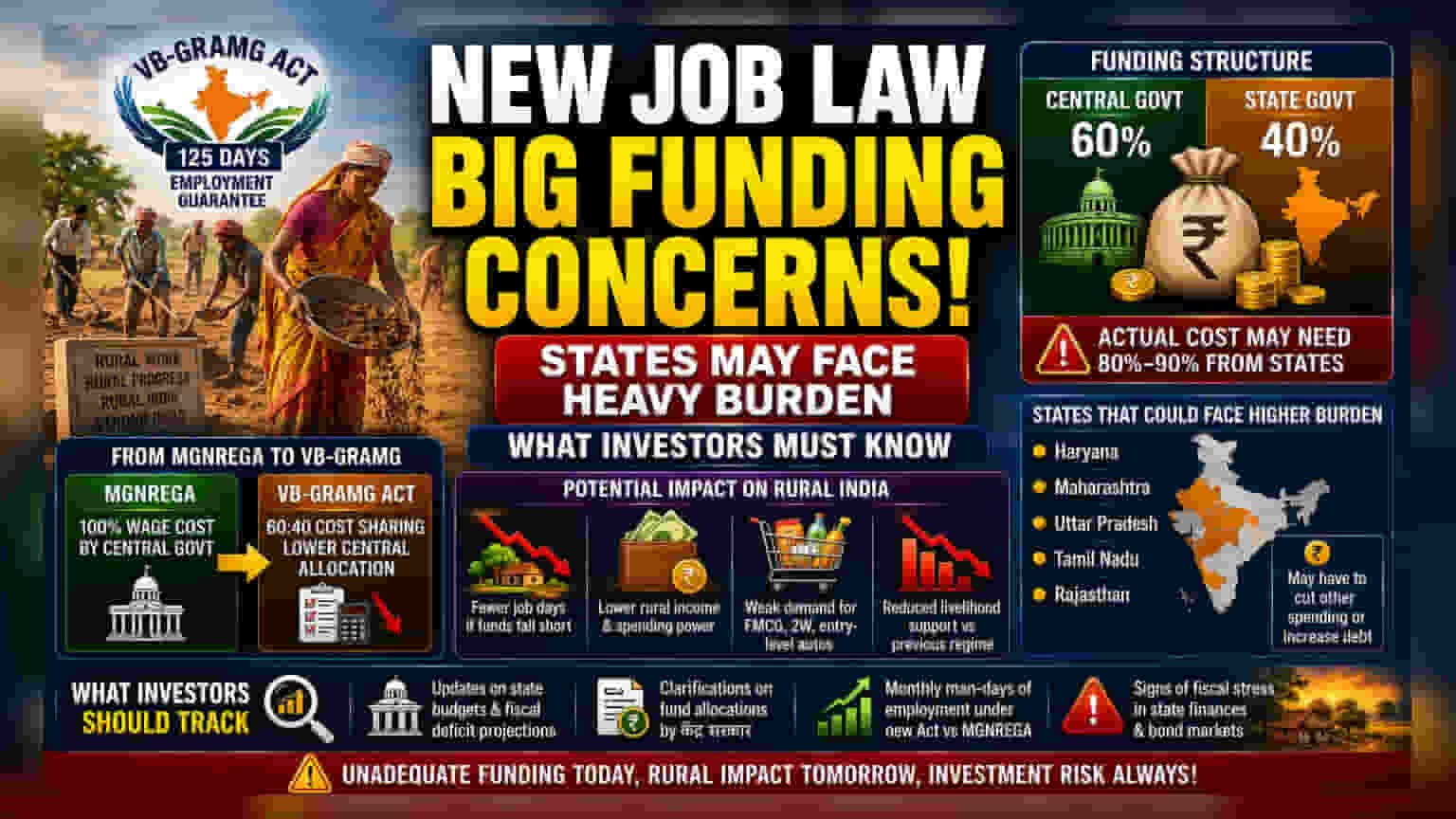


The new Viksit Bharat-Guarantee for Rozgar & Aajeevika Mission (Gramin) Act, which replaced MGNREGA, faces criticism as insufficient central allocations leave states to cover up to 90% of costs in some regions. With the scheme mandating 125 days of employment under a 60:40 central-state funding model, states may face significant fiscal pressure. Investors should monitor the impact on state deficits and potential ripple effects on rural consumer demand.
What Happened
The implementation of the Viksit Bharat-Guarantee for Rozgar & Aajeevika Mission (Gramin) Act, or VB-GRAMG, has run into immediate concerns regarding its financial structure. This new law, which replaced the Mahatma Gandhi National Rural Employment Guarantee Act (MGNREGA), mandates 125 days of employment for rural workers. Under the new guidelines, the funding is split between the central government at 60% and state governments at 40%. However, labor advocacy groups, including the NREGA Sangharsh Morcha and the Foundation for Responsive Governance, have analyzed official data and concluded that the current central allocation is significantly lower than what is required to meet the 125-day employment guarantee.
Why This Matters For State Finances
For investors and market observers, the primary concern is fiscal federalism and the health of state budgets. Under the previous MGNREGA structure, the central government provided 100% of the funding for wages, which limited the direct fiscal burden on states. The shift to a 60:40 cost-sharing model, combined with an alleged shortfall in central allocations, forces states to fill the financing gap. If states are required to fund 80% to 90% of the costs to maintain the employment guarantee, it could lead to higher-than-expected state fiscal deficits. This, in turn, may force state governments to either borrow more or cut back on other forms of capital expenditure to accommodate the unplanned outflow.
Potential Impact On Rural Demand
The effectiveness of this new scheme is closely linked to rural consumption patterns, which are a major driver of demand for sectors like fast-moving consumer goods, two-wheelers, and entry-level automobiles. If states find themselves unable to bridge the funding gap, the actual number of employment days provided could drop significantly below the promised 125 days. Analysts note that reduced rural employment opportunities could negatively impact household income in rural areas, potentially cooling demand for consumer goods. The funding shortfall also raises questions about whether the scheme can achieve the same level of livelihood support as its predecessor.
The Bigger Business Context
This development highlights the complexities of transitioning from an entirely centrally-funded welfare model to a shared-responsibility model. When the central government sets a mandate that relies on state participation, the execution risk becomes tied to the fiscal capacity of individual states. States like Haryana, Maharashtra, Uttar Pradesh, Tamil Nadu, and Rajasthan have been flagged as potentially facing a much higher financial burden than the 40% cap intended by the legislation. If these states prioritize the employment guarantee, they may need to make difficult choices regarding their own budget priorities, which is a development worth monitoring for broader economic implications.
What Investors Should Track
Investors should keep an eye on upcoming state budget revisions and any official clarifications from the Union Ministry of Rural Development regarding the funding allocations. The key monitorable is whether the central government adjusts its interim allocations to bridge the gap or if states are left to bear the additional costs. Furthermore, market watchers should track monthly reports on man-days of employment generated under the new Act compared to historical MGNREGA figures. Any sustained decline in rural employment figures or signs of significant fiscal stress in state government bonds could serve as early warning signs of broader economic adjustments.