

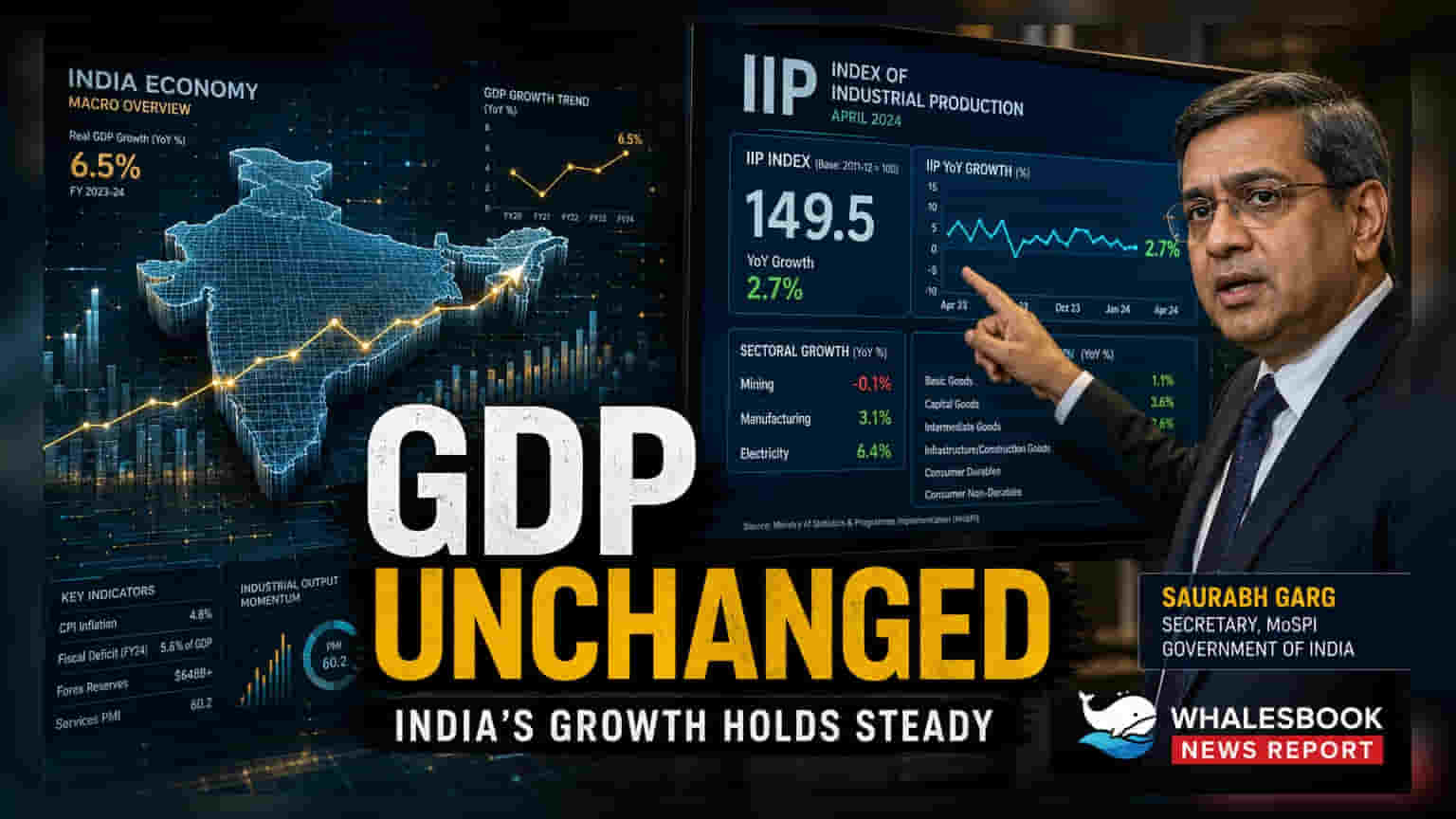
The Ministry of Statistics and Programme Implementation (MoSPI) confirmed that its updated Index of Industrial Production (IIP) methodology will not directly change GDP or GVA calculations. While the new series adopts the Producer Price Index to improve accuracy, it remains a measure of output rather than value-added economic contribution.
What Happened
The Ministry of Statistics and Programme Implementation (MoSPI) has introduced a revised series for the Index of Industrial Production (IIP). Despite the technical updates, MoSPI Secretary Saurabh Garg clarified that these changes will not directly alter the official Gross Domestic Product (GDP) or Gross Value Added (GVA) estimates for the country. The update is part of a broader government effort to modernize India's economic data collection and statistical reporting systems.
Shifting Toward Producer Price Index
A significant change in the new IIP series is the move from the Wholesale Price Index (WPI) to the Producer Price Index (PPI). The government considers PPI a more precise metric because it tracks factory-gate prices—the prices received by domestic producers—rather than wholesale market prices. This transition is intended to better reflect the true state of industrial production, particularly for industries with complex product specifications or long manufacturing timelines. By aligning with international best practices, the ministry aims to make industrial data more reliable and relevant to modern market conditions.
Why The GDP Link Remains Unchanged
Investors should note that the IIP and GDP serve different analytical purposes. The IIP is designed specifically to measure the volume of industrial output. In contrast, GDP and GVA calculations focus on the value added by different sectors. Because the IIP does not account for value-added contributions, it cannot directly replace or alter the components used to calculate national income. According to MoSPI, the weights utilized in the IIP are actually sourced from national accounts, meaning that GDP data effectively influences the IIP, rather than the other way around.
Modernizing Statistical Reporting
The statistical overhaul includes other initiatives to improve economic transparency. The government has launched a services-sector Producer Price Index, which currently covers seven service categories, with intentions to broaden this scope in the coming years. Furthermore, the ministry is working toward incorporating a banking services price index to refine GDP calculations within the financial sector. MoSPI is also evaluating whether to eventually integrate output PPI data into GVA calculations after completing the necessary validation processes.
What Investors Should Track
While the IIP revision does not change the bottom-line GDP figures, the shift to a PPI-based measurement is a positive step for data quality. Investors tracking macro-economic trends should monitor how these refined industrial statistics impact future reporting on factory output and sector-specific performance. The key monitorable will be the ministry's progress in integrating these new indices into the wider national accounting framework, which could provide a clearer, more granular view of industrial health over the coming quarters.