

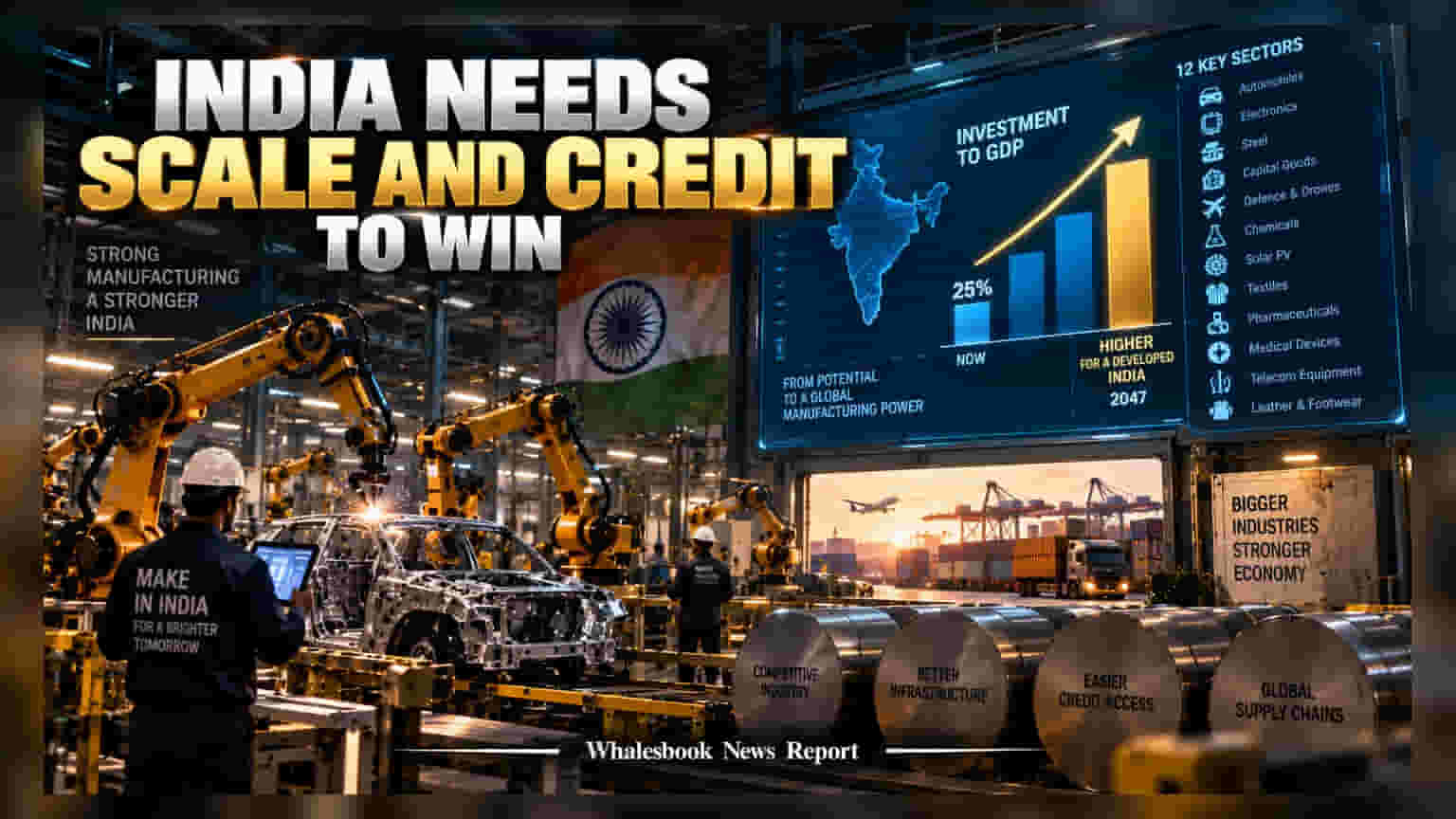
NITI Aayog has mapped out a strategy to transform India into a global manufacturing hub, identifying 12 priority sectors for expansion. The plan focuses on removing barriers like land acquisition and credit access to drive private investment. Investors should watch for policy shifts in areas like chemicals, textiles, and renewable energy as the country pushes for higher industrial output.
NITI Aayog has set a clear policy roadmap to position India as a global manufacturing powerhouse, as outlined in its August 2026 report on key sectors for the 2047 economic goal. The strategy marks a shift in focus, prioritizing 12 specific industries that are deemed critical for integrating India into global supply chains rather than relying solely on low-value assembly.
The 12 priority sectors include automobiles, electronics, steel, capital goods, defence and drones, chemicals, solar PV manufacturing, textiles, pharmaceuticals, medical devices, telecom and networking equipment, and leather and footwear. Among these, the planning body has highlighted four industries—chemicals, textiles, telecom equipment, and solar PV—as primary areas for immediate attention to enhance competitiveness.
Ashok Kumar Lahiri, Vice Chairperson of NITI Aayog, has stated that sustainable growth must be driven by the private sector, fueled by profit-driven investment. The government's objective is to foster an environment that attracts long-term capital by addressing structural weaknesses that have historically hindered large-scale industrial projects. Key among these bottlenecks are challenges in land acquisition, high costs of capital, and fragmented supply chains that limit economies of scale.
For investors and market observers, the core challenge lies in the current investment-to-GDP ratio, which remains around 25%. This is significantly lower than the levels seen in East Asian economies during their period of rapid industrial transformation. NITI Aayog’s report suggests that to move into a higher income bracket, India must deepen its credit markets. The country's credit-to-GDP ratio remains below that of peers like China or Singapore, making access to affordable capital a persistent hurdle for manufacturing firms.
Global risks remain a significant factor in this growth strategy. The report acknowledges that protectionist measures, tariff wars, and the potential erosion of existing trade frameworks could threaten export-oriented manufacturing goals. Additionally, the need for skilled labor and consistent infrastructure development means that progress in these 12 sectors may not be uniform.
Investors tracking this space should watch for future policy updates regarding land reforms, labor market adjustments, and financial sector moves aimed at improving credit availability. While the government's roadmap provides a clear focus, the speed of execution, improvements in logistics, and the ability of companies to effectively integrate into global value chains will determine the actual impact on revenue and profitability for firms in these sectors.