

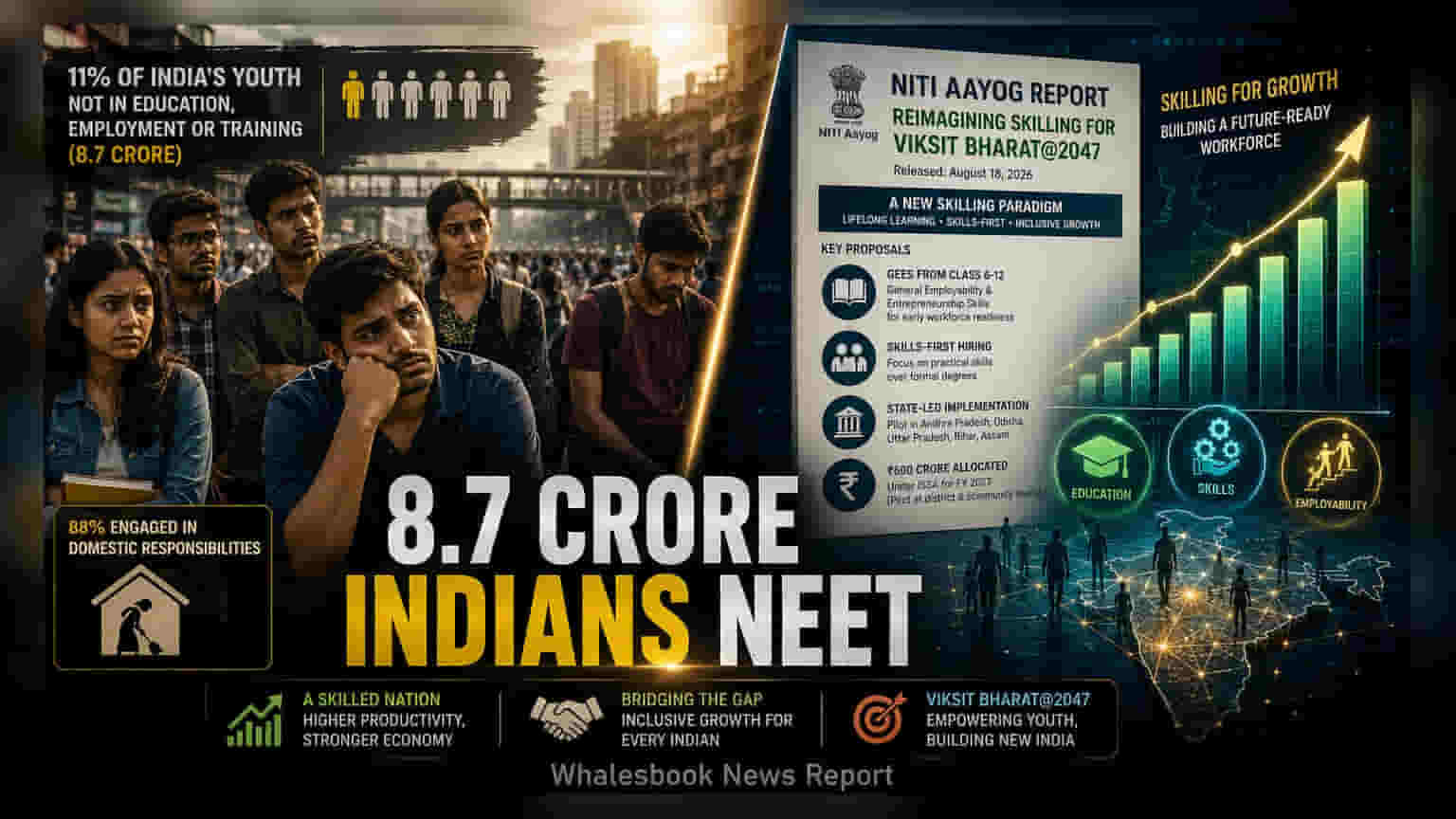
NITI Aayog has identified 8.7 crore Indians as NEET—not in education, jobs, or training—and proposed a major national skilling shift. The report recommends adopting "skills-first" hiring and introducing vocational training from Class 6. This structural change is significant for Indian businesses and the labor market, as it aims to bridge the gap between degree-based education and actual industry needs.
A new report from NITI Aayog, titled 'Reimagining Skilling for Viksit Bharat@2047' and released on August 18, 2026, has highlighted a critical gap in India's labor market. The study found that approximately 8.7 crore individuals, or 11% of India's youth, fall into the NEET category, which stands for those not in education, employment, or training. The data indicates that 88% of these individuals are primarily engaged in domestic responsibilities, suggesting that current skilling initiatives often miss a large portion of the population due to social and mobility barriers.
To address this, NITI Aayog has proposed a fundamental shift in how India approaches skill development. The strategy moves away from the traditional model of linear progression—from school to college to work. Instead, it promotes a framework of lifelong learning. A key proposal is to introduce General Employability and Entrepreneurship Skills (GEES) for students starting from Class 6 through Class 12. This is aimed at preparing students for the workforce earlier in their educational journey.
Another significant recommendation is a shift toward "skills-first" hiring by employers. Currently, the report notes that only a small fraction of graduates are employed in roles that directly align with their formal qualifications. By moving away from a strict reliance on university degrees and focusing on practical skills, the government hopes to expand the talent pool and reduce the mismatch between what schools teach and what companies need.
Implementation will be led by state governments, with the Ministry of Skill Development and Entrepreneurship supporting the initiative. The plan involves piloting new integration strategies in states including Andhra Pradesh, Odisha, Uttar Pradesh, Bihar, and Assam. The initiative is linked to the Integrated Scheme in Skilling Architecture (ISSA), with Rs 600 crore allocated for the 2027 fiscal year to test these methods at district and community levels.
For the corporate sector and investors, this proposal represents a potential change in the labor market. If widely adopted, a shift toward "skills-first" hiring could disrupt traditional education-focused business models, such as private degree colleges and certain coaching sectors, while potentially creating demand for vocational training, certification, and specialized skilling services. Companies in the IT, manufacturing, and services sectors, which often face high training costs for new recruits, may benefit if the workforce becomes "job-ready" through such programs.
However, the initiative carries notable risks. The success of this overhaul depends entirely on the effectiveness of coordination between state governments, district administrations, and the private sector. Historically, Indian vocational training programs have faced challenges with uneven implementation and a lack of alignment with industry requirements. Additionally, the high percentage of NEET individuals involved in domestic duties points to deep-seated social barriers that require more than just technical training to solve. Investors and industry participants will likely monitor the progress of the planned pilot programs to see if they can produce measurable improvements in labor productivity and employment rates.