 Whalesbook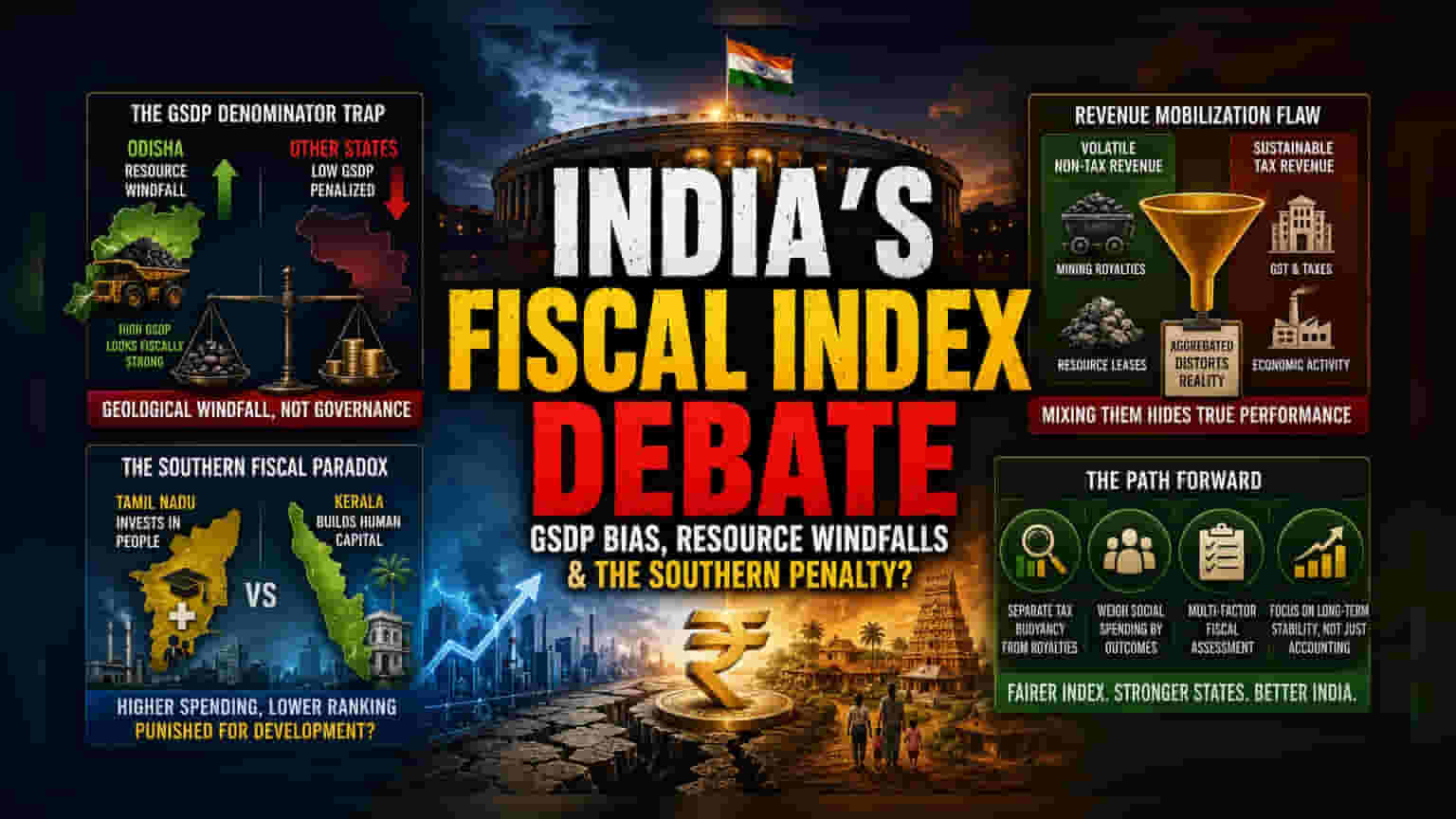


The GSDP Denominator Trap
At the heart of the latest fiscal controversy is the methodology employed by the national planning body. By relying heavily on Gross State Domestic Product (GSDP) as a denominator, the index creates a structural skew that disproportionately benefits states with natural resource wealth. Because mining royalties and resource-linked revenues can lead to rapid, non-industrial GSDP growth, states like Odisha appear to possess superior fiscal discipline. In reality, this reflects a geological windfall rather than administrative ingenuity. When GSDP is used to normalize metrics like the Gross Fiscal Deficit, it masks underlying spending patterns, allowing resource-rich regions to sustain higher levels of debt while appearing fiscally lean on paper.
The Southern Fiscal Paradox
A distinct divergence has emerged between the northern industrializing belts and the southern states, where decades of investment in health, education, and social infrastructure have resulted in higher committed expenditures. The recent demotion of Tamil Nadu and the stagnant performance of Kerala highlight a systemic friction: the index rewards the preservation of capital rather than the active deployment of it. While the index categorizes these states as underperformers, they remain the engines of India's demographic and social capital development. Critics contend that by forcing these states into an austerity-centric framework, the index ignores the long-term multiplier effects of social spending, creating an artificial divide between fiscal prudence and developmental necessity.
Revenue Mobilization and Structural Weakness
The current framework fails to distinguish between sustainable tax buoyancy and volatile, geography-dependent non-tax revenue. By aggregating these streams, the NITI Aayog provides a distorted view of fiscal self-reliance. True fiscal health should theoretically measure a state’s ability to generate revenue from economic activity rather than extracting value from subterranean assets. Economists argue that a more robust index would decouple institutional tax performance from non-tax mining royalties to reveal which states are actually improving their administrative tax efficiency. Without this separation, the index risks encouraging a race to the bottom in social investment to chase higher, albeit superficial, fiscal scores.
The Future of Sub-National Fiscal Policy
Moving forward, the pressure to revise the index’s scoring architecture is mounting. There is an increasing demand for the inclusion of social progress indicators that weigh committed expenditures against developmental outcomes. If the current methodology remains unchanged, there is a risk that states may be incentivized to curtail essential public services simply to move up the rankings. A shift toward a multifaceted assessment—incorporating tax buoyancy and social infrastructure returns—would likely provide a more transparent and equitable reflection of India’s sub-national economic realities, moving the conversation away from mere accounting toward genuine, long-term state stability.