

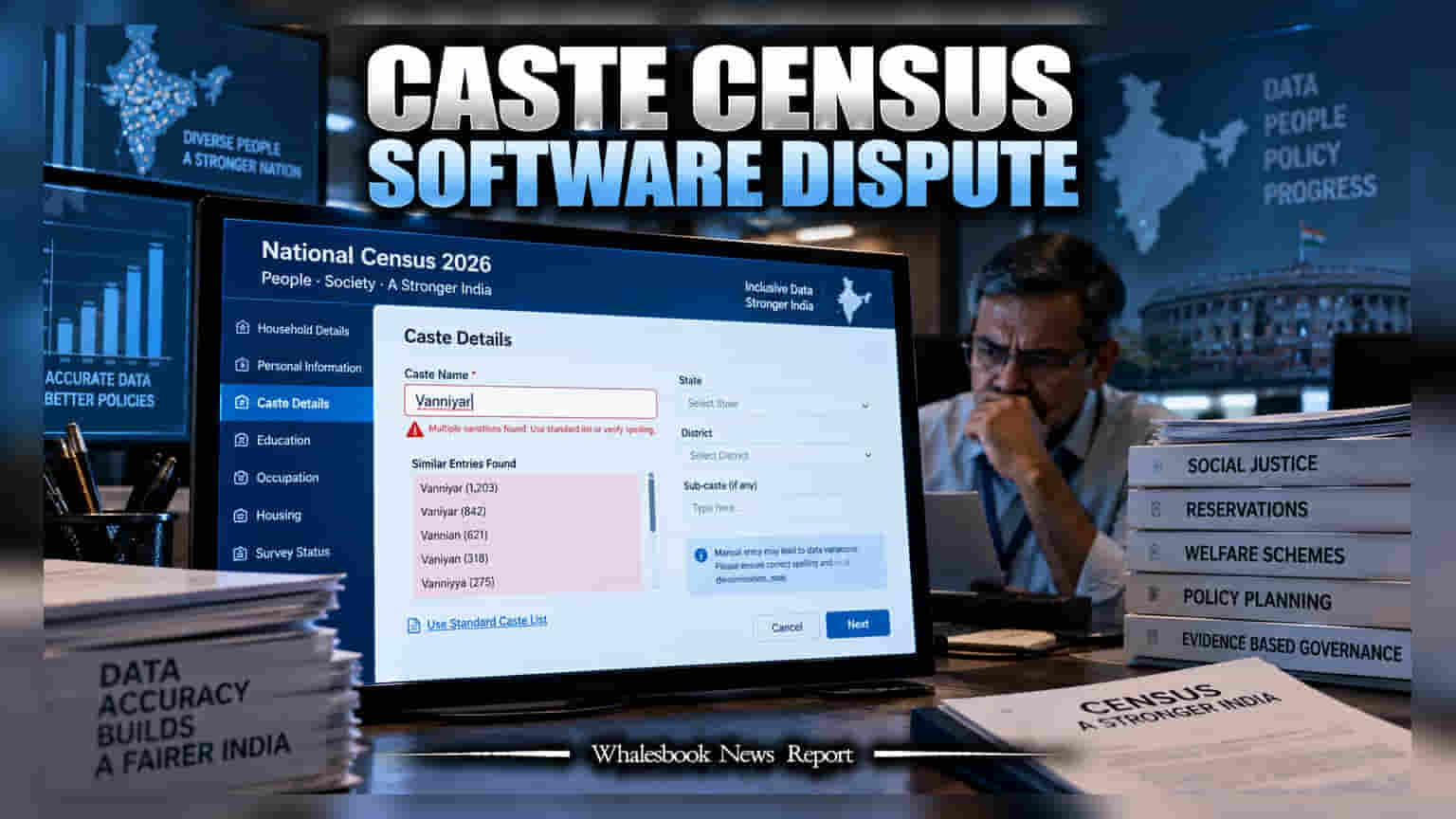
PMK President Anbumani Ramadoss has publicly challenged the Union government's manual text entry method for the ongoing national caste census. He argues this approach will lead to data fragmentation, urging the use of standardized, pre-defined caste lists instead. The disagreement highlights concerns over the reliability of the survey, which forms the basis for future welfare and reservation policy planning.
Pattali Makkal Katchi (PMK) President Anbumani Ramadoss, a key ally within the National Democratic Alliance (NDA), has formally expressed opposition to the central government's implementation strategy for the upcoming national caste census. The primary contention lies in the government's decision to permit enumerators to manually type caste names into the system, rather than selecting them from a pre-defined, standardized database.
The central issue raised by the PMK is the potential for severe data fragmentation. While India officially recognizes approximately 4,147 distinct caste groups, critics argue that an open-ended, manual entry system could generate millions of unique variations due to regional differences in spelling, local nomenclature, and linguistic nuances. Experts suggest that such volatility would make it difficult to aggregate data accurately, potentially rendering the findings less useful for targeted welfare schemes and policy formulation.
To mitigate these risks, the PMK is advocating for the integration of official central and state caste lists into a drop-down menu system. This methodology aligns with recent state-level surveys conducted in Bihar and Telangana, where standardized codes were used to streamline data collection. Proponents of this model argue that utilizing pre-validated lists ensures consistency and improves the speed and reliability of data processing.
From an economic and policy perspective, the accuracy of this census data is critical. Government spending on social welfare, education, and various reservation-linked programs is often allocated based on demographic data. If the resulting dataset is fragmented or inconsistent, it may complicate the government's ability to distribute resources effectively or design evidence-based socioeconomic policies. This has drawn the attention of the Indian National Congress, which has aligned with the PMK’s position, adding significant political weight to the demand for a more technological approach to the survey.
The debate highlights a broader tension between administrative ease and data precision. While the government has previously expressed concerns that pre-defined lists might inadvertently exclude certain groups or cause confusion with regional descriptors, critics maintain that the lack of structure poses a greater threat to the integrity of the entire exercise. The ongoing discourse underscores the complexities involved in executing a national survey of this scale and suggests that the methodology could face further scrutiny or adjustments as the census process progresses. The next important update to monitor will be any potential government response regarding software updates or the incorporation of standardized lists before the enumeration reaches its peak in the coming months.