

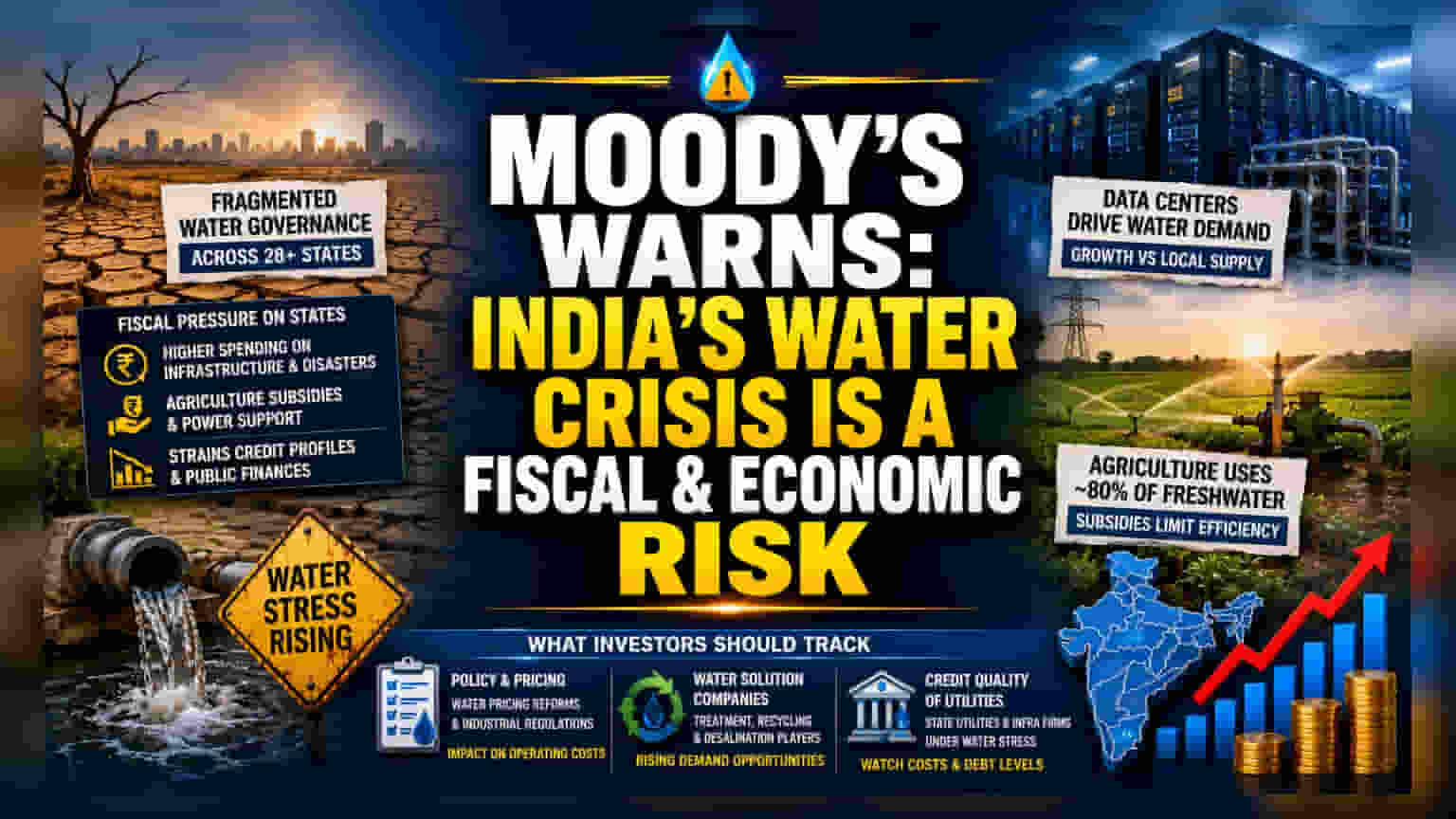
Moody’s Ratings has flagged that India’s fragmented water governance and heavy agriculture subsidies could threaten fiscal stability. The agency notes that rising industrial demand, particularly from data centers, is straining limited resources. Investors may monitor how these water risks impact government spending, utility companies, and water-intensive industries.
What Happened
Moody’s Ratings has issued a warning regarding India’s water management framework. The agency highlighted that the country’s fragmented governance—where water rights and management are spread across more than 28 states—creates significant fiscal and economic risks. The report suggests that current policies, which often involve heavy subsidies for agriculture and slow reallocation of water resources, are struggling to keep pace with modern economic demands and climate variability. For investors, this signals that water scarcity is moving from an environmental concern to a core economic and fiscal issue.
The Fiscal And Credit Risk
Why does water management impact a country’s fiscal health? According to the report, inefficient systems lead to higher government spending on emergency infrastructure, disaster management for floods or droughts, and subsidies to maintain water and power supply for agricultural pumping. When states carry heavy financial burdens to keep water cheap for farming, it reduces their ability to invest in other areas. Moody’s notes that this pressure on state budgets and the potential for service disruptions can strain credit profiles, especially in regions that are already facing high climate exposure.
The Industrial Strain And Data Center Growth
One of the most specific pressures mentioned is the rapidly growing demand from water-intensive industries. Data centers, which are expanding quickly due to cloud computing and artificial intelligence, require massive amounts of water for cooling their server farms. Unlike traditional industries, data centers often operate in clusters that can strain local water tables. The agency points out that utilities and local governments face a difficult trade-off: supporting this new, high-growth economic activity while managing the potential conflict with local communities over limited water supplies.
The Agriculture Dilemma
Agriculture remains the largest user of water in India, accounting for approximately 80% of freshwater consumption. Because water pricing for this sector is heavily subsidized, there is limited incentive for efficiency, leading to significant groundwater depletion. This creates a structural challenge for the economy. Reforms in water pricing or distribution are politically difficult, but the report suggests that without better management, the economic disruptions caused by water shortages—such as crop failures or industrial shutdowns—will become more frequent and costly.
What Investors Should Track
Investors may want to watch how these risks play out in three key areas:
First, policy changes regarding water pricing and industrial usage regulations. If governments move toward stricter usage norms or higher industrial water tariffs, companies with water-intensive operations may see a rise in their operating costs.
Second, companies focusing on water treatment, recycling, and desalination technologies. As water becomes a scarcer resource, businesses that help others recycle water or reduce consumption may see increased demand for their solutions.
Third, the credit quality of state-level utilities and government-owned infrastructure firms. Investors in these bonds or companies may monitor whether water stress leads to higher operational costs or debt levels for these entities.