 Whalesbook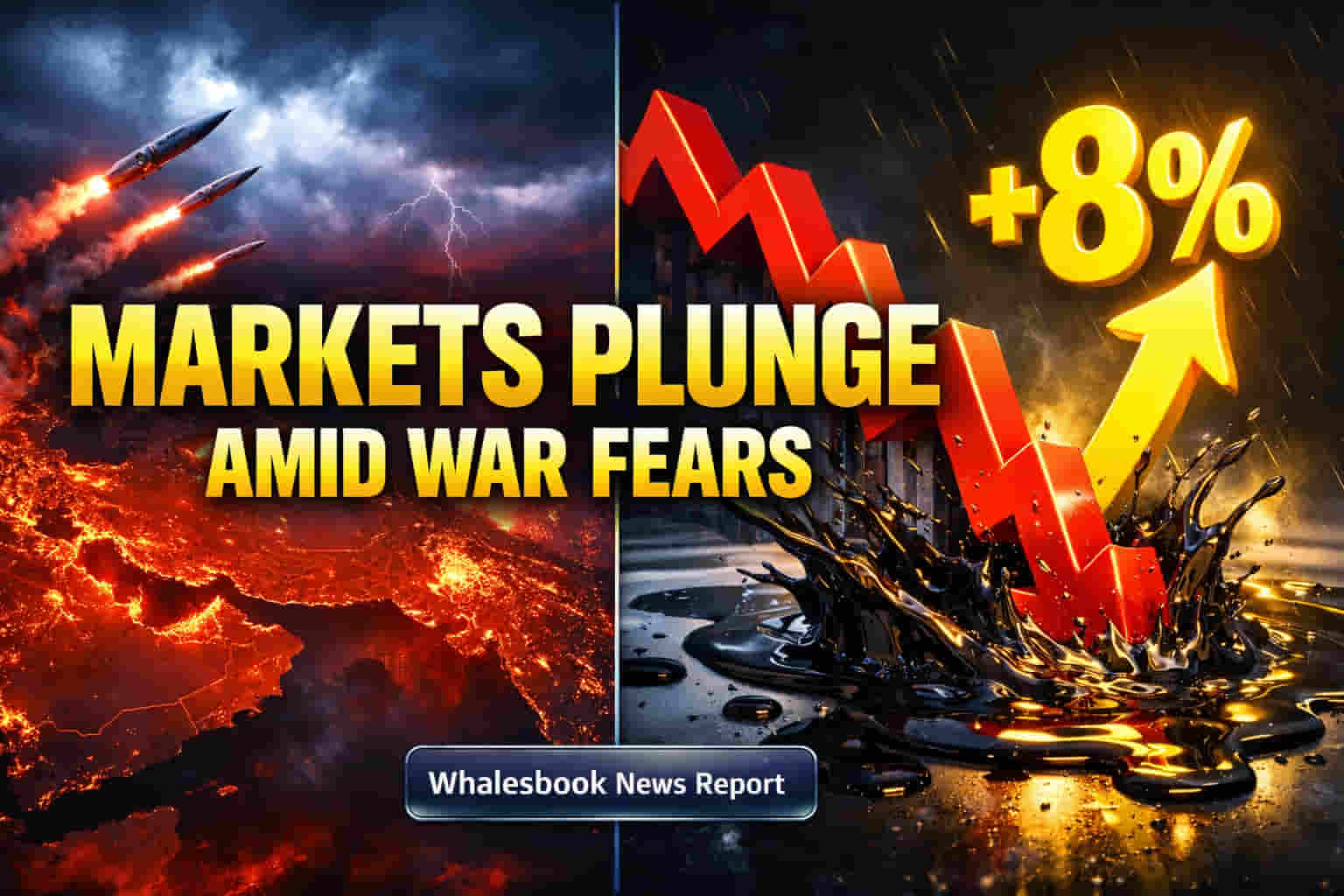


THE SEAMLESS LINK
The market's dramatic reaction was primarily driven by the immediate physical and psychological impact of escalating conflict in the Middle East. Beyond the headline figures of market cap erosion and commodity price spikes, deeper analysis reveals a complex interplay of sustained uncertainty, technological integration in warfare, and specific regulatory responses within key economies like India.
### The Core Catalyst: Conflict and Capital Flight
The US-led strikes on Iran and subsequent retaliatory actions triggered a widespread risk-off sentiment across global financial markets. Brent crude oil futures jumped by as much as 13% to trade above $80 a barrel, while WTI crude saw similar gains, reflecting immediate fears of supply chain disruptions. This commodity shockwave reverberated through equity markets; US stock futures fell by over 1%, European indices like the FTSE 100 and CAC 40 also declined, though energy and defense stocks provided some resilience. Asian markets presented a mixed picture, with Shanghai seeing gains in oil stocks while others like Hong Kong and Japan slumped. In India, the benchmark Sensex and Nifty indices opened sharply lower, with the Sensex dropping 1,048 points and Nifty 50 down 313 points, culminating in a ₹10 lakh crore erosion in market capitalization over three sessions as over 869 stocks hit 52-week lows. Defense stocks globally, including US firms like Lockheed Martin and RTX, saw pre-market gains, while travel and hospitality sectors faced significant headwinds, with airlines like InterGlobe Aviation tumbling over 7%.
Separately, in a development highlighting the evolving nature of modern conflict, reports emerged that the US military utilized Anthropic's Claude AI for intelligence assessments and target selection during strikes on Iran, even after President Trump had reportedly ordered federal agencies to cease using the technology. This integration of AI, despite regulatory and ethical disputes with the company, signals a new frontier in warfare that could have downstream implications for technology sector valuations and national security policies.
### The Analytical Deep Dive: Global Fallout and India's Position
The conflict's impact extends beyond immediate market price action. The disruption of shipping through the Strait of Hormuz, a critical chokepoint handling approximately 20% of global oil supply, poses a significant risk to energy markets. Analysts warn that sustained disruption could push oil prices to $100-$130 per barrel, a scenario that would profoundly impact global inflation and economic growth forecasts. For India, a major energy importer, higher crude prices threaten to widen its current account deficit, weaken the rupee (which fell past 91 per dollar), fuel inflation, and trigger capital outflows. India currently holds a three-week buffer in crude oil inventory, providing some short-term relief. Historically, similar geopolitical tensions have led to substantial market volatility, with the India VIX, a measure of market volatility, surging to its highest level since June 2025.
Concurrent with the Middle East crisis, India and Canada set an ambitious target to boost bilateral trade to $50 billion by 2030, agreeing to finalize a Comprehensive Economic Partnership Agreement (CEPA) and sign a $2.6 billion uranium supply deal. This diplomatic initiative offers a contrasting narrative of cooperation amidst global uncertainty, though its market impact is overshadowed by the immediate geopolitical risks.
### ⚠️ THE FORENSIC BEAR CASE
The elevated geopolitical risk premium embedded in oil prices, estimated between $4 to $10 per barrel, is a persistent threat to market stability. The duration of the conflict remains highly uncertain; President Trump indicated it could last four weeks or more, raising concerns about prolonged supply disruptions and a sustained period of elevated energy costs. Such a scenario could trigger a global inflationary scare, potentially delaying any anticipated interest rate cuts by central banks. Furthermore, the integration of AI tools like Anthropic's Claude into military operations, despite US government directives against the company, suggests a potential disconnect between policy and operational execution, raising questions about regulatory oversight and the ethical implications of AI in conflict zones. While some analysts suggest markets are pricing a limited conflict, any escalation beyond current expectations, particularly sustained disruption to the Strait of Hormuz, could lead to more severe economic fallout, potentially impacting global GDP growth. Travel and logistics sectors face compounding risks from flight cancellations, airspace closures, and increased shipping insurance costs, adding further pressure on already sensitive supply chains.
### THE FUTURE OUTLOOK
Analysts' outlooks on oil prices vary, with some forecasting averages around $60-$63 per barrel for 2026 based on fundamental supply-demand factors, while others predict prices could spike to $80 or even $100+ if disruptions are severe or prolonged. OPEC+ producers are expected to increase output by 206,000 barrels per day in April, a move that could offer some counter-pressure to rising prices, though actual increases might be modest. In India, the Securities and Exchange Board of India (SEBI) Chairman Tuhin Kanta Pandey has adopted a 'wait and watch' approach regarding further derivatives reforms, intending to first assess the impact of existing rules designed to curb speculation and protect retail investors. This measured regulatory stance suggests a focus on market stability amid prevailing uncertainty, recognizing that nearly 92% of retail traders incur losses in the Futures and Options segment.