

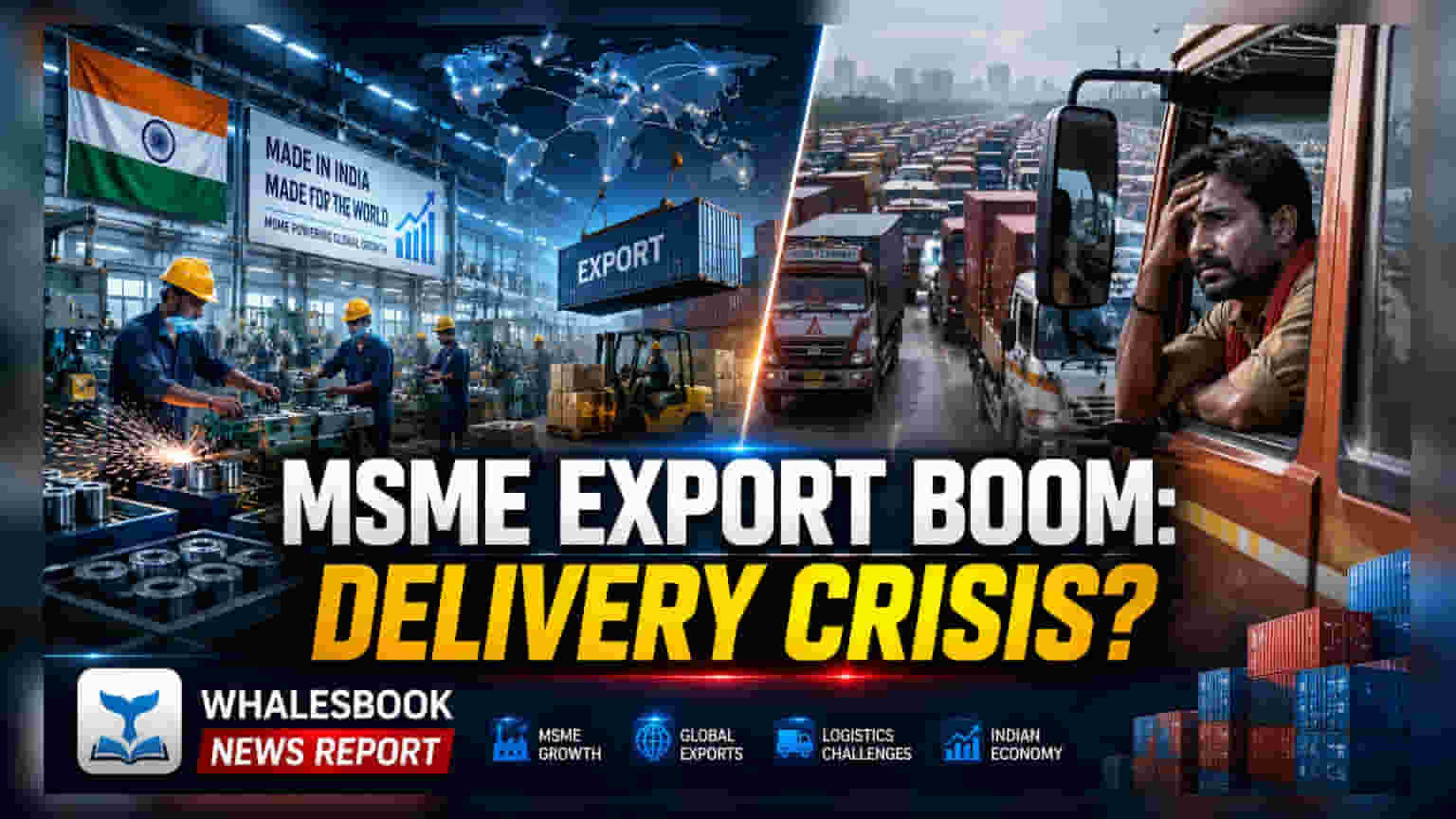
India’s MSME exports tripled to ₹12.39 lakh crore by FY25, now comprising half of total merchandise exports. Despite this growth, small firms struggle with logistics costs that are more than double those of large corporations. Investors may track how digital logistics adoption impacts the long-term competitiveness and profit margins of these smaller manufacturers.
What Happened
India’s Micro, Small, and Medium Enterprises (MSMEs) have seen a significant jump in export performance, with total shipments reaching ₹12.39 lakh crore in FY25. This is a sharp increase from ₹3.95 lakh crore recorded in FY21. The sector now accounts for approximately 50% of India's total merchandise exports. While this demonstrates strong global demand and rising manufacturing capability, it has also highlighted a growing gap in how smaller firms handle the logistics and delivery expectations of international buyers compared to their larger, better-funded counterparts.
The Logistics Cost Burden
A primary challenge for MSMEs is the disparity in logistics expenses. Official industry analysis shows that firms with an annual turnover of up to ₹5 crore face logistics costs amounting to 16.9% of their output. In contrast, larger enterprises with turnovers exceeding ₹250 crore manage these costs at just 7.6%. This cost difference creates a competitive disadvantage, as smaller players find it harder to absorb fluctuations in fuel prices, transport volatility, and infrastructure inefficiencies that larger companies can handle through economies of scale.
Why Reliability Matters for Exports
International buyers are increasingly prioritizing delivery reliability as much as product quality. For an MSME, a single missed delivery or shipment delay can lead to serious consequences, including financial penalties, the disruption of a buyer’s production line, or even the permanent cancellation of contracts. Because nearly 65% of India’s freight is moved by road, smaller manufacturers are particularly exposed to transit delays and congestion. Unlike large corporations, many MSMEs lack internal logistics departments, making it difficult to maintain the consistent performance required to secure long-term, repeat business in global markets.
Technology as a Competitive Lever
To bridge this gap, many MSMEs are turning to technology-enabled logistics platforms. These tools provide smaller firms with capabilities previously available only to large companies, such as real-time tracking, optimized route planning, and faster market access. Adoption of these platforms has been linked to lower transportation costs and more predictable delivery timelines. As the government continues to implement programs like the National Logistics Policy and PM GatiShakti to improve multimodal connectivity, the ability of smaller firms to integrate with these digital ecosystems will be a key factor in their success.
What Investors Should Track
As India targets $1 trillion in merchandise exports by 2030, the MSME sector's ability to maintain its growth trajectory—estimated at 12-15% annually—depends heavily on solving these supply chain bottlenecks. Investors may track whether these smaller firms can effectively reduce their logistics-to-output ratio through digital adoption. Additionally, monitor the performance of logistics-service providers that cater specifically to the MSME segment, as their ability to provide reliable, cost-effective solutions will be vital for sustaining the export momentum of India’s smaller manufacturers.