

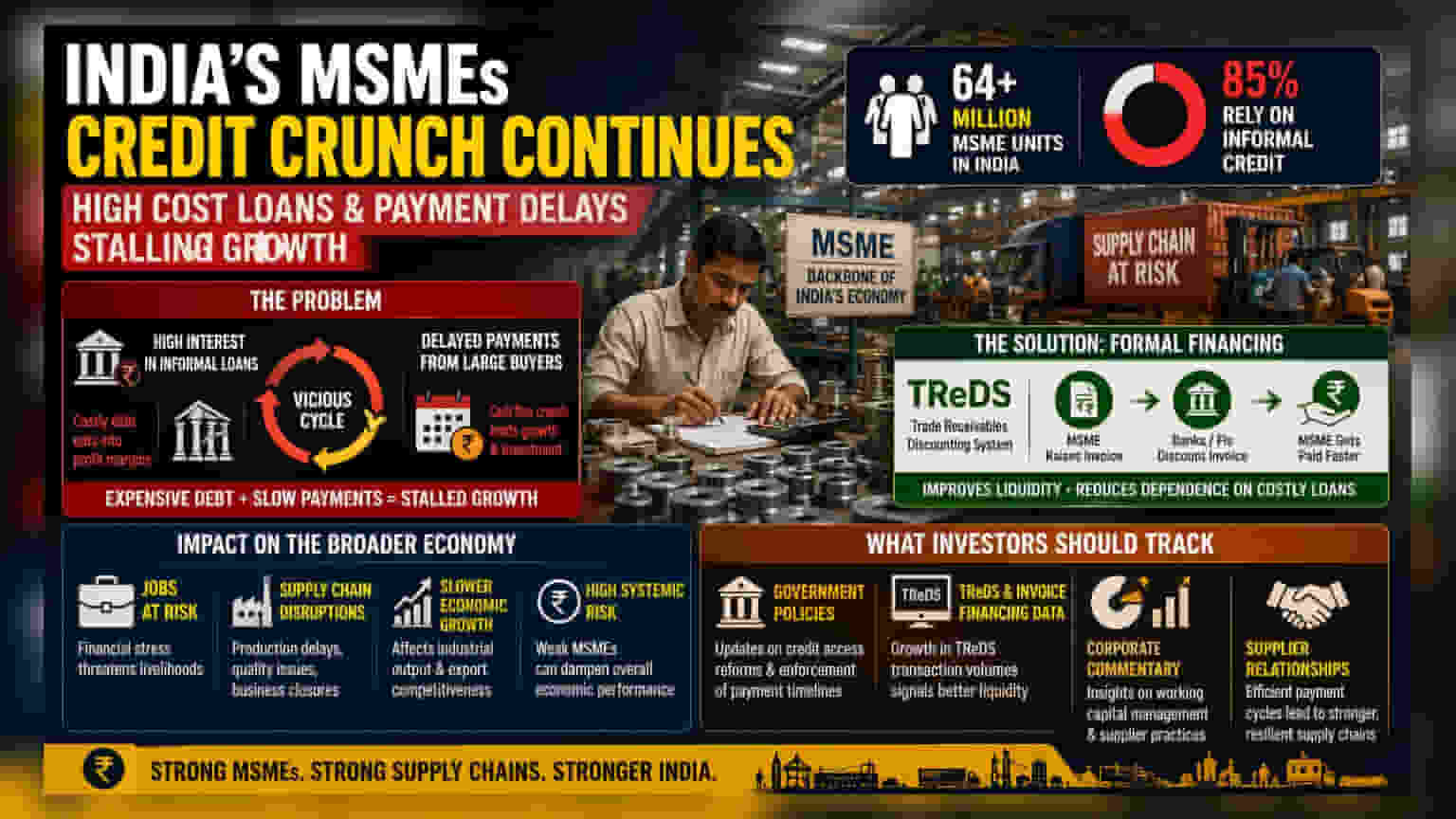
With 85% of India’s 64 million MSMEs relying on expensive, informal credit, delayed payments from large clients are squeezing their cash flow. This persistent financial stress hinders the sector's growth and creates potential supply chain risks. Investors should monitor how policy changes and platforms like TReDS address these challenges to stabilize the sector.
What Happened
India’s Micro, Small, and Medium Enterprises (MSMEs), which form the backbone of the country's employment and export markets, are facing a persistent financial hurdle. Reports indicate that approximately 85% of the over 64 million MSME units in India rely on informal credit sources. Because this credit often comes with high interest rates, it places a heavy financial burden on these smaller businesses. To make matters worse, many of these firms struggle with delayed payments from their larger corporate clients. This combination of expensive debt and slow cash collection creates a cycle of financial strain that limits the ability of these companies to expand or invest in better technology.
Why Payment Delays Hurt Growth
When large companies delay payments to their smaller suppliers, it forces the MSMEs to manage their daily expenses using borrowed money. This is essentially a working capital crisis. When a small business has to pay high interest on loans to cover the gap while waiting for payment, its profit margins shrink significantly. For investors, this is important because it highlights a potential weak point in the supply chain. If MSMEs are financially stressed, it can lead to production delays, quality issues, or even business closures, which may eventually disrupt the operations of larger listed companies that rely on these small suppliers.
The Role of Formal Financing
To bridge this gap, policy experts and industry bodies are pushing for better adoption of formal financing mechanisms. One such tool is the Trade Receivables Discounting System (TReDS). This platform allows MSMEs to sell their invoices to banks or financial institutions to get paid faster, rather than waiting for the long credit periods offered by large buyers. However, the challenge remains in the widespread adoption of such platforms. When MSMEs cannot access affordable, formal credit, they remain vulnerable to market shocks and economic slowdowns.
Impact on the Broader Economy
For the Indian economy, MSMEs are crucial for job creation. When the sector is under financial pressure, the impact is felt beyond just the small business owners. It can affect overall industrial production and export competitiveness. Investors tracking sectors like manufacturing, textiles, and consumer goods should look at how these companies manage their supplier payment cycles. Companies that maintain efficient payment practices with their MSME suppliers are often better positioned to handle supply chain disruptions. Conversely, a sector-wide reliance on expensive informal credit is a systemic risk that can dampen overall economic performance.
What Investors Should Track
Investors may want to monitor several key indicators regarding the MSME sector. First, look for updates on government policies aimed at improving credit access and enforcing stricter payment timelines. Second, check data on the volume of transactions on TReDS and similar invoice-financing platforms, as rising numbers indicate better liquidity for small businesses. Finally, watch for management commentary from large-cap industrial or consumer goods companies regarding their working capital management and supplier relationships, as this can provide insight into the financial health of the smaller companies within their supply chain.