 Whalesbook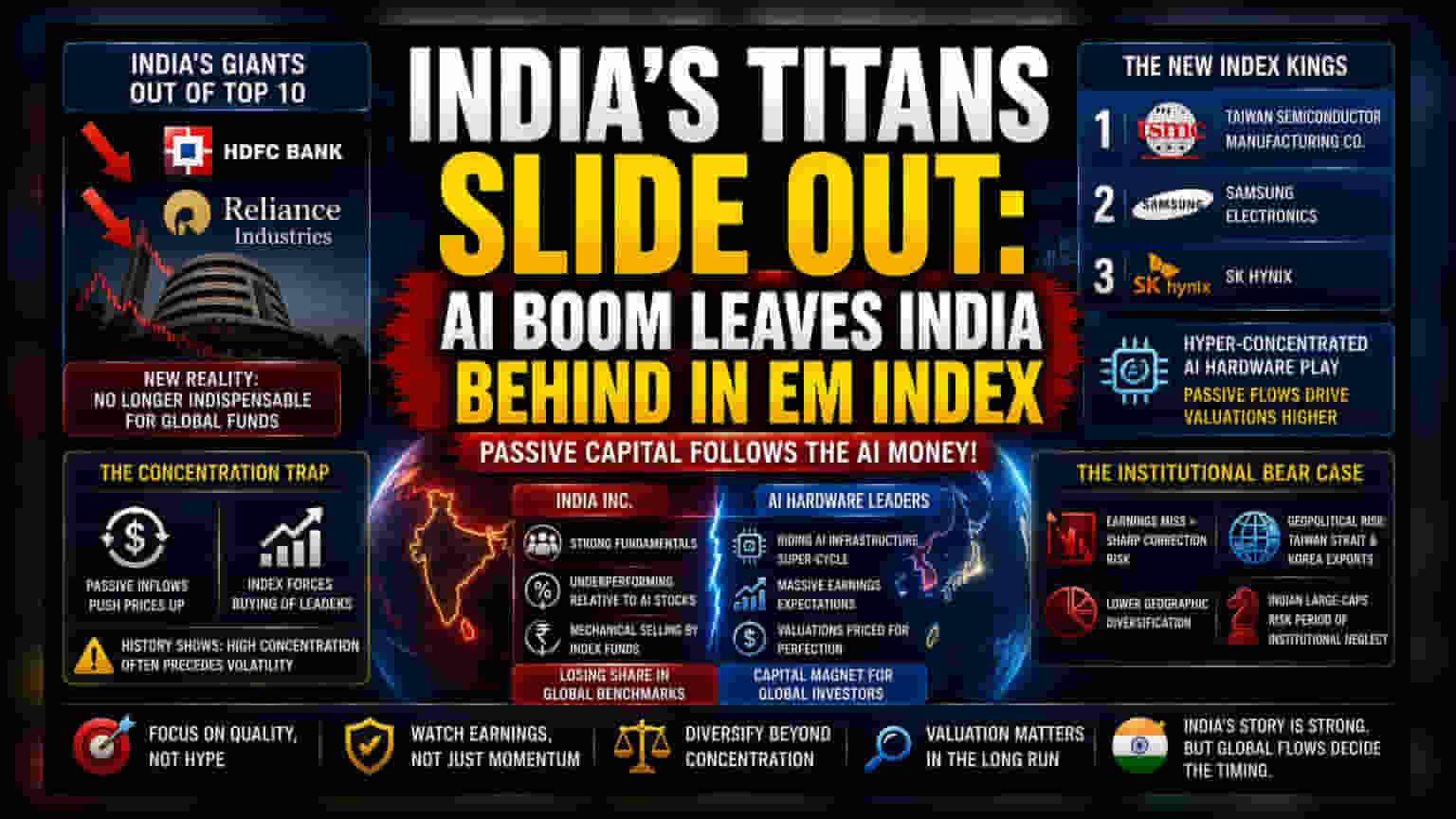


The departure of India’s corporate titans from the upper echelon of the MSCI Emerging Markets Index marks a significant transition in how global passive capital views value. By sliding out of the top 10 list, HDFC Bank and Reliance Industries have effectively ceded their status as indispensable pillars for international portfolio managers. This shift is not merely a reflection of domestic equity underperformance but a direct byproduct of a hyper-concentrated global appetite for AI hardware.
The Concentration Trap
Global index tracking is increasingly subject to the performance of a select few entities in the semiconductor supply chain. Currently, Taiwan Semiconductor Manufacturing Company, Samsung Electronics, and SK Hynix represent a disproportionate slice of the benchmark. This creates a feedback loop where passive fund inflows automatically inflate the valuations of these tech-heavy entities, forcing managers who track the index to follow suit regardless of individual valuation concerns. The result is a benchmark that behaves less like a diversified emerging market tracker and more like a concentrated tech-sector proxy. While historical data shows that such concentration often precedes volatility, the current momentum shows no sign of decoupling.
The Valuation Disconnect
Unlike the defensive growth profile offered by Indian financial and conglomerate sectors, the current index leaders are tied to the cyclical demands of the global compute infrastructure. Market participants are now grappling with the fact that India’s growth story—previously characterized by domestic consumption and industrial expansion—is currently failing to compete with the sheer speculative velocity of the semiconductor boom. Recent filings indicate that passive funds are effectively forced to sell the laggards to buy the leaders, creating a mechanical drag on Indian equities that exists independently of their underlying fundamentals.
The Institutional Bear Case
Reliance on a handful of AI-related stocks poses a systemic danger to the index. If earnings for these semiconductor giants fail to keep pace with the aggressive expansion of their price-to-earnings ratios, the correction could be sharp and widespread. Furthermore, the exclusion of Indian firms reduces the geographic diversity of the index, leaving investors heavily exposed to geopolitical tensions within the Taiwan Strait and the broader South Korean export climate. Management teams at these excluded firms face the immediate challenge of proving that their growth potential can survive in an environment where global liquidity is being vacuumed up by tech-centric mandates. Failure to re-assert value parity risks consigning Indian large-caps to a period of institutional neglect as index-tracking capital continues to migrate toward the current concentration of AI winners.