

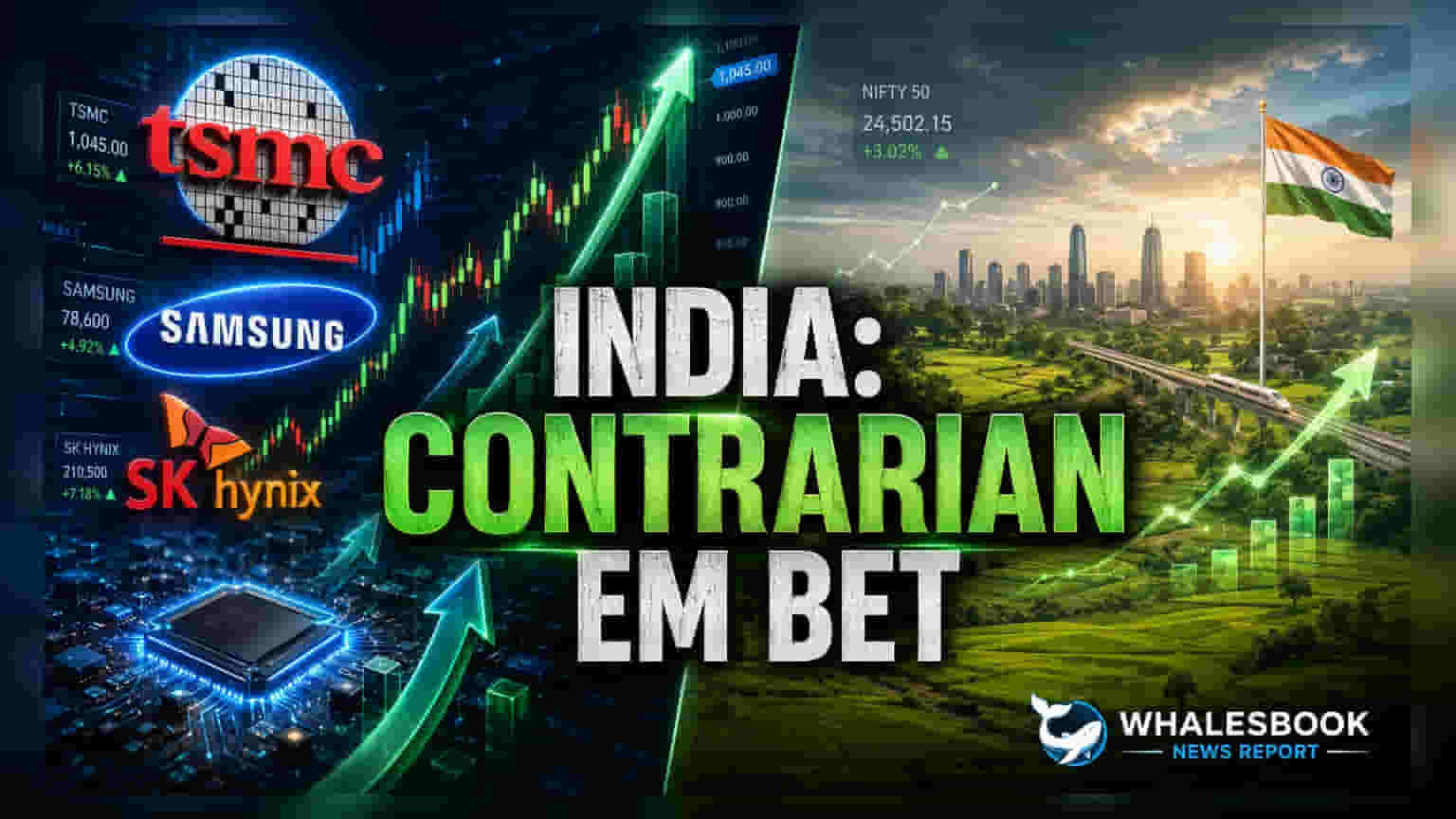
The MSCI Emerging Markets Index rally is currently concentrated in three semiconductor giants, which account for 72% of its year-to-date gains. While markets like Taiwan and South Korea trade at high valuation premiums, India and China remain at discounts compared to their 10-year average P/E ratios. This disparity highlights a potential shift in investor focus if market sentiment moves beyond the technology sector.
The global rally in emerging markets is currently defined by an intense focus on technology, particularly in the semiconductor space. Recent data indicates that three major companies—Taiwan Semiconductor Manufacturing Co. (TSMC), Samsung Electronics, and SK Hynix—have become the primary drivers of the MSCI Emerging Markets (EM) Index. Together, these firms represent roughly 30% of the index and are responsible for nearly 18 percentage points of its year-to-date return. This means that approximately 72% of the gains seen in the benchmark so far this year can be traced back to these three stocks alone.
Valuation Divergence Across Emerging Markets
While the headline index has climbed back toward 2021 levels, the performance is not uniform across all regions. There is a clear divide between technology-heavy markets and other developing economies. Taiwan and South Korea, which now make up nearly half of the index, are trading at valuation levels significantly higher than their historical norms. Specifically, Taiwan is trading at an 85.09% premium to its 10-year average Price-to-Earnings (P/E) ratio, while South Korea stands at a 71.52% premium.
In contrast, India and China offer a different picture. India is currently trading at a modest 2.39% discount, and China at a 10.98% discount relative to their respective 10-year average valuations. For investors, this valuation gap suggests that if the current rally broadens to include sectors outside of artificial intelligence and chip manufacturing, markets currently trading at lower valuations may become more attractive.
Impact of Technology Sector Concentration
The artificial intelligence boom has led to a rapid increase in the weight of the technology sector within emerging markets. As of May 2026, technology companies accounted for 44.2% of the MSCI EM Index, up from 28.3% in December 2025. This surge in weight has come at the expense of other sectors such as Healthcare, Consumer Cyclical, and Communication Services, which have seen their influence within the benchmark decrease.
This high concentration creates a specific risk profile for the index. Because such a large portion of the benchmark is now tied to the performance and sentiment surrounding a few semiconductor firms, the overall index may become more sensitive to volatility in the tech space. If there is a shift in sentiment toward AI or a pullback in chip stocks, the overall emerging market index could face pressure, even if other sectors within these countries remain stable. Investors looking at this space will likely track whether the market rally expands into other industries or if the concentration in tech-centric economies persists.