

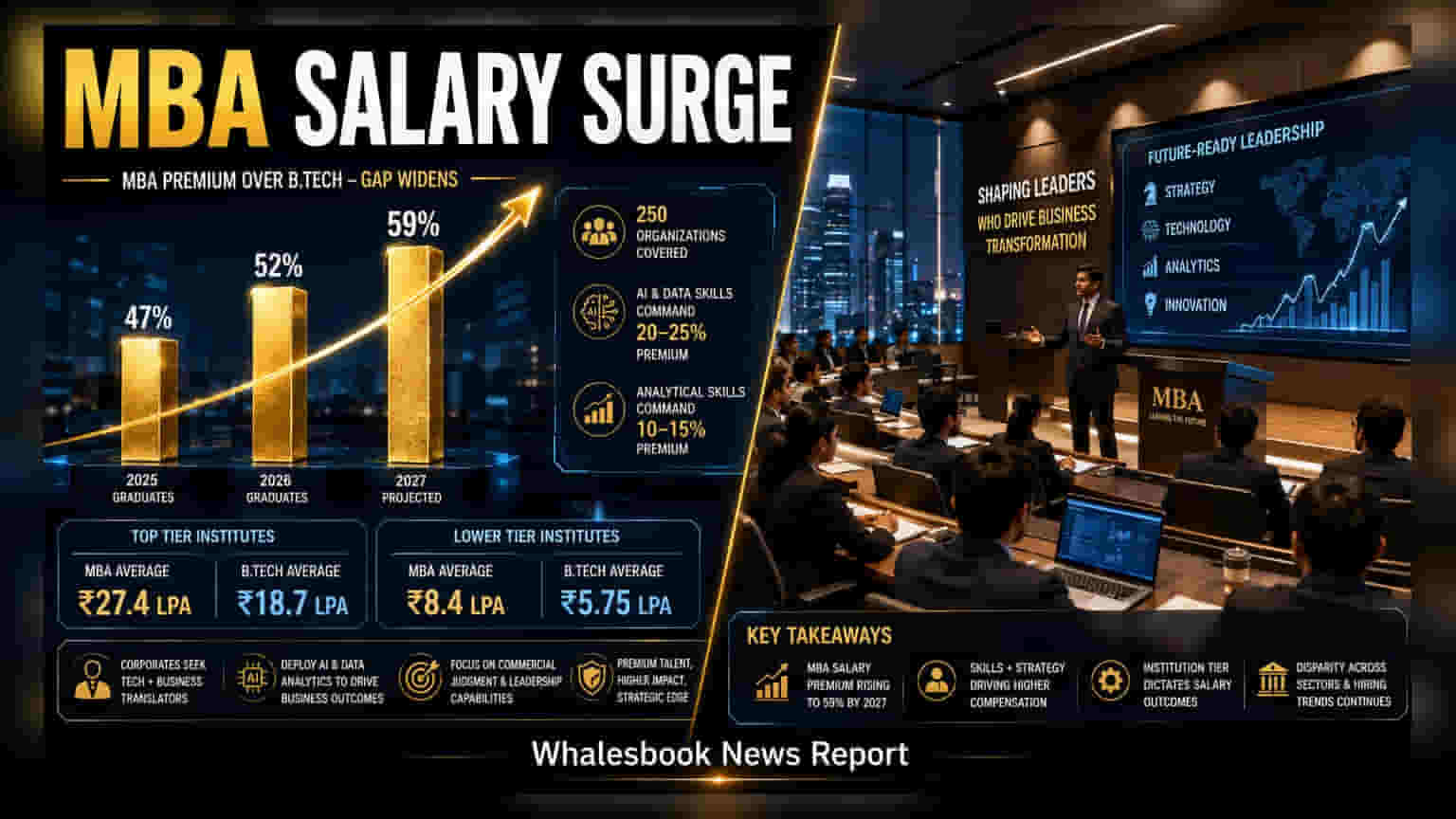
The salary premium for MBA graduates over engineering counterparts is projected to hit 59% in 2027, according to a Deloitte India report. Corporations are aggressively shifting hiring budgets to attract talent that can bridge the gap between technical AI skills and business strategy. Investors should note this trend as it reflects how companies are prioritizing human capital investment to drive digital transformation and long-term efficiency.
The hiring landscape for the Indian workforce is undergoing a shift as corporations adjust their compensation strategies to favor talent that can manage the intersection of technology and business strategy. According to Deloitte India’s latest Campus Workforce Trends report, the salary premium for MBA graduates compared to their B.Tech counterparts is on a clear upward trajectory. The gap, which stood at 47% for the 2025 graduating class, rose to 52% in 2026 and is now projected to widen to 59% by 2027.
This trend is driven by a change in corporate demand. Companies are moving away from hiring purely for technical roles and are instead prioritizing professionals who act as translators. These individuals possess the ability to deploy AI and data analytics to generate tangible business outcomes. The data, covering 250 organizations, indicates that firms are willing to pay a premium for candidates who combine technical proficiency with commercial judgment and leadership capabilities.
For investors observing corporate human capital costs, the salary data underscores a wider divergence in the job market. There is a distinct split based on institutional prestige and specific skill sets. At top-ranked business schools, average annual salaries have reached ₹27.4 lakh, significantly outpacing the ₹18.7 lakh average for top-tier engineering graduates. Conversely, the gap remains wide at lower-tier institutions, where average salaries for MBA and engineering graduates are ₹8.4 lakh and ₹5.75 lakh, respectively.
Beyond general salary trends, specific skills now dictate compensation levels. Candidates with verified expertise in AI and data analytics can command an additional 20-25% salary premium, while those with strong analytical and problem-solving skills secure a 10-15% increase. This focus on specialized talent suggests that companies are allocating more of their budget toward high-impact roles, which may affect long-term profit margins depending on how effectively this talent translates into business growth.
However, the market is not uniform. While demand for strategic and AI-literate talent remains high, hiring activity is uneven across sectors. Traditional IT services and other legacy industries have seen a slowdown, which could impact placement stability. The risk for organizations lies in the potential for wage inflation if the productivity of these high-priced hires does not keep pace with their compensation. As companies continue to integrate AI into their operations, the ability to retain and utilize this specialized talent will be an important metric for tracking long-term operational efficiency.