

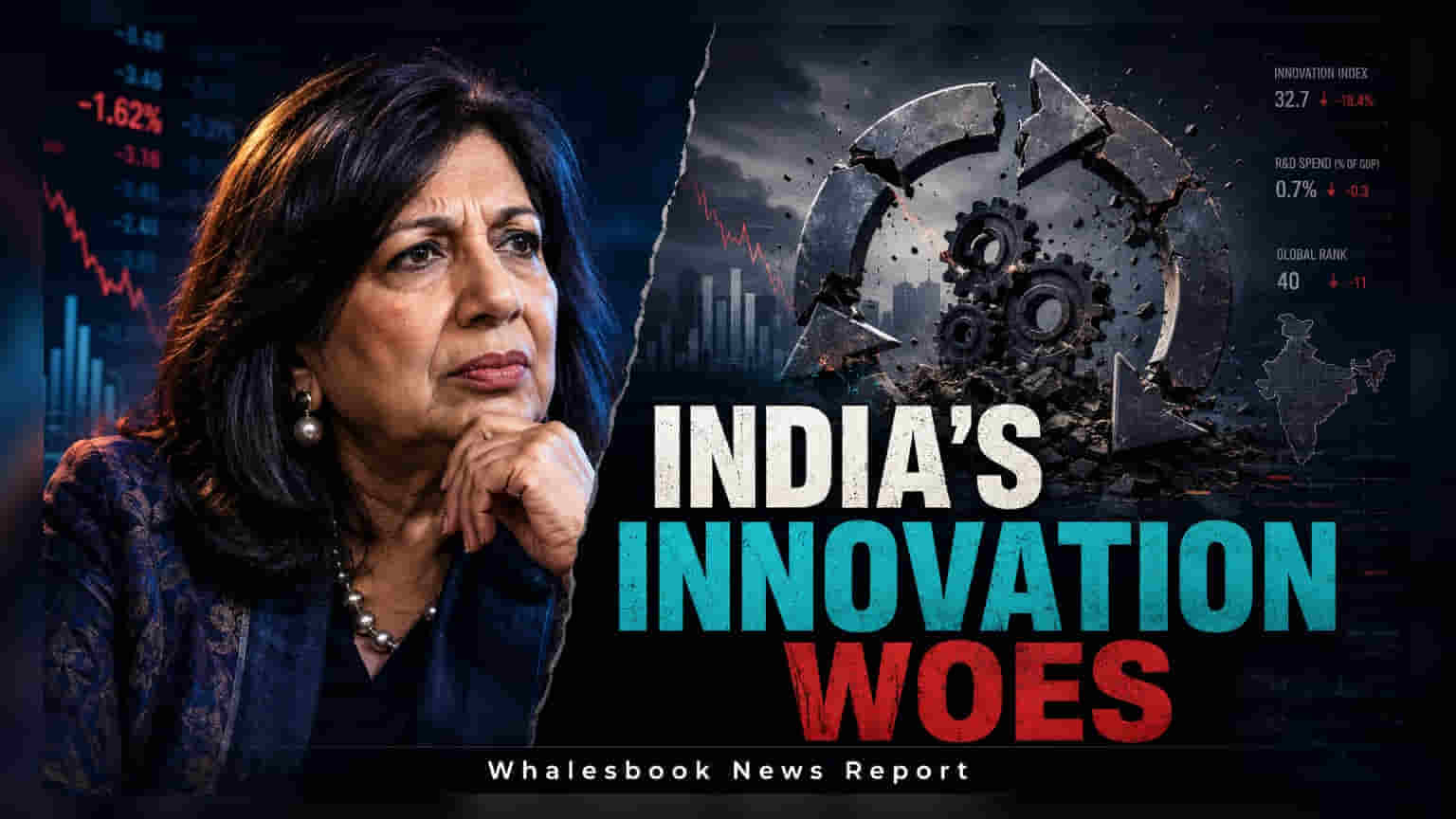
Biocon Chairperson Kiran Mazumdar Shaw has highlighted that slow regulatory reforms and a risk-averse investment culture are hindering India's ability to build globally disruptive companies. She notes that while India has strong scientific talent, the lack of long-term 'patient capital' often forces promising domestic innovations to stall before reaching scale.
Biocon Executive Chairperson Kiran Mazumdar Shaw recently pointed to structural gaps in the Indian innovation landscape, arguing that the nation is yet to produce globally transformative entities on par with international giants. While India has cultivated a vibrant startup ecosystem, Shaw suggests that the transition from a laboratory breakthrough to a world-leading enterprise is often interrupted by regulatory delays and a focus on short-term financial returns over long-term technological development.
The Challenge of Scaling Technology
Commercializing new technology requires a massive, sustained influx of capital that transcends initial government grants or seed funding. Shaw explains that a healthy innovation cycle relies on a steady flow of venture capital that follows a company from its early development through to public listing or acquisition. In India, however, this funding pipeline often dries up before companies can achieve the scale necessary to disrupt global markets. This creates a reliance on incremental improvements rather than the creation of entirely new technology categories.
Investment Culture and Risk Appetite
The Indian investment climate frequently favors companies that offer predictable dividends or share buybacks, as these provide more certain outcomes for shareholders. Shaw advocates for a shift in this mindset, encouraging investors to back 'blue-sky' ideas—highly ambitious projects with uncertain timelines but potential for massive impact. The reluctance to commit capital to projects with long gestation periods means that many high-risk, high-reward domestic technologies fail to secure the financial runway needed to mature.
Lessons from Historical Failures
To illustrate the cost of this funding gap, Shaw referenced the case of the Simputer, a handheld device developed at the Indian Institute of Science in the early 2000s. Although the device was technically innovative, it struggled to compete due to a lack of manufacturing scale and sustained commercial support. The project serves as a reminder that technological capability alone is insufficient without a robust ecosystem to carry a product through to mass-market success.
Future Frontiers in Biotechnology
Looking toward emerging sectors, Shaw identified biology as a key area where India could establish a global footprint. Rather than focusing on replicating existing artificial intelligence models, she suggests that the country should leverage its scientific talent to explore novel concepts like DNA-based computing and energy-efficient biological systems. The ability to succeed in these areas will depend on whether domestic capital can pivot toward supporting research-heavy ventures that do not provide immediate, quarter-to-quarter profit growth.
Investors may monitor whether government policies under the Research, Development and Innovation scheme lead to faster regulatory clearances and if institutional investors begin to adjust their mandates to accommodate more long-term, research-focused capital allocations.