 Whalesbook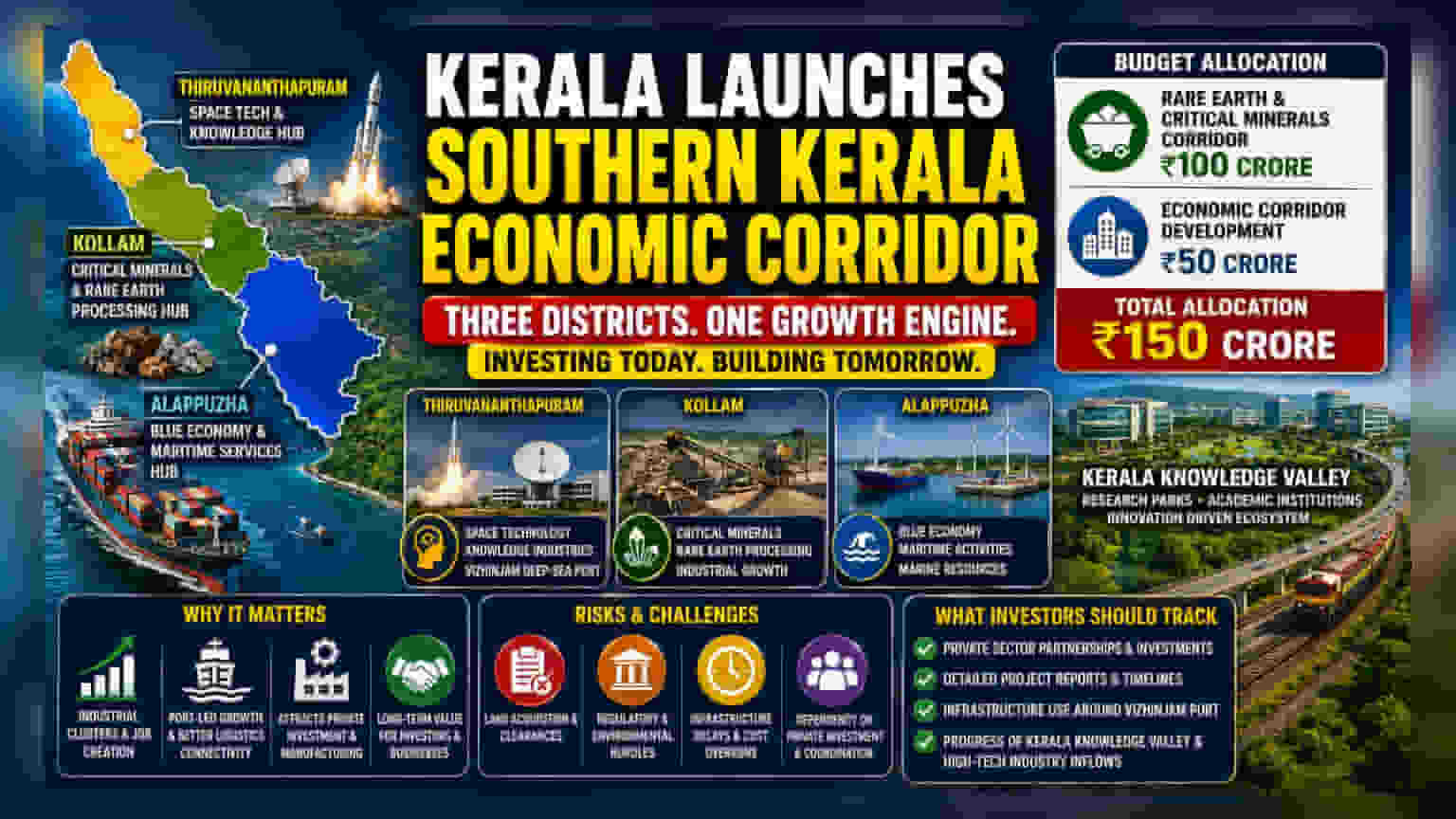
Kerala has launched the 'Southern Kerala Economic Corridor' across Thiruvananthapuram, Kollam, and Alappuzha to boost space technology, rare earth processing, and the blue economy. With an initial allocation of ₹150 crore, the project aims to create industrial clusters. For investors, this long-term infrastructure plan signals potential opportunities in logistics, port connectivity, and strategic manufacturing sectors.
What Happened
The Kerala state government has announced the creation of the 'Southern Kerala Economic Corridor,' a strategic initiative designed to integrate three southern districts—Thiruvananthapuram, Kollam, and Alappuzha—into a unified economic zone. During the recent budget presentation, Chief Minister V.D. Satheesan announced a total allocation of ₹150 crore for this project. Specifically, ₹100 crore has been set aside for the Rare Earth and Critical Minerals Corridor, while ₹50 crore is earmarked for the broader economic corridor development.
Strategic Focus and Development
The government plans to leverage the specific strengths of each district to drive industrial growth. Thiruvananthapuram is set to become a hub for space technology and knowledge-based industries, supported by existing research institutions and the operational Vizhinjam deep-sea port. Kollam will be developed as a center for the processing of critical minerals and rare earths, while Alappuzha is designated to focus on the 'blue economy,' which covers maritime activities and marine resources. Additionally, the state has proposed a 'Kerala Knowledge Valley' to house research parks and academic institutions to support this ecosystem.
Why It Matters For Investors
For investors and market observers, this corridor reflects a push toward regional industrial clustering. The inclusion of Thiruvananthapuram’s infrastructure, particularly the Vizhinjam deep-sea port (operated by Adani Ports and SEZ), is a critical component. Improved road and rail connectivity between these districts could enhance logistics efficiency and support port-linked industries. While the current budget allocation is relatively small, it serves as seed funding to attract private investment in manufacturing, technology, and maritime services. If successful, such corridors often lead to long-term development of industrial real estate, logistics hubs, and ancillary business support services in the region.
Implementation Risks and Challenges
Investors should keep in mind the typical challenges associated with large-scale infrastructure projects in India. The success of this corridor will depend heavily on the speed of land acquisition, environmental clearances, and the ability to attract private capital. Infrastructure projects often face delays due to regulatory hurdles or cost overruns. Furthermore, while the government has laid out a vision, the actual pace of development will depend on how effectively the state coordinates with central agencies, especially for sectors like space technology and mining, which often fall under federal jurisdiction.
What Investors Should Track
The most important factor for investors is the actual execution timeline. Monitoring for updates on private sector partnerships, detailed project reports, and further budgetary allocations will be key. Investors may also track whether this initiative leads to improved infrastructure utilization around the Vizhinjam port and whether new companies or manufacturing units announce plans to set up operations in these designated clusters. The progress of the 'Kerala Knowledge Valley' may also offer insights into the state's long-term commitment to attracting high-tech industries.