

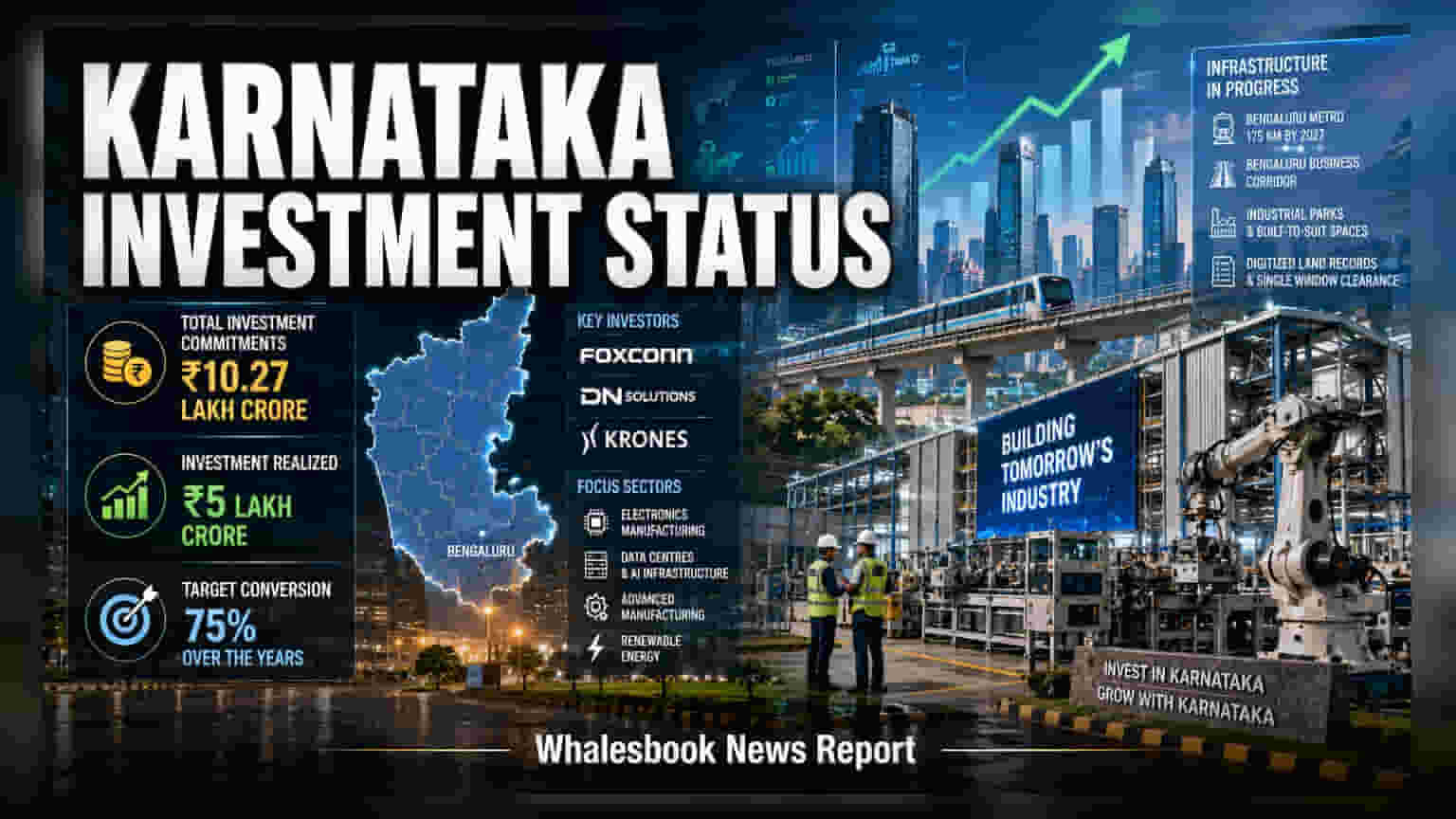
Karnataka Industries Minister M.B. Patil has reaffirmed the state’s industrial strength, citing ₹10.27 lakh crore in total investment commitments. While the state aims for a 75% project conversion rate, it continues to address investor concerns regarding infrastructure bottlenecks and land acquisition hurdles.
Karnataka continues to position itself as a key industrial hub, with the state government actively addressing concerns about infrastructure bottlenecks. During the India Today Karnataka Summit 2026, Industries Minister M.B. Patil stated that the state remains a top choice for global and domestic companies despite challenges related to urban infrastructure and logistics.
From a financial perspective, the state reports significant traction in its industrial pipeline. Authorities have secured investment commitments totaling ₹10.27 lakh crore, with approximately ₹5 lakh crore already realized on the ground. The government has set a target of achieving a 75% conversion rate, meaning it expects a large portion of these promised investments to translate into operational facilities over the coming years. Major global firms, including Foxconn, DN Solutions, and Krones, are currently advancing their expansion plans within the state, indicating that despite noise around local congestion, significant capital is still flowing in.
However, the government is not ignoring the realities faced by businesses. Minister Patil acknowledged that rapid urban growth in Bengaluru has put pressure on city resources, particularly traffic and public infrastructure. For investors, these factors are critical, as they can impact project timelines and the ease of doing business. Land acquisition also remains a primary monitorable, as complex ownership structures and legal disputes can often delay the start of large projects. To reduce these risks, the state is focusing on digitizing land records and promoting built-to-suit industrial spaces to speed up the time it takes to move from an agreement to a factory launch.
To support continued growth, the government is rolling out new policies and infrastructure projects. This includes a dedicated Data Centre Policy aimed at supporting artificial intelligence and high-computing needs, which require stable, high-quality power and water. Additionally, the state is working on transport projects, such as the expansion of the Bengaluru metro, which aims to reach 175 km of connectivity by 2027 to help ease workforce mobility. Investors may track the actual conversion of these investment commitments into operational status, the speed of land acquisition for new projects, and the progress of infrastructure developments like the Bengaluru Business Corridor as key indicators of the state's long-term industrial viability.