 Whalesbook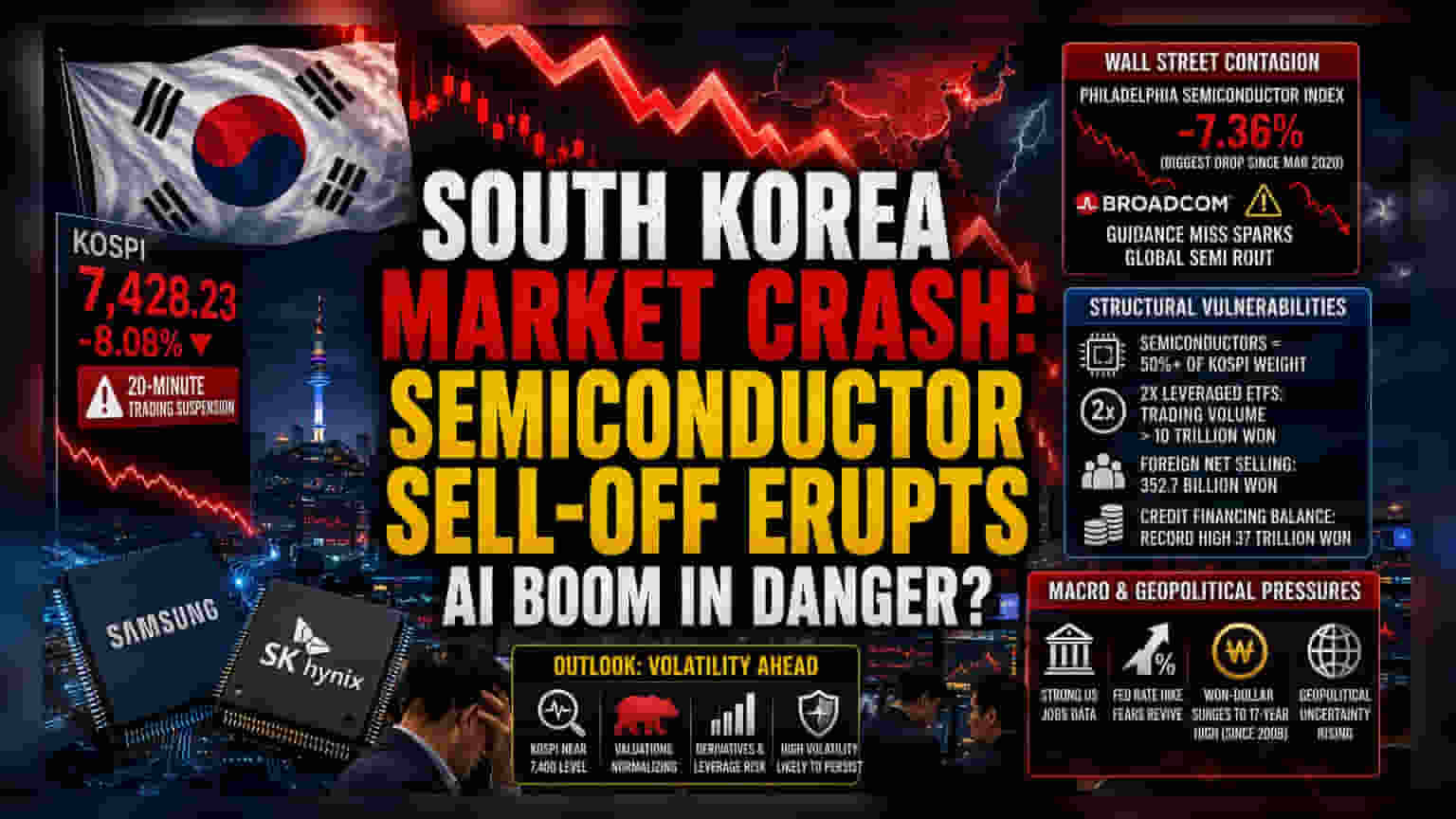


The Semiconductor Contagion
The collapse of the KOSPI index, which saw a 20-minute trading suspension after plummeting over 8% on Monday, represents a violent correction for a market that had positioned itself as the primary infrastructure provider for the global AI boom. The catalyst was not domestic, but rather a sharp contagion originating from US markets. After Broadcom reported guidance that failed to meet sky-high investor expectations, the Philadelphia Semiconductor Index suffered its most significant daily decline since March 2020. This sentiment quickly migrated to Seoul, where semiconductor stocks—which account for over 50% of the KOSPI’s market capitalization—bore the brunt of the liquidation.
Structural Vulnerabilities in the Rally
The intensity of Monday’s sell-off highlights the fragility of South Korea's "two-stock dependency." With Samsung Electronics and SK Hynix together comprising more than half of the index's weight, the concentration risk has become a systemic liability. This volatility was compounded by the rapid expansion of 2x single-stock leveraged ETFs. These instruments, which saw trading volumes exceed 10 trillion won in recent weeks, have acted as a volatility multiplier. As retail investors rushed to buy the dip, institutional and foreign flows remained firmly in selling mode, with foreign net selling reaching 352.7 billion won early in the session.
The Forensic Bear Case: Macro and Geopolitical Pressures
Beyond the semiconductor sector, the market is grappling with a precarious macro environment. A robust US jobs report has revived concerns regarding Federal Reserve interest rate hikes, pulling the rug from under emerging market equities. Simultaneously, the won-dollar exchange rate has surged to levels not seen since the 2008 global financial crisis, further discouraging foreign capital inflows. While the Korea Development Institute recently raised its 2026 growth outlook to 2.5%, citing strong chip exports, the market’s current behavior suggests that investors are pricing in a severe breakdown in the demand cycle. Furthermore, the rise in credit financing balances to a record high of 37 trillion won across the KOSPI and KOSDAQ suggests that a forced deleveraging event may still be in the early stages.
Outlook and Market Stability
With the KOSPI falling toward the 7,400 level, the focus shifts to whether this represents a temporary liquidity trap or a deeper structural reset of the AI-driven valuations seen earlier this year. While leadership at firms like SK Hynix continues to point toward long-term AI infrastructure dominance, the immediate concern is the normalization of valuation multiples. Analysts remain cautious as the market awaits stabilization, noting that the excessive use of derivative instruments and high retail leverage will likely keep intraday volatility elevated well above historical averages.