

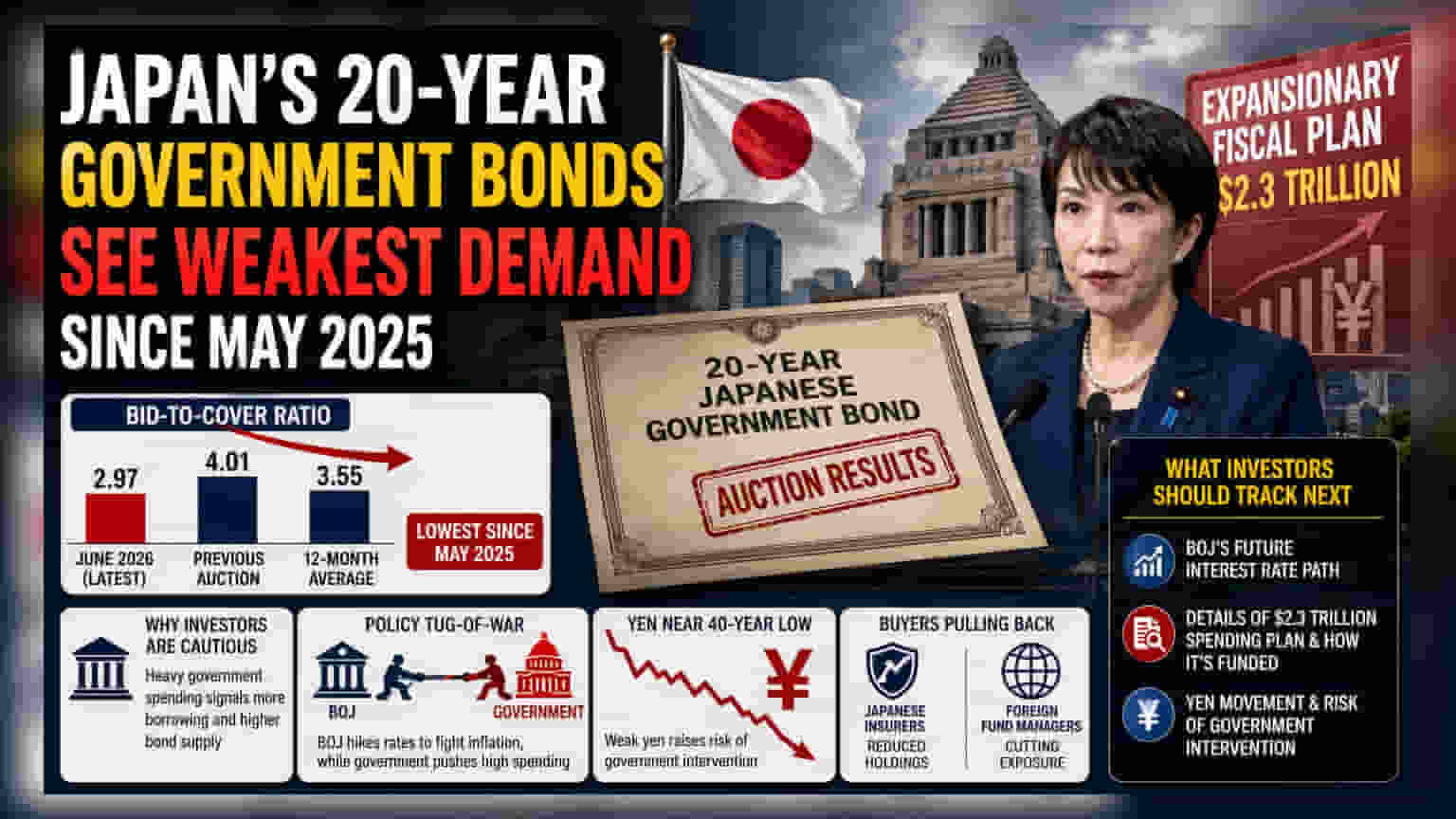
Demand for Japan's 20-year government bonds has hit its lowest level in over a year, with the bid-to-cover ratio falling to 2.97. Investors are cooling on these long-term assets due to concerns over high inflation, the Bank of Japan's uncertain rate hike path, and the government's massive $2.3 trillion spending plan.
What Happened
Japan’s market for long-term government debt is facing a hurdle. In the latest auction for 20-year government bonds, demand from investors was notably weak. The bid-to-cover ratio, which is a standard measure of how many investors are trying to buy the bonds compared to the supply available, dropped to 2.97. This marks the lowest level of demand since May 2025. It also shows a significant cooling of interest compared to the previous auction, where the ratio was 4.01, and the 12-month average of 3.55.
Why Investors Are Cautious
Market participants are currently worried about the government's fiscal direction. Prime Minister Sanae Takaichi has introduced an ambitious expansionary fiscal program that includes a long-term expenditure plan worth $2.3 trillion. When a government signals such high levels of spending, it often implies the need for heavy borrowing, which increases the supply of bonds. If the market feels there is too much supply, prices for these bonds may drop. This, combined with persistent concerns about inflation, is making investors hesitant to lock their money into long-dated government debt.
The Policy Tug-of-War
The Bank of Japan (BOJ) is walking a fine line. It recently raised benchmark interest rates to their highest level since 1995 to combat inflation, and meeting minutes suggest the central bank recognizes the need for further increases. However, the reality on the ground is complicated. While the central bank is trying to tighten monetary policy, the government’s push for high spending suggests a more relaxed approach. This mix of signals leaves investors uncertain about whether interest rates will rise quickly enough to control inflation, or if the BOJ will be forced to keep policy loose to support government spending plans.
Global And Currency Context
The weakness in the bond market is happening while the Japanese Yen is hovering near a 40-year low against major global currencies. This has created an environment where traders are constantly watching for potential government intervention to support the currency. The shift in investor behavior is also clear: Japanese insurers, which are typically stable, long-term buyers of domestic super-long bonds, reduced their holdings in May. International fund managers are also scaling back their exposure, signaling a broader trend of caution among global investors regarding Japanese long-term debt.
What Investors Should Track Next
The key factor to watch is the Bank of Japan's future interest rate strategy. Investors will monitor if the central bank prioritizes inflation control over the government's spending agenda. Additionally, any updates on how the $2.3 trillion expenditure plan is funded will be important. If the government issues more debt than expected, it could continue to put pressure on bond prices. Finally, market watchers will track the Yen’s movement, as a major shift could force the government to step into the markets, changing the landscape for bond investors once again.