

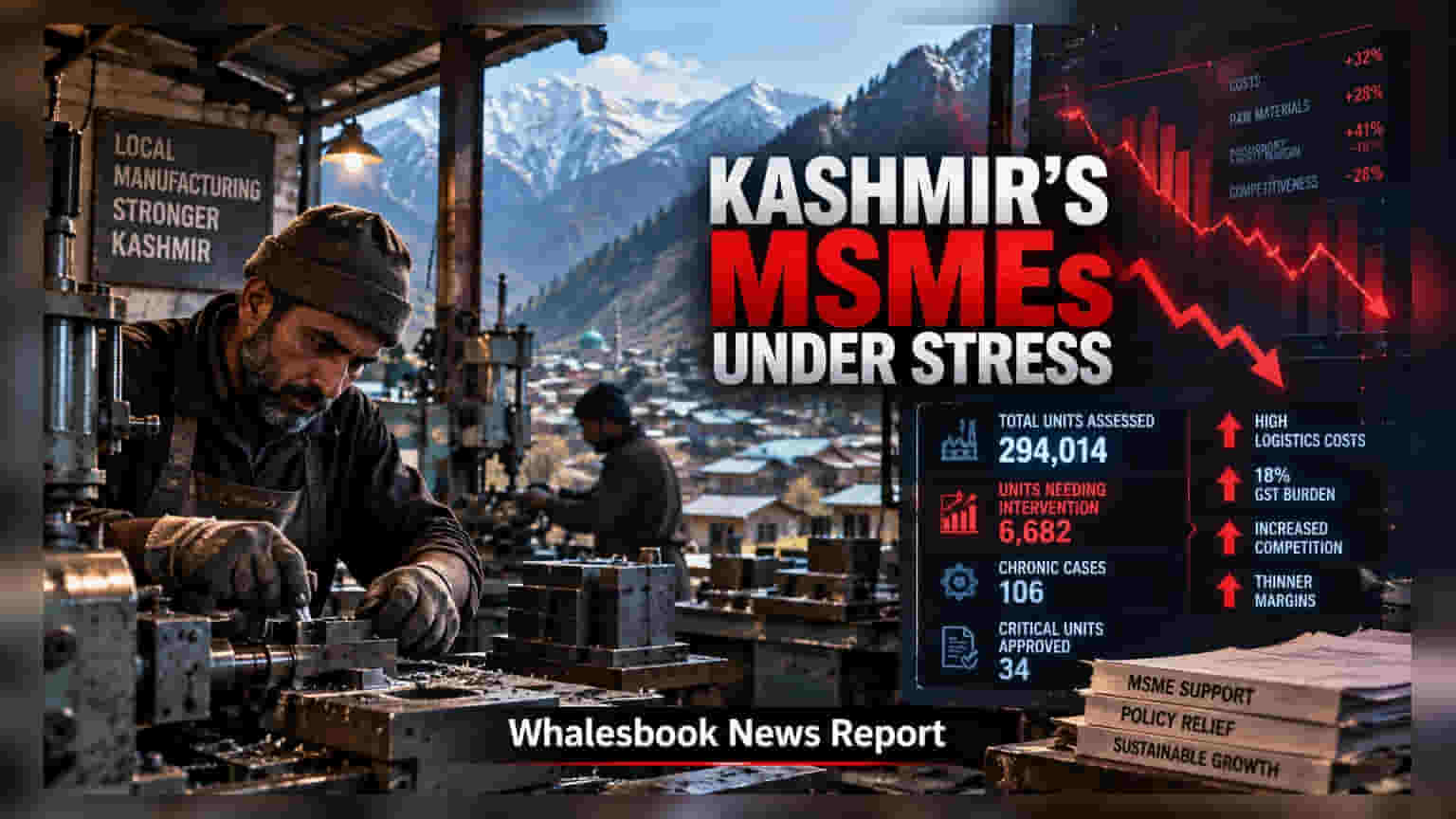
The Jammu and Kashmir government has initiated a diagnostic program to revive 6,682 struggling small businesses under its MSME Health Clinic initiative. Local manufacturers report that high logistics costs and the removal of the Lakhanpur toll tax have made it difficult to compete with cheaper goods from other states. The success of this rehabilitation effort will depend on how the administration addresses these structural cost disadvantages.
The Jammu and Kashmir administration has launched a formal effort to rehabilitate struggling small and medium-sized enterprises. The initiative, dubbed the MSME Health Clinic, is designed to identify and support units that are currently under financial distress. Recent data from the Industries and Commerce Department shows that out of 294,014 total units assessed in the region, 6,682 require active intervention to remain viable. Among these, 106 units have been identified as chronic cases, while 34 critical units have already received initial approval from the District-Level Apex Committee for support measures.
Challenges in Market Competitiveness
While the government is focused on diagnostic profiling—a process used to determine the financial health and specific needs of a business—industry representatives point to deeper economic hurdles. Manufacturers in the region face significant structural disadvantages, primarily due to geography. Transporting raw materials into the hilly terrain of Jammu and Kashmir results in higher logistics costs compared to manufacturers located in the mainland.
Before the implementation of the Goods and Services Tax (GST) and the subsequent removal of the Lakhanpur toll tax, the local economy operated with a different tax structure that provided a buffer for home-grown products. The removal of the toll tax effectively removed a layer of protection that previously shielded local producers from price competition. As a result, lower-priced goods from other states now enter the local market more easily, often creating a price disadvantage for local MSMEs that are trying to maintain profit margins while managing higher input and transport costs.
The Impact of Tax and Policy Changes
Beyond logistics, the transition to the national GST regime has introduced new financial pressures. Small businesses, which historically relied on different regional tax structures, have had to adapt to the 18 percent GST slab. Business leaders, including those from the Federation Chamber of Industries Kashmir, have noted that this adjustment has been particularly burdensome for units with limited cash flow. These firms are now calling for a specific industrial policy that includes protective measures for local manufacturing to ensure they can survive in an open, competitive market environment.
Moving forward, the effectiveness of the MSME Health Clinic will likely depend on whether the government can move beyond diagnostic profiling to provide tangible solutions, such as subsidies or operational incentives that address the logistics gap. Investors and industry stakeholders will monitor whether the District-Level Apex Committee continues to approve rehabilitation measures and if the administration introduces further policy support to offset the structural disadvantages currently affecting local manufacturing competitiveness.