

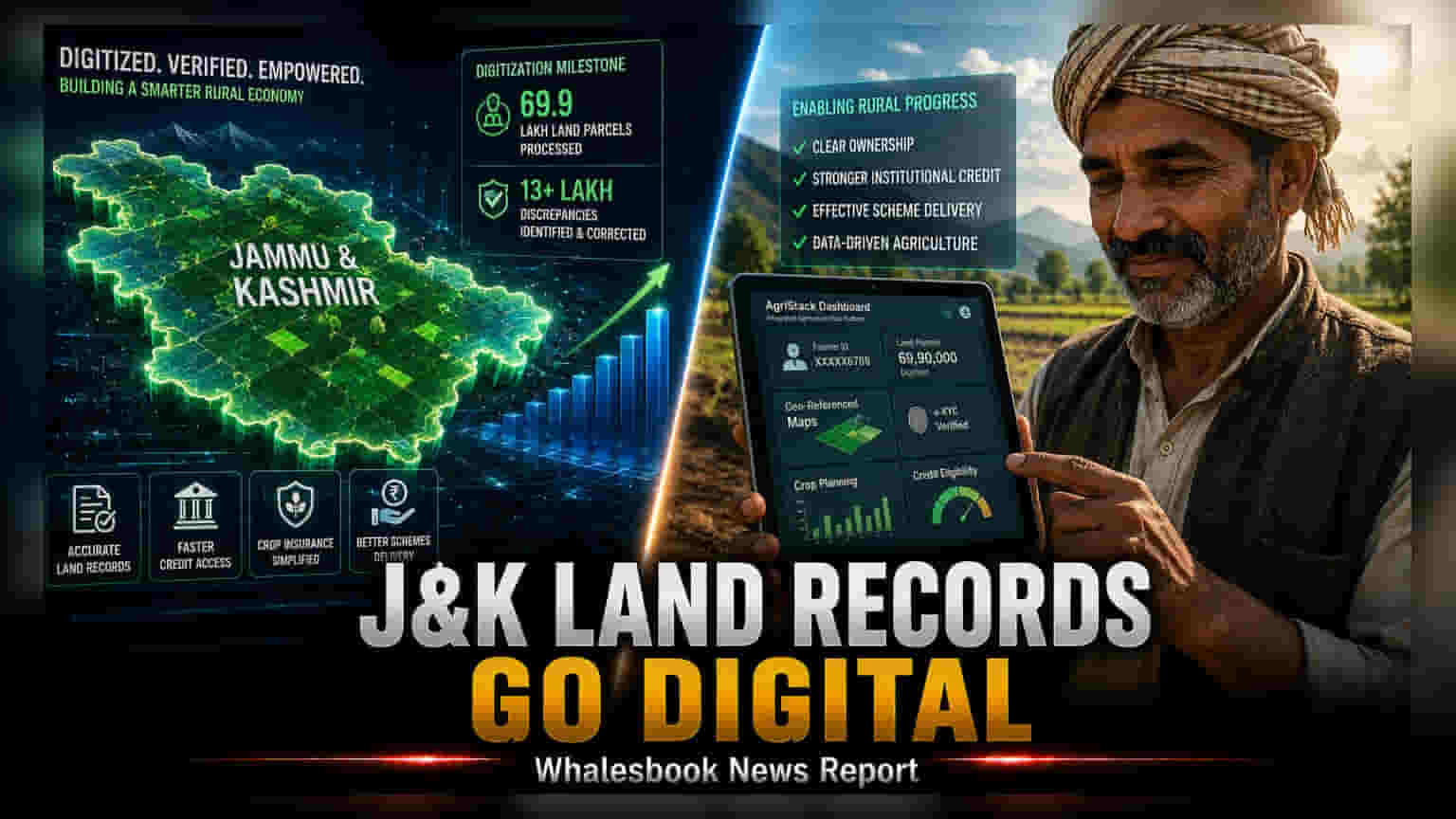
The Jammu & Kashmir government has digitized 70 lakh land parcels to integrate with the Centre’s AgriStack framework. This modernization effort aims to streamline agricultural services and improve access to farm credit by creating a verified, digital land database. While the project enhances transparency, the transition faces potential challenges regarding record accuracy and implementation.
The Jammu & Kashmir administration has completed a significant digitization drive, processing nearly 70 lakh land parcels. This effort is designed to replace traditional manual records with a modernized, digital database aligned with the Centre’s AgriStack framework. The integration is intended to create a reliable foundation for agricultural services, such as crop planning, credit disbursement, and government scheme delivery.
Scaling Digital Infrastructure
The project involves more than just scanning documents. To ensure data accuracy, officials conducted a rigorous verification process, identifying and correcting over 13 lakh discrepancies. These corrections were handled through public grievance redressal and field verification to ensure the records reflect current ownership and land shares. The Revenue Department has implemented a three-tier system—involving data entry, verification, and approval—to maintain integrity, with electronic audit trails for every modification.
AgriStack and Economic Impact
AgriStack serves as a digital public infrastructure for India’s agriculture sector. By integrating land records, the system aims to create a unique Farmer ID linked to geo-referenced maps and e-KYC data. For the rural economy, this move is significant because clear land ownership and digitized records can simplify how farmers access institutional credit, crop insurance, and various subsidies. When land data is machine-readable and verifiable, banks and financial institutions can potentially speed up loan processing, reducing the dependency on paper-heavy manual checks.
Technology and Implementation Risks
The initiative utilizes specialized software developed in collaboration with BISAG-N and the National Informatics Centre. While the move toward a digital-first approach enhances transparency, it is not without hurdles. Large-scale digitization projects often encounter risks related to ground-truthing, where the digital record may occasionally mismatch physical possession, leading to land disputes. Furthermore, pending inheritance mutations and potential authentication failures during e-KYC processes can cause delays. Experts also monitor whether the shift to a centralized system might inadvertently spark legal challenges as historical record errors are surfaced and corrected through the new digital framework.
Future Monitorables
The success of this initiative will be measured by how effectively the verified data is adopted by banks, insurance providers, and agricultural input companies for their operations. Investors and observers interested in the agricultural sector will track the broader rollout of AgriStack across other states, as this digital framework is expected to influence how agricultural data is utilized for future credit and resource allocation across the country.