 Whalesbook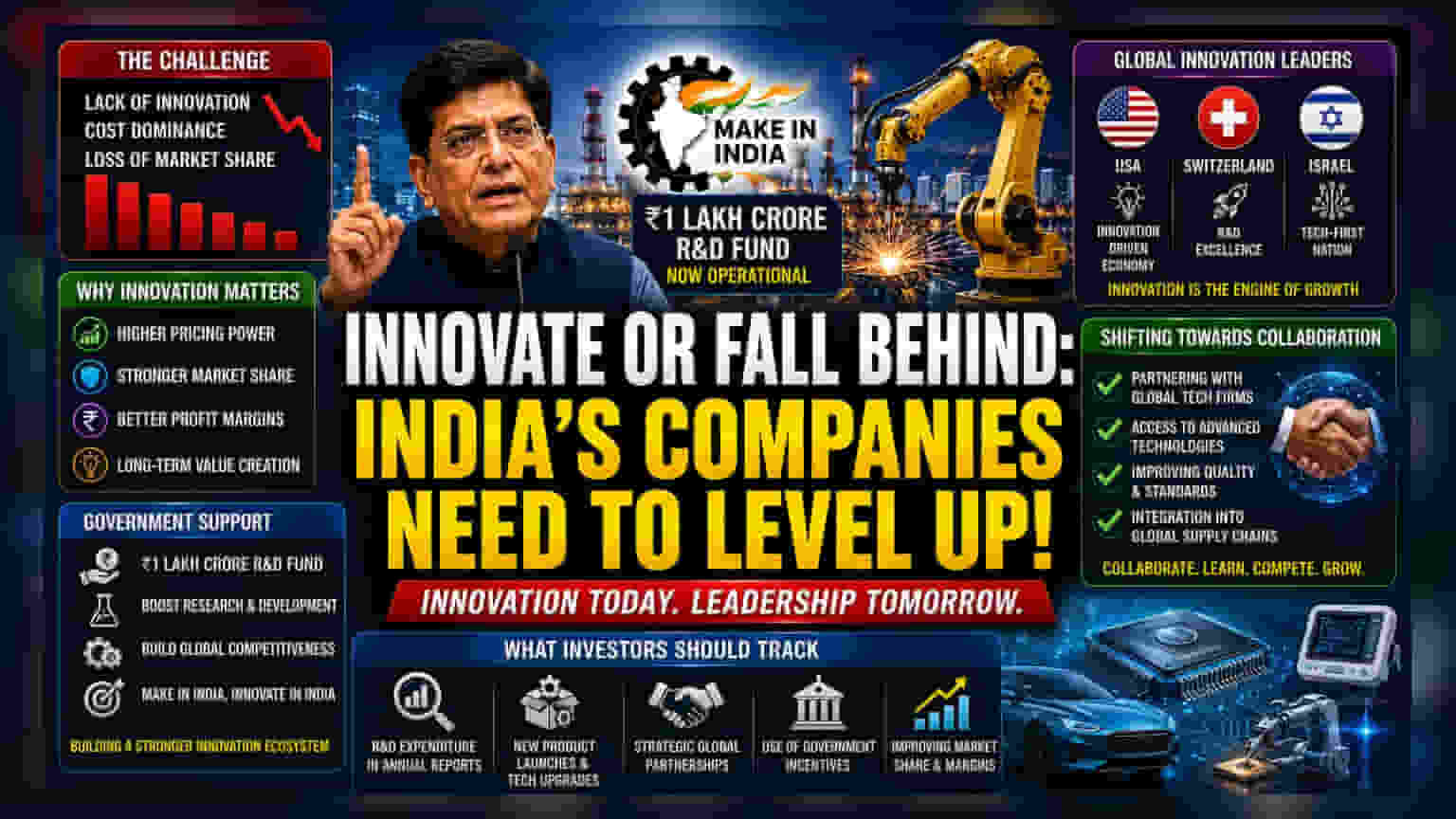


Commerce Minister Piyush Goyal attributed the loss of market share by domestic firms to a failure to keep up with technological advancements. He emphasized the need for an innovation-driven culture and highlighted a ₹1 lakh crore fund for research and development. Investors may consider how technological adaptability, R&D spending, and global collaborations impact a company's competitive advantage and long-term profit margins.
What Happened
Commerce and Industry Minister Piyush Goyal recently highlighted a critical challenge facing the Indian manufacturing and services sectors: a lag in innovation. During his address, the Minister noted that many domestic companies have historically lost significant market share to foreign brands because they failed to adapt quickly to rapid technological advancements. He argued that while domestic players often focused on cost-efficiency, a lack of investment in research and development left them vulnerable to international competitors who brought more advanced products to the market.
Why Innovation Matters for Investors
For investors, innovation is more than a buzzword; it is a direct indicator of a company’s long-term survival and pricing power. When a company fails to innovate, it often struggles to charge a premium for its products, leading to lower profit margins. Conversely, companies that consistently spend money on research and product upgrades are better positioned to defend their market share against both domestic and international rivals.
In the current market environment, the ability to adopt new technologies—whether in electronics, automotive, or industrial goods—is essential for sustaining growth. Investors often view a company's commitment to R&D not just as an expense, but as a long-term investment that builds a competitive advantage. Companies that ignore technological shifts often face a gradual erosion of value, making them less attractive over time.
Government Support and the R&D Push
To bridge this gap, the government has made operational a ₹1 lakh crore fund dedicated to research and development. This initiative is designed to create a more supportive environment for companies to innovate within India, rather than relying solely on imported technology. The objective of the 'Make in India' initiative is to ensure that domestic manufacturers are not just assembly units but are also capable of contributing to global supply chains through homegrown innovation.
The Minister drew comparisons to successful ecosystems in countries like the United States, Switzerland, and Israel, where innovation has been the backbone of economic strength for decades. The government aims to foster a similar environment where financial incentives are paired with strong R&D capabilities.
The Shift Toward Global Collaboration
One positive trend highlighted by the Minister is that many Indian companies are now actively partnering with global technology firms. This strategy allows domestic firms to gain access to modern technology and manufacturing processes while leveraging their own local expertise. By integrating with global supply chains, Indian companies can improve their quality standards and learn to compete on a global scale.
What Investors Should Track
Investors looking at company performance in the coming quarters may want to monitor several key areas. First, check the 'Research and Development' expenses in the annual reports of manufacturing and technology-focused companies. Rising R&D expenditure often signals that a management team is serious about long-term competitiveness. Second, look for management commentary regarding new product launches and technological upgrades. Third, pay attention to strategic partnerships with global companies, as these can be a reliable indicator of a company’s willingness to modernize its operations. Finally, keep an eye on whether companies are using available government incentives effectively to fund their growth and technological expansion.