

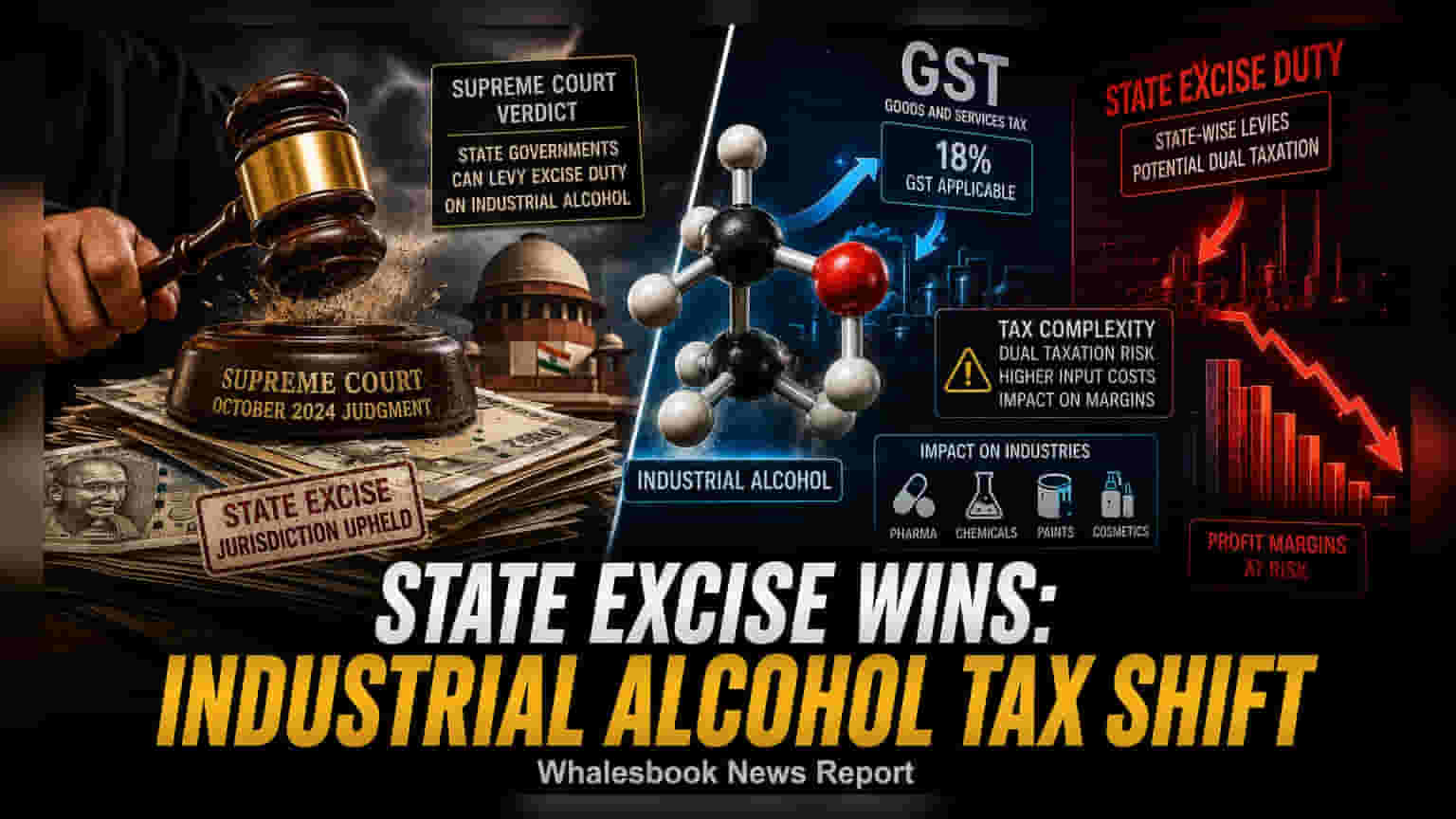
Since the October 2024 Supreme Court ruling allowing states to levy excise duty on industrial alcohol, firms in chemicals and pharma face persistent tax complexity. The potential for dual taxation between GST and state excise duties remains a key factor impacting operational costs.
The Supreme Court’s October 2024 judgment regarding the taxation of industrial alcohol continues to be a critical monitorable for the Indian manufacturing sector. The verdict, which granted state governments the power to levy excise duties on industrial alcohol, ended a decades-long constitutional dispute. However, as of August 2026, companies in industries that rely heavily on this commodity, such as pharmaceuticals, chemicals, paints, and cosmetics, are still navigating the resulting tax complexities.
The Source of Tax Complexity
Industrial alcohol, often derived from rectified spirit, is a primary raw material for many manufacturing processes. Before the 2024 Supreme Court ruling, the taxation structure was relatively more unified under the Goods and Services Tax (GST) framework. The court's decision clarified that 'intoxicating liquor'—which it defined to include industrial alcohol—falls under the jurisdiction of state governments for excise taxation purposes.
This creates a unique challenge: industrial alcohol remains subject to GST, while states now hold the constitutional authority to also impose excise duties. For a manufacturer, this creates a potential scenario of dual taxation, where the same input could be taxed by both the central GST regime and new state-level excise levies. Businesses are now carefully watching state-specific notifications that could alter their input cost structures.
Impact on Profit Margins and Operations
For investors, the primary concern is the potential impact on operating margins. If states move to implement significant excise duties on industrial alcohol, companies may face a direct increase in their raw material procurement costs. Whether these companies can pass on the additional tax burden to customers will depend on the pricing power within their specific industry segments. Firms that are unable to fully pass on costs may see their profit margins tighten.
Furthermore, the current environment necessitates complex tax planning. Companies with a pan-India manufacturing footprint may have to deal with varying tax policies across different states. This fragmentation could increase compliance costs and complicate supply chain logistics, as manufacturers might seek to optimize their production locations based on the state-specific tax regime.
Monitoring the GST Council
The resolution of this fiscal disconnect now largely rests with the GST Council. There has been ongoing discussion about harmonizing these levies to prevent a scenario where industrial alcohol is taxed twice, which would effectively raise the cost of goods for end consumers. Investors should track future meetings of the GST Council, as any policy recommendation to remove industrial alcohol from the GST net or to provide input tax credits for state excise duties would be a significant development.
For now, the risk remains one of operational uncertainty. Until there is a uniform framework or clear guidelines from the GST Council, companies will likely continue to operate under a cloud of fiscal ambiguity. Investors may monitor the management commentary of companies in the chemicals, pharmaceutical, and consumer goods sectors during their quarterly earnings calls, as leadership teams often disclose how they are navigating these changes in state-level tax policies.