 Whalesbook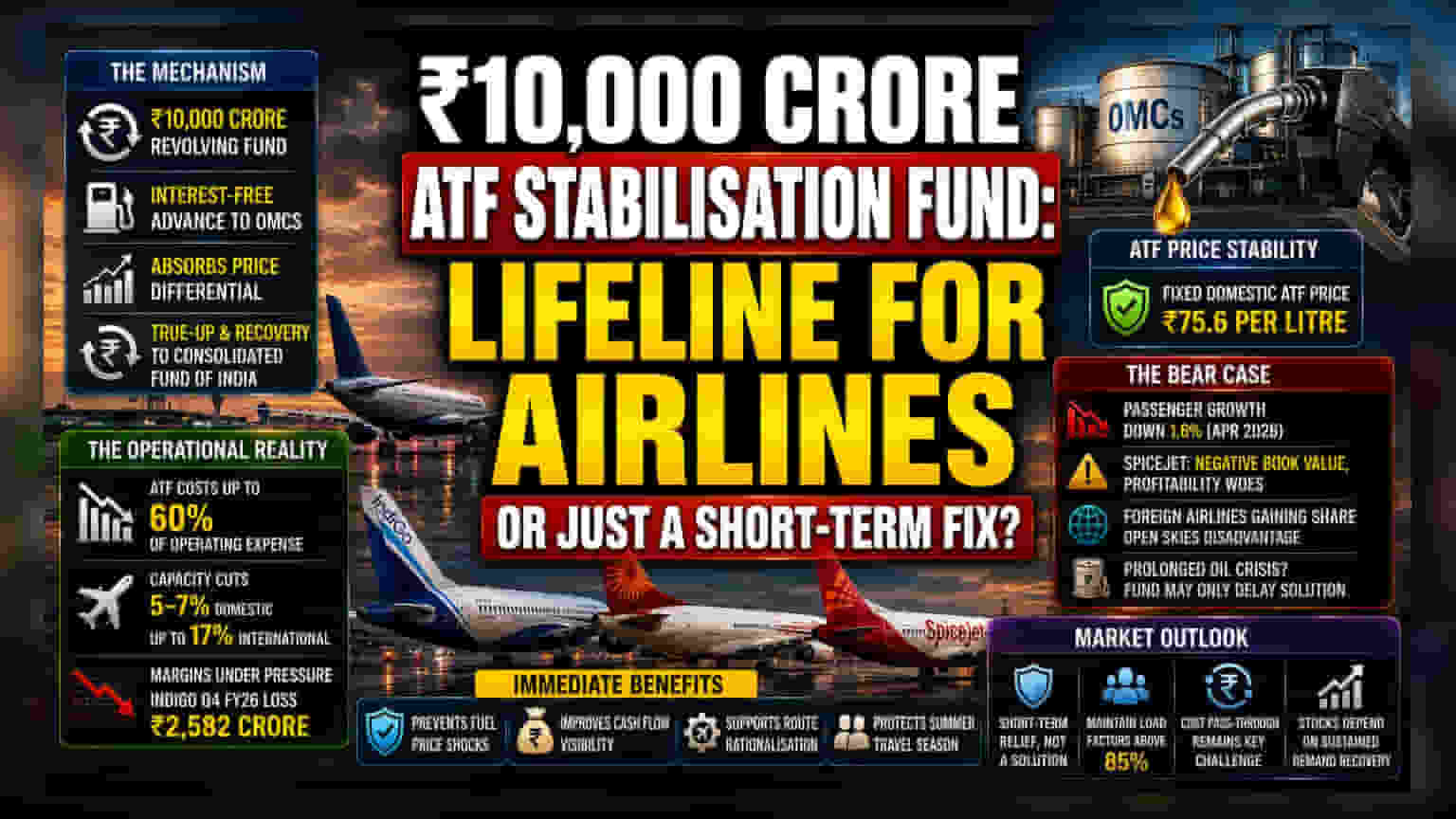


The Mechanism of Stability
The Union Cabinet’s approval of a ₹10,000 crore ATF Price Stabilisation Fund represents a direct intervention in the volatility-stricken aviation market. Rather than a simple subsidy, the scheme operates as a revolving, interest-free advance to Oil Marketing Companies (OMCs). This fund is designed to absorb the difference when import parity prices for jet fuel breach a predetermined benchmark, providing airlines with a more predictable cost base. Crucially, the mechanism includes a 'true-up' provision: as global oil markets moderate, the OMCs will recover the differential to replenish the Consolidated Fund of India, effectively making this a liquidity bridge rather than a permanent drain on the exchequer.
The Operational Reality
For airlines like IndiGo and Air India, this intervention arrives after months of acute margin compression. With aviation turbine fuel costs skyrocketing—in some instances reaching 60% of total operating expenditure—carriers had little recourse but to rationalize schedules. Recent data shows that major players have already cut capacity by 5-7% domestically and up to 17% on international routes for the June-August period. The government’s decision to fix domestic ATF prices at ₹75.6 per litre serves as a necessary floor to prevent the total erosion of airline profitability, which has seen heavy hitters like IndiGo report significant quarterly losses following the surge in crude benchmarks.
The Forensic Bear Case
Despite the immediate relief, the structural weaknesses of the Indian aviation sector remain. Even with a fuel price cap, carriers are grappling with the broader economic reality of slowing passenger growth, which ICRA recently noted declined by 1.6% in April 2026. Smaller, debt-laden carriers like SpiceJet face a more precarious future; despite the fund, the company’s negative book value and persistent profitability challenges make it difficult for investors to find a clear path to turnaround. Furthermore, foreign airlines are gaining market share, benefiting from open airspace corridors that remain closed to many Indian carriers due to the regional geopolitical standoff. If the crisis in West Asia is prolonged, a ₹10,000 crore buffer may only delay, rather than solve, the fundamental requirement for airlines to find more robust hedging strategies.
Market Outlook and Sentiment
Brokerage analysts remain cautious, viewing the fund as a short-term stabilizing measure that fails to address the underlying vulnerability to global oil geopolitics. While the intervention provides a floor for operational planning, the ultimate trajectory of airline stocks depends on their ability to pass through remaining costs and maintain load factors above the current 85% threshold. Future performance will be heavily contingent on whether this policy effectively prevents a broader collapse in summer travel demand, which is currently being tested by elevated airfares.