 Whalesbook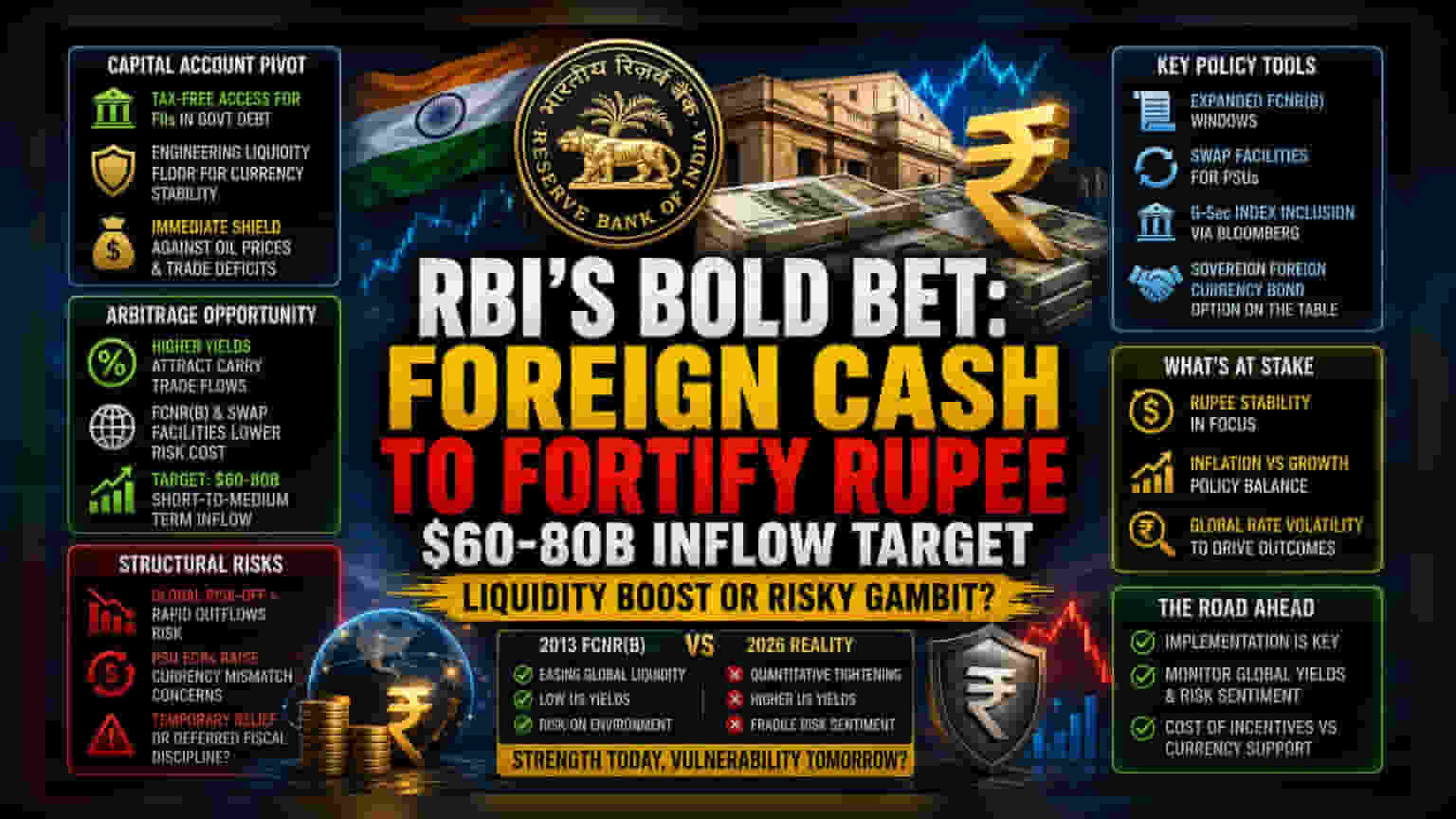


The Capital Account Pivot
The strategic shift toward aggressive foreign capital mobilization represents a direct response to a hardening Balance of Payments (BoP) environment. By dismantling tax barriers for foreign institutional investors (FIIs) in the government debt segment, the Reserve Bank of India (RBI) is attempting to engineer a liquidity floor. This move is less about long-term debt reform and more about immediate currency stabilization. The logic follows a standard playbook: improve the carry trade appeal of Indian sovereign paper to offset the drag of elevated oil prices and persistent trade deficits.
Assessing the Arbitrage Opportunity
While the market anticipates an influx of $60 billion to $80 billion, the efficacy of these measures hinges on the spread between domestic yields and the cost of hedging. The proposed FCNR(B) windows and swap facilities for Public Sector Undertakings (PSUs) are essentially designed to minimize the cost of risk for offshore capital. However, comparing this to the 2013 FCNR(B) mobilization reveals a different global backdrop. Unlike the mid-2010s, current global markets are navigating a complex phase of quantitative tightening. The success of this initiative will be measured by whether the inflow can withstand potential volatility in the U.S. Treasury market, which often dictates the flow of emerging market debt.
Structural Risks and the Bear Case
The reliance on debt-based inflows presents a distinct vulnerability. While index inclusion—specifically through platforms like Bloomberg—offers a catalyst for passive fund flows, it also binds the domestic bond market to global risk-off sentiment. If global risk appetite shifts, India faces the risk of rapid capital outflows, which would exacerbate the very currency pressure these measures seek to mitigate. Furthermore, the reliance on PSU-driven external commercial borrowings (ECBs) could expose state-owned firms to heightened currency mismatch risks if the rupee continues its depreciation trajectory. Analysts remain wary of whether these policy levers provide structural strengthening or merely serve as a temporary liquidity bridge that defers fiscal discipline.
The Future Outlook
Market participants are currently monitoring the implementation guidelines for the swap facilities as the primary barometer for success. While initial data suggests positive absorption of sovereign debt, the broader trend depends on the interplay between the RBI’s inflation mandate and the government’s borrowing requirements. As policymakers weigh the option of sovereign foreign currency bond issuance, the market is pricing in a period of intense volatility. For now, the focus remains on whether the cost of these incentives will outweigh the benefit of short-term currency support in a higher-for-longer interest rate environment.