 Whalesbook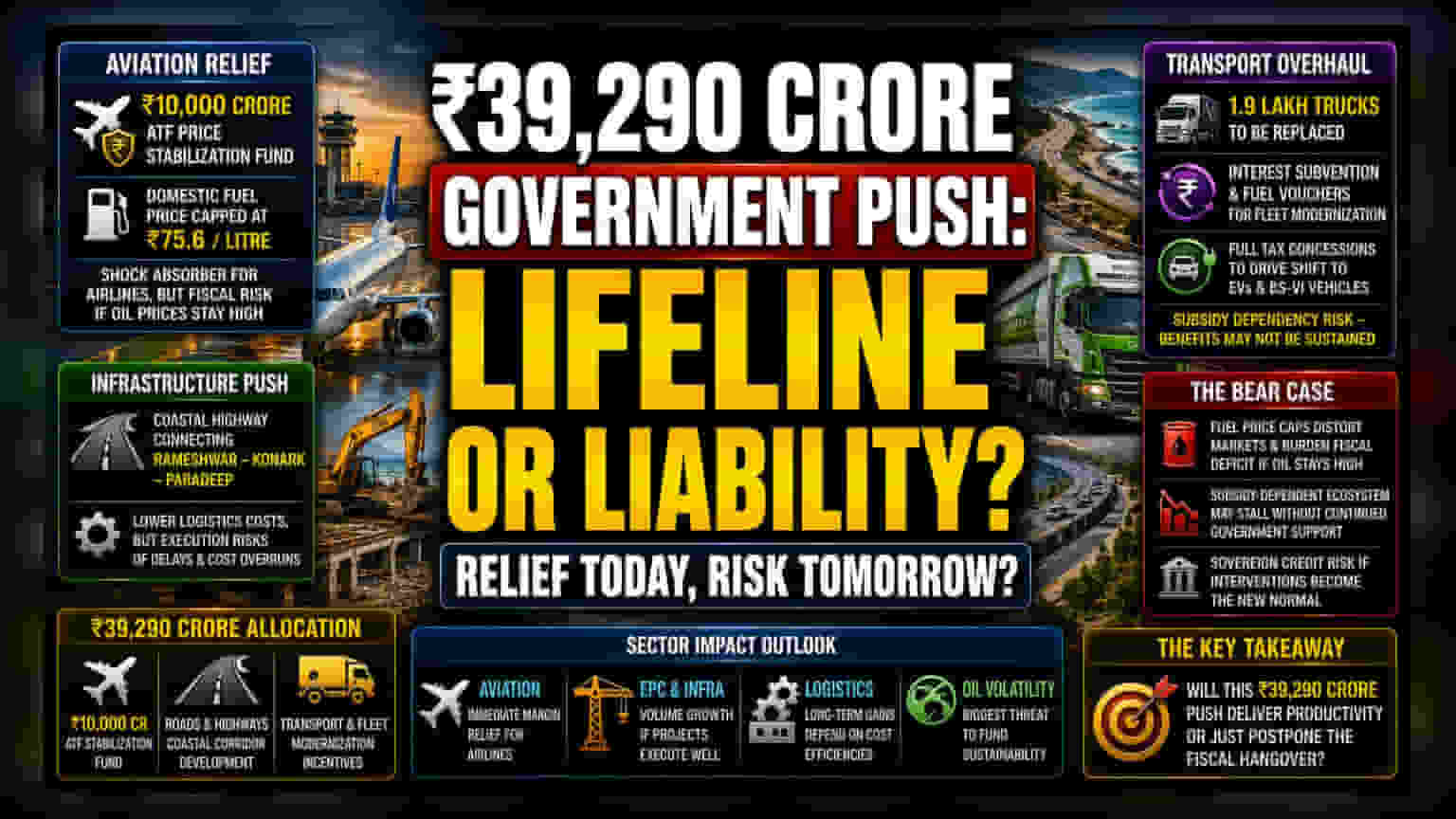


The Fiscal Balancing Act
The government’s decision to commit 39,290 crore toward economic revitalization represents a tactical pivot toward supply-side intervention. By earmarking 10,000 crore for an Aviation Turbine Fuel (ATF) price stabilization fund, the administration is effectively acting as a shock absorber for the airline industry. While this provides immediate relief to carriers like Interglobe Aviation, it introduces a complex precedent where the state assumes the volatility risk of global commodity markets. The mechanism to cap domestic fuel prices at 75.6 per litre suggests an attempt to shield carriers from global crude swings, but such interventionist policies historically risk widening the fiscal deficit if global energy prices remain elevated for sustained periods.
Infrastructure Overhang and Execution Risk
Beyond the fuel subsidy, the allocation toward road networks—including the coastal highway linking Rameshwar, Konark, and Paradeep—is intended to lower logistics costs. However, the efficacy of these capital expenditures depends entirely on execution speed. Historically, highway projects in Bihar and Telangana have faced significant land acquisition hurdles and cost overruns. Investors should monitor whether these disbursements will be inflationary, as sudden liquidity injections into construction and transport sectors often lead to localized material price spikes. Unlike the infrastructure push of the previous fiscal year, this tranche focuses heavily on fleet modernization, which may prove more effective in reducing carbon overhead than in generating immediate GDP multipliers.
The Forensic Bear Case: Subsidy Dependencies
From a structural perspective, the reliance on state-backed interest subvention and fuel vouchers for the National Capital Region transport overhaul warrants skepticism. While intended to accelerate the shift to electric and BS-VI compliant vehicles, these incentives create a subsidy-dependent ecosystem. If state governments fail to maintain the 100% motor vehicle tax concessions, the projected replacement rate of 1.9 lakh trucks may stall, leaving the fiscal commitment underutilized. Furthermore, market participants should note that capping fuel prices, while beneficial for airline margins in the short term, distorts price signals that are necessary for long-term operational efficiency. Investors must also account for potential sovereign credit rating sensitivities if such interventions become the standard response to sector-specific inflation.
Future Outlook and Sectoral Sensitivity
Market analysts remain divided on the long-term impact of this capital infusion. While the aviation sector anticipates immediate margin expansion, the broader industrial and logistics sectors face mixed signals. If the government’s infrastructure spend correlates with a rise in regional construction activity, firms associated with engineering, procurement, and construction (EPC) may see volume growth. However, persistent global volatility in crude benchmarks remains the primary threat to the sustainability of the ATF stabilization fund. Forward-looking valuations for transport-dependent entities will likely pivot on how effectively these subsidies transition into genuine productivity gains rather than mere operational support.