

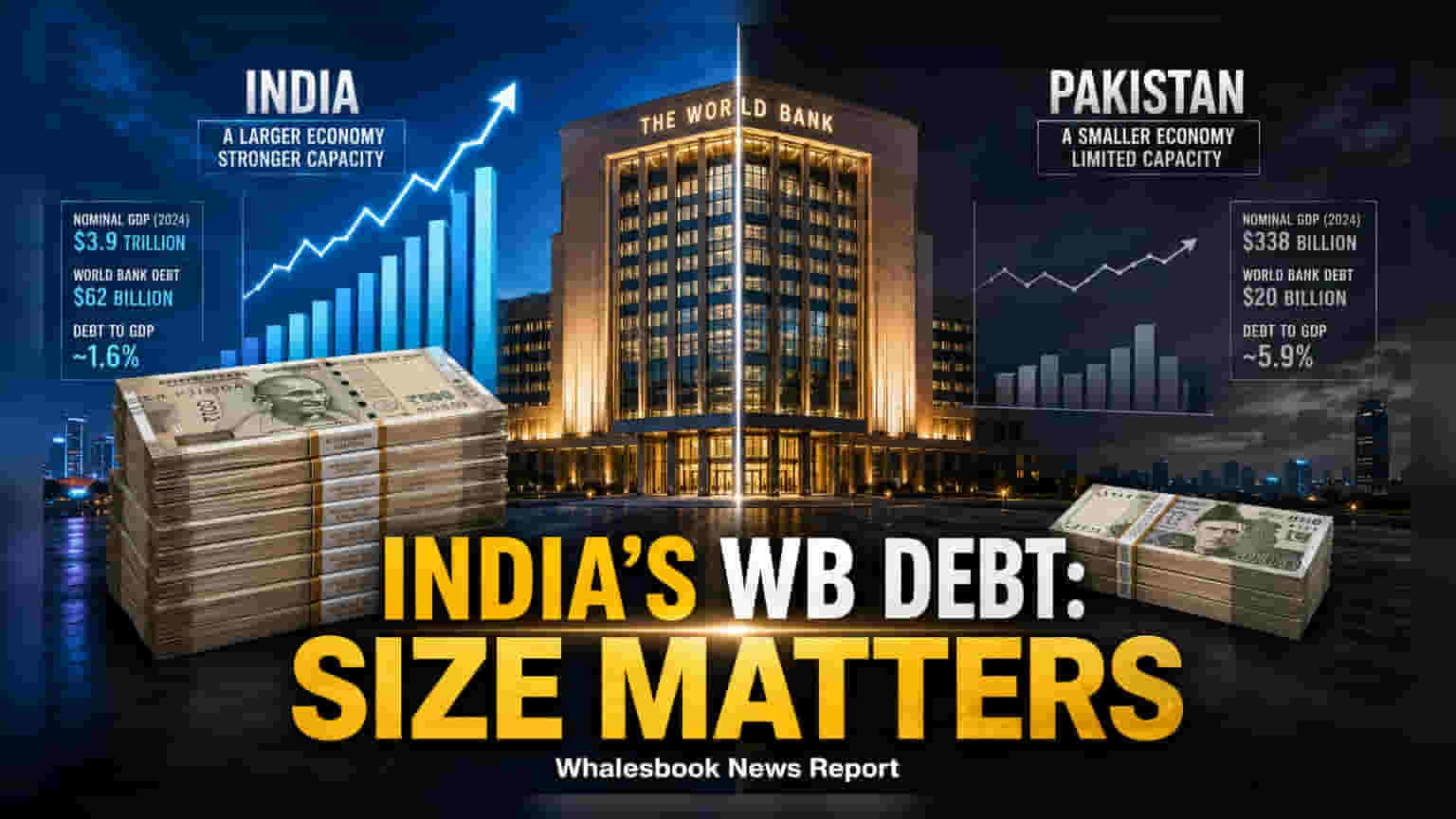
Recent reports labeling India as the World Bank’s largest borrower overlook its massive economic scale. With a $4 trillion economy, the $34.35 billion outstanding debt is manageable compared to smaller, more burdened nations. The debt has actually declined from its 2020 peak, reflecting stable management amidst global uncertainty.
Recent discussions regarding India’s position as the largest borrower from the World Bank often rely on raw dollar figures, which can provide a distorted view of the country's actual financial health. As of March 2026, India’s outstanding debt to the World Bank stood at approximately $34.35 billion. While this number is high in absolute terms, it does not tell the full story without comparing it to the size of the national economy.
Understanding the Economic Scale
Comparing debt across different countries without accounting for their economic size is a common pitfall. India’s economy is estimated to be nearing $4 trillion. In this context, a debt of $34.35 billion represents a very small portion of the country's total output. When investors or analysts evaluate the risk of national debt, they look at the debt-to-GDP ratio rather than the absolute dollar amount. A smaller economy with lower absolute debt can often face more significant financial pressure than a large economy with higher absolute debt, simply because the latter has a much larger base of economic activity to service those obligations.
Downward Trend in Debt
Contrary to the perception that borrowing is spiraling, India’s outstanding debt to the World Bank has actually been trending downward. In 2020, the outstanding debt was approximately $39.6 billion. Since then, the figure has dropped by over 13%. This indicates that the pace of loan repayment and cancellations has successfully outpaced the addition of new loans. This trend suggests that the country is not becoming increasingly dependent on this specific source of external funding relative to its economic growth.
Broader Macroeconomic Context
India’s fiscal health is also supported by its broader external finance fundamentals. In August 2026, Fitch Ratings affirmed India’s Long-Term Issuer Default Rating at 'BBB-' with a stable outlook. This rating reflects the country’s robust growth prospects and solid external financial position. While India does face challenges—including a fiscal deficit and the need to manage government debt levels—these factors are evaluated within the framework of a growing, resilient economy. The Reserve Bank of India and government data show that while external debt has increased, much of this is driven by private sector borrowing rather than government-led accumulation.
Risks to Watch
While the current World Bank debt is manageable, the economic environment presents real challenges. Global factors such as energy price volatility, triggered by geopolitical tensions, can impact the cost of imports and pressure the trade balance. Additionally, the global interest rate environment is a monitorable factor, as higher borrowing costs can impact the overall cost of servicing external debt. Investors and market observers typically track these macroeconomic indicators—specifically inflation, the current account deficit, and foreign exchange reserves—to gauge the stability of the economy. The focus remains on how effectively the country manages these variables against the backdrop of a changing global financial environment.