 Whalesbook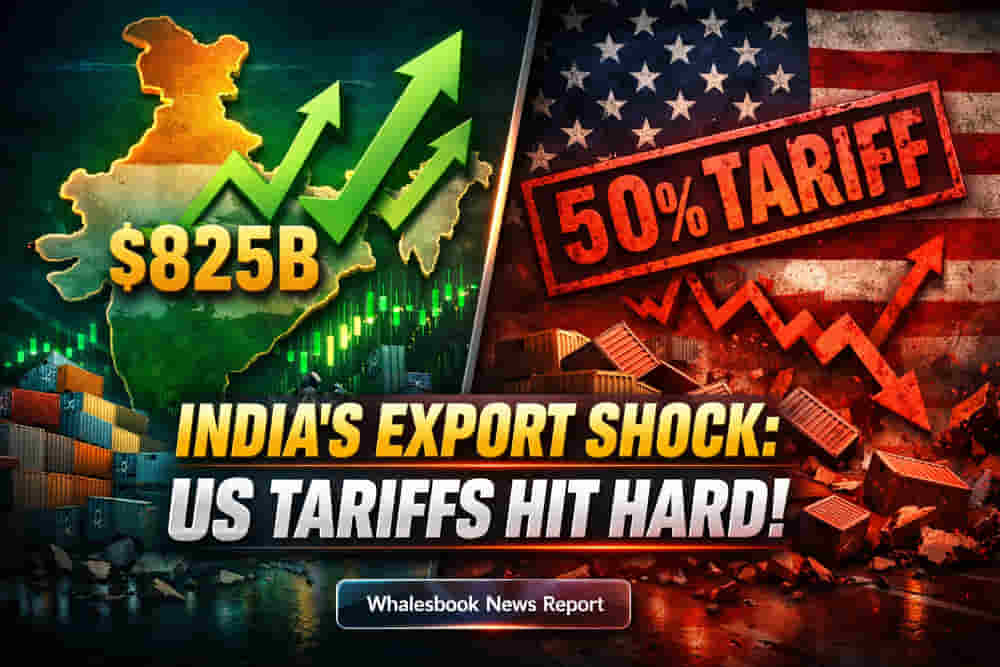
Record Exports Amidst Global Storm
India's trade in 2025 began with optimism, expecting new agreements and market access. However, global geopolitical conflicts, supply chain disruptions, and rising freight costs created a turbulent backdrop. Despite these headwinds, India's exports showed resilience, with total merchandise and services exports reaching an all-time high of $825.25 billion in FY25, marking a 6.05% year-on-year growth.
The US Tariff Shocks
This momentum faced a significant hurdle in April when the United States announced sweeping tariff measures, including a baseline 10% rate and reciprocal tariffs. India was hit with a 26% tariff, raising concerns. In August, after accusations of indirectly funding Russia's war efforts via oil imports, US tariffs on Indian goods escalated sharply to 50%. Commerce Minister Piyush Goyal strongly rebutted external pressure on sovereign trade decisions.
Navigating Protectionism and Slow Progress
Negotiations for a comprehensive bilateral trade agreement with the US progressed slowly, with multiple rounds yielding no definitive breakthrough. This uncertainty loomed over export-oriented sectors heavily reliant on the American market.
Diversification Strategy: New FTAs
To counter these challenges, India actively pursued trade diversification. In July, a Free Trade Agreement was signed with the UK, awaiting operationalisation. The European Free Trade Association FTA came into force in October, opening new opportunities. December saw the conclusion of negotiations for a Comprehensive Economic Partnership Agreement with Oman, providing duty-free access to over 98% of Omani tariff lines. India also finalized an FTA with New Zealand.
Impact on Indian Sectors
These diversification efforts helped cushion global uncertainties. In the first half of FY26, India's exports grew 5.86%, led by services. Electronics, engineering goods, and pharmaceuticals were key drivers. Exports to the US also rose 13% due to front-loading before tariffs took effect. However, elevated US tariffs are now impacting labour-intensive sectors like textiles and leather.
Government Support Measures
The government responded with policy support. The Export Credit Guarantee Corporation lowered insurance costs for volatile markets. A weaker rupee provided relief, and GST rationalisation offered domestic support. An export promotion mission aims to incentivize market diversification.
Future Trade Outlook
Talks with the US remain complex, involving both a trade agreement and a framework deal for tariffs. Beyond the US, India is negotiating with the EU, EAEU, MERCOSUR, Chile, Peru, and the Maldives, and exploring expanded agreements with Australia and the UAE, among others. While these agreements may take time, they reduce reliance on any single market. The biggest potential uplift hinges on bridging differences with Washington for a mutually acceptable trade pact.
Impact
This news has a significant impact on the Indian stock market, investor sentiment, and businesses reliant on international trade. Sectors like textiles, engineering, pharmaceuticals, and electronics are directly affected by trade policies and tariffs. Fluctuations in export performance can influence corporate earnings and India's overall economic growth. The successful negotiation of FTAs can boost specific sectors and companies, while tariff shocks can lead to volatility. Impact Rating: 9/10
Difficult Terms Explained
- Geopolitical Conflicts: International disputes affecting trade and stability.
- Protectionism: Shielding domestic industries via tariffs or quotas.
- Bilateral Agreements: Treaties negotiated by two countries.
- Supply Chains: The process of moving goods from supplier to customer.
- Freight and Insurance Costs: Expenses for transporting and insuring goods.
- Merchandise and Services Exports: Selling physical goods vs. intangible services abroad.
- Tariffs: Taxes on imported goods.
- Reciprocal Tariffs: Tariffs imposed in response to another country's tariffs.
- Sovereign Trade Decisions: A country's independent right to set trade policy.
- Unilateral Diktats: Orders imposed by one party without consensus.
- Free Trade Agreement (FTA): Pact between countries to reduce trade barriers.
- Operationalised: Put into effect.
- Comprehensive Economic Partnership Agreement (CEPA): Broad trade deal including services, investment, etc.
- Duty-Free Access: Ability to import/export without customs duties.
- Tariff Lines: Specific categories of goods for customs duties.
- Front-loading: Shipping goods in advance of a predicted event (like tariffs).
- Labour-intensive Sectors: Industries requiring significant human labor.
- Export Credit Guarantee Corporation (ECGC): Agency providing credit risk insurance to exporters.
- Country Risk Ratings: Assessment of political and economic risks in a country.
- GST Rate Rationalisation: Adjusting Goods and Services Tax rates.
- Export Promotion Mission: Initiative to boost exports.
- Eurasian Economic Union (EAEU): Economic union in Northern Eurasia.
- MERCOSUR: South American trade bloc.
- Gulf Cooperation Council (GCC): Political and economic union of Arab states.