 Whalesbook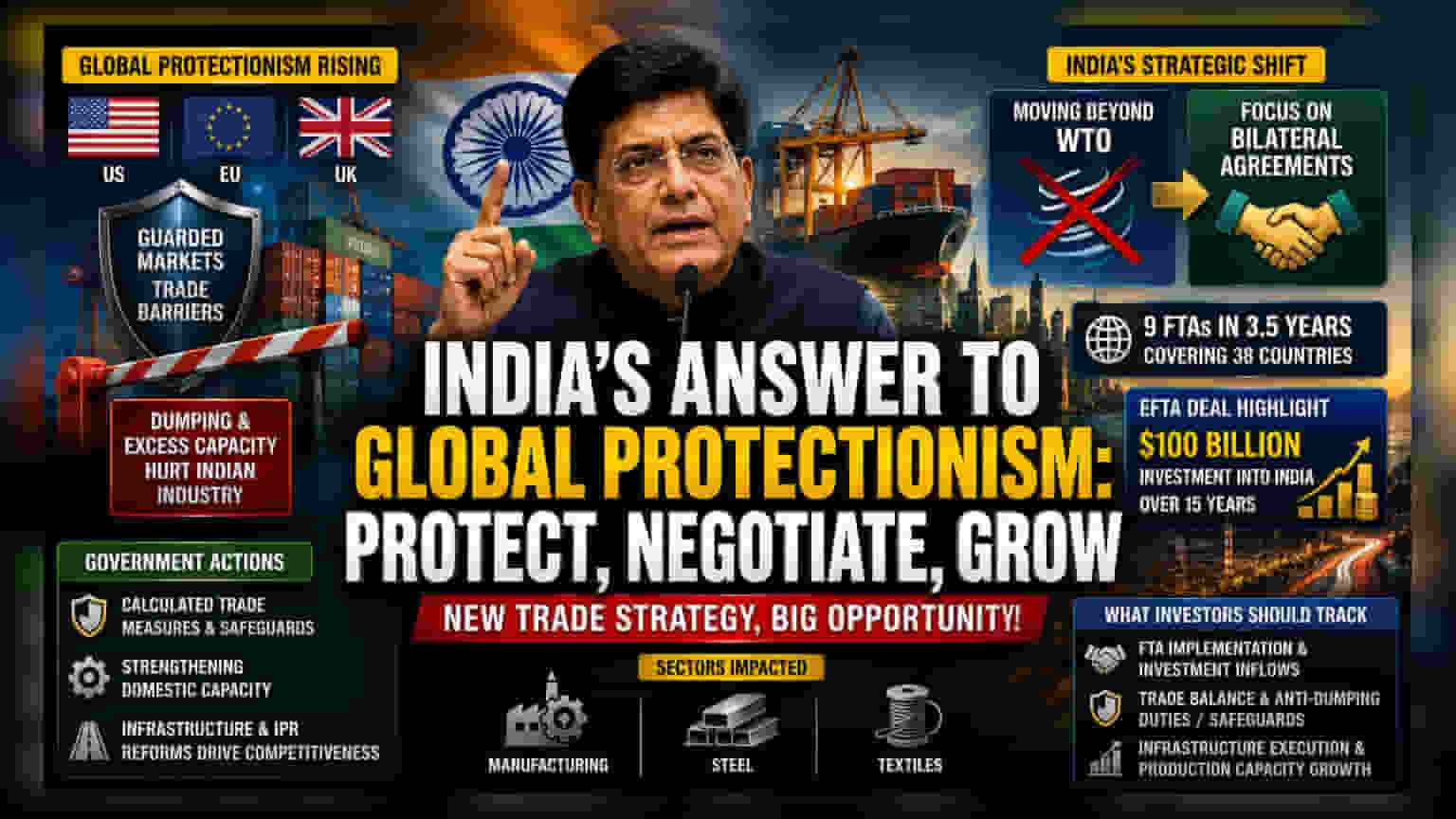


Commerce Minister Piyush Goyal has highlighted that India is actively countering global protectionism by shifting toward bilateral trade agreements. With major economies imposing barriers, India has signed nine Free Trade Agreements in recent years to secure market access and attract $100 billion in potential investments. For investors, this shift signals a focus on protecting domestic manufacturing from unfair import competition while driving growth through international partnerships.
What Happened
Commerce and Industry Minister Piyush Goyal recently addressed the growing trend of global protectionism, where nations increasingly implement policies to shield their domestic industries. Speaking at the India Global Innovation Connect, the Minister noted that developed economies like the US, EU, and UK are adopting more guarded trade stances. He explained that India must respond to this reality by protecting its own economy from unfair trading practices, such as the dumping of low-cost goods and excess capacity coming from certain global regions. To navigate this, the government is moving away from a reliance on the World Trade Organization (WTO), which the Minister described as currently less effective, and is instead prioritizing direct bilateral agreements.
Why This Matters For Investors
For Indian investors, trade policy directly impacts the profitability and stability of various sectors, particularly manufacturing, steel, and textiles. When global markets restrict access or protect their own industries, it can limit export opportunities for Indian companies. Conversely, when foreign nations flood the Indian market with cheap, subsidised goods—a practice known as dumping—it creates severe margin pressure for domestic producers. The government’s shift toward bilateral trade deals aims to manage this balance. By securing Free Trade Agreements (FTAs), India is attempting to open foreign markets for Indian goods while retaining the right to protect its domestic industry through calculated trade measures.
The Shift to Bilateral Trade
India has significantly ramped up its engagement through trade partnerships, signing nine Free Trade Agreements in the last three and a half years. These agreements cover 38 countries, including several developed economies. A key example is the Trade and Economic Partnership Agreement (TEPA) with the European Free Trade Association (EFTA) nations, which includes a commitment for $100 billion in investments into India over 15 years. This strategy is designed to integrate India deeper into global supply chains and attract capital that can help domestic companies upgrade their technology and improve product quality, making them more competitive internationally.
The Business Context and Risks
While the push for investment is clear, investors should be mindful of the risks associated with global trade volatility. If international markets become more protectionist, the risk of dumping increases, which can hurt the profit margins of Indian companies that cannot compete with artificially low-priced imports. To counter this, the government is focusing on strengthening domestic capacity. This includes ongoing reforms in intellectual property rights (IPR) and heavy spending on infrastructure, such as ports, airports, and power systems. The goal is to make Indian production more efficient and capable of competing on value rather than just price.
What Investors Should Track
Moving forward, investors may want to monitor several key areas. First, watch for the actual implementation and investment inflow resulting from the newly signed FTAs, particularly the long-term commitment from EFTA nations. Second, monitor the trade balance and any specific anti-dumping duties or trade safeguards announced by the government, as these directly protect domestic margins. Finally, track whether the promised infrastructure and regulatory improvements actually lead to higher domestic production capacity, as this will determine the long-term success of India’s trade strategy against global protectionism.