 Whalesbook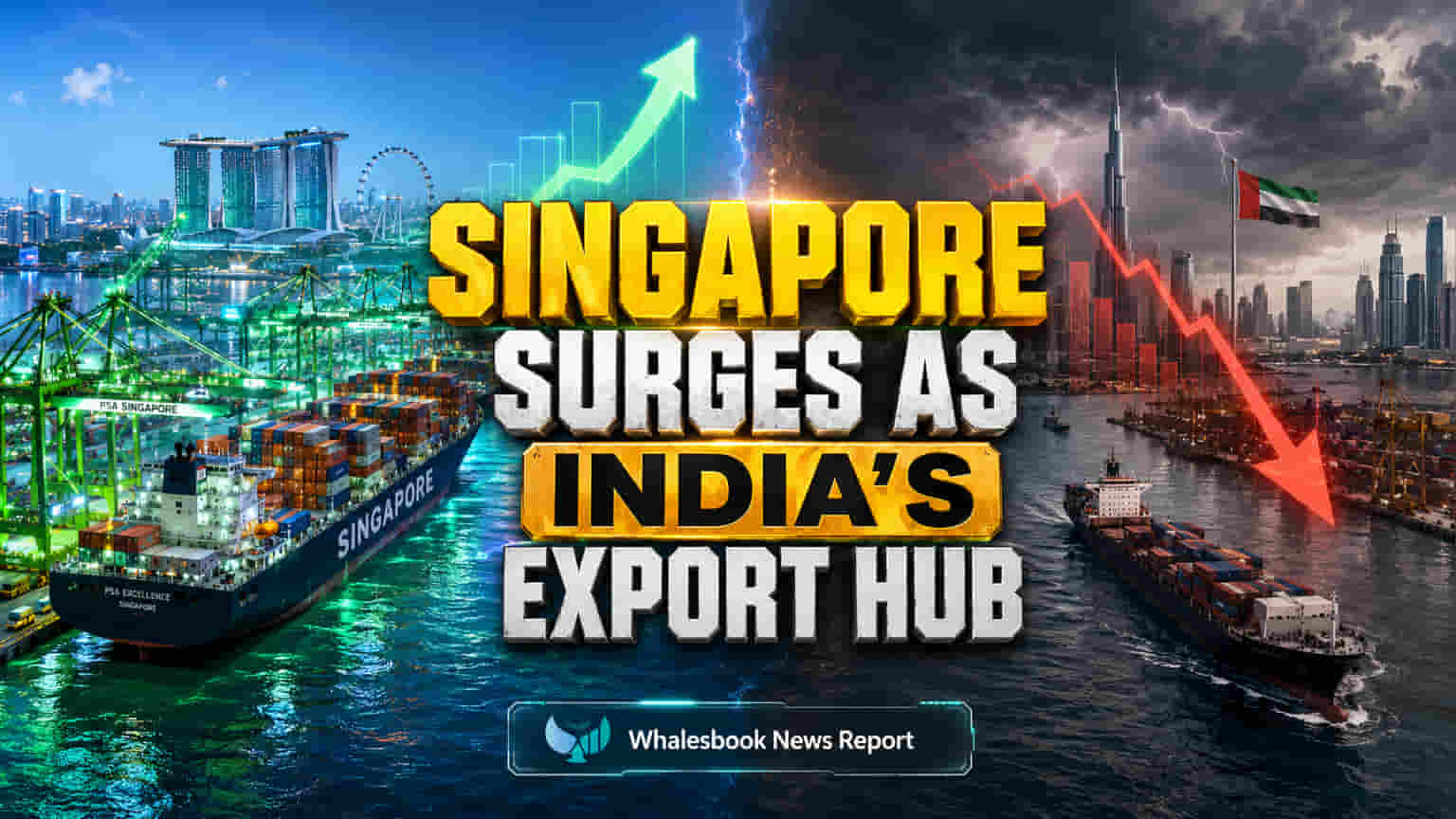


The Rerouted Trade Equation
Geopolitical tensions in West Asia have significantly changed India's trade routes, making Singapore its second-largest export destination and displacing the United Arab Emirates. This shift, intensifying since February, sees exporters and logistics firms rerouting cargo away from the contested shipping lanes in the Persian Gulf. Data for April 2026 shows India's exports to Singapore surged by 180 percent year-on-year to $3.20 billion. Meanwhile, exports to the UAE fell 36 percent to $2.18 billion in the same period. This reallocation shows the strategic importance of both hubs, now seen through the lens of geopolitical stability.
The Widening Import Bill and Currency Strain
The closure of the Strait of Hormuz, a key global energy route, has put heavy pressure on India's import bill and currency. Brent crude oil prices rose past $119 a barrel in late April 2026, reaching a four-year high, and averaged $117 per barrel for the month. This surge directly inflates India's energy import costs, which climbed to $18.62 billion in April 2026 from $12.18 billion in March. The rising import costs contributed to a merchandise trade deficit of $28.38 billion in April 2026, and has been a key reason for the Indian Rupee's depreciation. By mid-May 2026, the rupee had weakened to near a record low of ₹96 against the US Dollar, a depreciation of over 5-7% year-to-date in 2026. This currency weakness makes all imports, from oil and gold to electronics, more expensive, increasing inflationary pressures.
Hubs, History, and Economic Factors
Singapore and the UAE have long competed as global logistics and transshipment hubs. The UAE, through entities like DP World, has aggressively challenged Singapore's PSA International, aiming to rival Singapore as Asia's premier trading hub. However, the current crisis highlights Singapore's resilient infrastructure and its key role in the new East-West trade flows. Historically, India has depended heavily on Gulf producers for crude oil, with traditional suppliers like Saudi Arabia and Qatar showing different import trends amidst the crisis. The conflict has also forced India to seek alternative import routes, increasing reliance on spot purchases from Russia and Iran. This shift, while necessary, comes with elevated freight and insurance costs, further straining the economy. The wider economic picture shows a weakening INR driven by a strong US Dollar, foreign portfolio investor (FPI) outflows totaling over $20 billion in the first four months of 2026, and persistent trade deficit pressures.
Exposed Economic Vulnerabilities
The current geopolitical shock reveals India's key weaknesses: its heavy reliance on imported energy and pressure on its foreign exchange reserves and currency. The Strait of Hormuz closure has directly impacted nearly 40-50% of India's crude oil imports and an important share of its LPG supply. While the government maintains comfortable forex reserves (around $690 billion), the ongoing depletion from interventions to support the rupee and higher import payments is causing concern. The widening trade deficit and currency depreciation create a negative feedback loop, making imports more expensive, fueling inflation, and potentially affecting GDP growth forecasts, with some projections showing FY 2026/27 growth at 6.7% from a previous 7.7%. The government's efforts to promote trade settlement in rupees are early, indicating continued reliance on dollar-denominated trade for the foreseeable future.
The Future Outlook: Diversification Imperative
In response to these pressures, India is actively pursuing diversification strategies, exploring new markets and alternative trade routes via Oman and Fujairah in the UAE. The government has also implemented austerity measures and encouraged fuel conservation. The long-term goal is clear: reduce dependence on unstable energy sources and key trade routes by accelerating the shift towards domestic renewable energy and enhancing energy efficiency. While exports show resilience, driven by sectors like electronics and petroleum products, managing the import bill and currency stability will remain paramount for economic stability in the coming quarters. The ongoing disruptions show the urgent need for structural reforms to improve energy security and strengthen the external sector.