 Whalesbook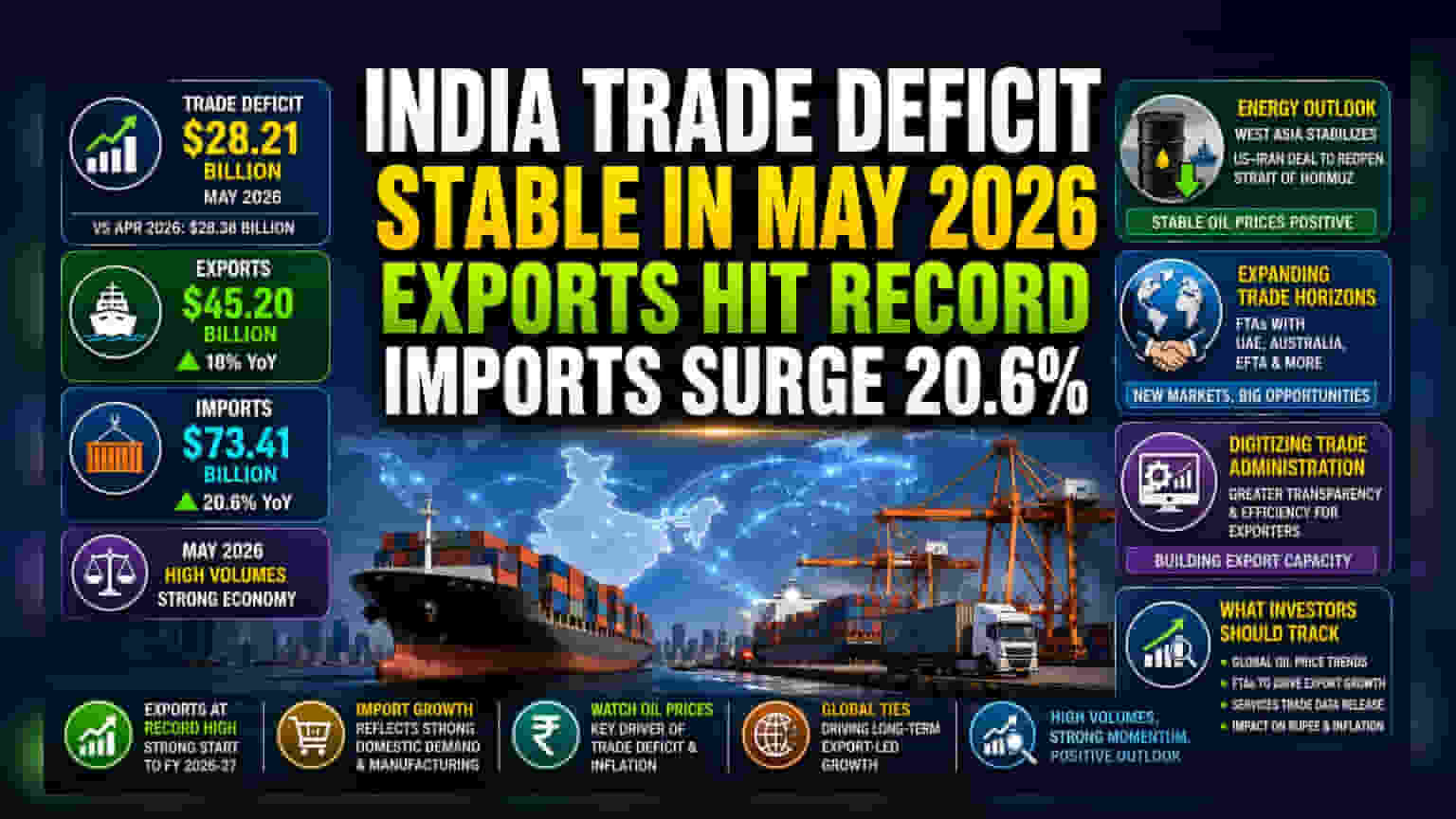


India’s trade deficit remained stable at $28.21 billion in May 2026, as record exports of $45.20 billion balanced out a rise in imports. With geopolitical risks easing in West Asia, the outlook for energy trade and national economic stability remains a key area for investors.
What Happened
India’s merchandise trade deficit remained consistent in May 2026, coming in at $28.21 billion. This figure is nearly identical to the $28.38 billion recorded in April 2026. Despite the large deficit gap, the underlying trade numbers showed strong activity. Merchandise exports reached a new monthly record of $45.20 billion, marking an 18 percent increase compared to the same period last year. Meanwhile, imports also grew, rising by 20.6 percent to reach $73.41 billion.
Why Trade Volume Matters
For investors, a trade deficit is not inherently negative, especially when it is driven by high trading volumes. When both imports and exports are growing at double-digit rates, it often suggests that the economy is active. Increased imports can reflect stronger domestic demand or the need for raw materials to fuel manufacturing. Simultaneously, record-breaking export growth suggests that Indian products and services are gaining competitiveness in global markets. The Commerce Ministry has noted that export performance in May was among the strongest seen recently, indicating a robust start to the new fiscal year.
The Energy and Geopolitical Angle
One of the most critical factors for India’s trade balance is the cost of energy imports. India remains a significant importer of crude oil, making the nation sensitive to global supply chain disruptions. Recent developments in West Asia have been a key monitorable. Reports indicate that the situation in the region is stabilizing, and a preliminary agreement between the United States and Iran to reopen the Strait of Hormuz is particularly significant. Since this is a vital route for global energy trade, its reopening could help stabilize crude oil prices. For Indian investors, this is positive news as lower or stable energy costs can reduce inflationary pressure and improve the balance sheets of companies heavily dependent on logistics and energy.
Moving Toward New Markets
The government continues to push for broader trade horizons through various Free Trade Agreements (FTAs). With deals involving nations like the UAE, Australia, and the European Free Trade Association, the focus is on expanding India’s export base. The Commerce Department is also digitizing trade administration to improve transparency and efficiency for exporters. These structural changes are aimed at supporting long-term, export-led economic growth. The significant growth in services exports over the past decade further complements the merchandise trade, providing a more balanced view of India's external economic health.
What Investors Should Track
While the trade numbers for May are stable, investors should continue to monitor several factors. The most immediate concern is the impact of global oil prices on the import bill. Even with the reopening of key shipping routes, any sudden spike in energy costs can impact India's trade deficit and, by extension, the Rupee and domestic inflation. Additionally, stakeholders will watch how the operationalization of new FTAs translates into actual export growth for specific sectors. Finally, the government’s plans to release more granular services trade data will provide clearer insights into the drivers of India’s economic growth in the coming months.