 Whalesbook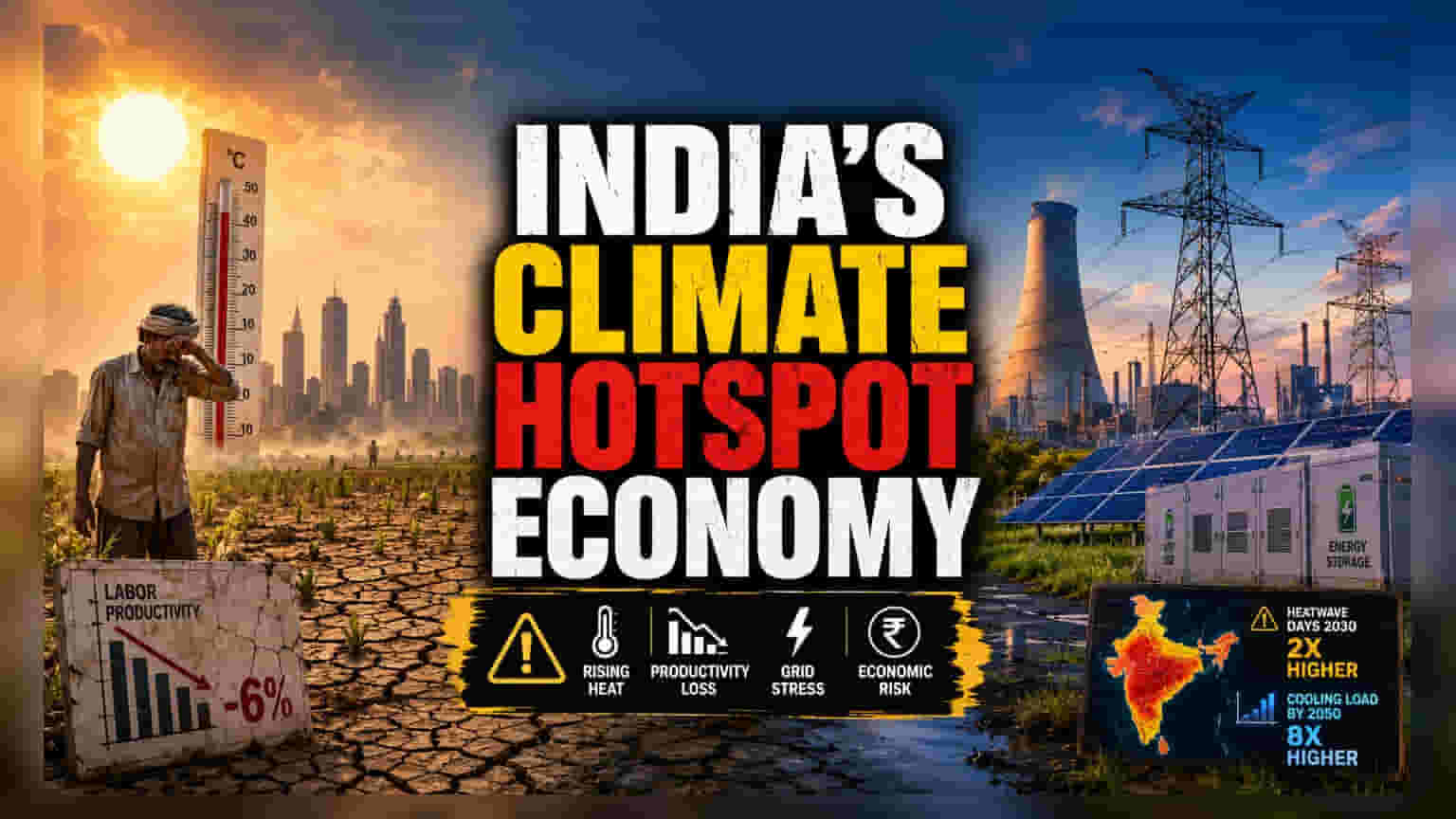


The Macroeconomic Heat Tax
The economic narrative surrounding India’s climate exposure has shifted from long-term sustainability concerns to immediate, operational drag. With the Ministry of Earth Sciences projecting a doubling of heatwave days by 2030, the traditional model of industrial and agricultural expansion is facing a structural ceiling. This is not merely an environmental challenge but a direct tax on labor productivity, which is expected to decline by 6% due to thermal stress. For a country reliant on heavy labor in construction and agriculture, this reduction effectively shrinks the available workforce, creating a localized inflationary pressure on wages and operational costs that broader national metrics often fail to capture.
Grid Volatility and Capital Allocation
The power sector is currently undergoing a violent transition as the demand for cooling load increases eightfold by 2050. Unlike past cycles where power infrastructure could be scaled linearly, the current climate regime necessitates massive capital expenditure into grid hardening and decentralized storage to manage peak load volatility. Investors should look closely at utility companies and infrastructure firms; those with outdated transmission networks or reliance on thermal-only generation are likely to face significant regulatory penalties and reliability surcharges. The move toward localized micro-climate intelligence is more than a policy shift—it is a necessity for risk-adjusted capital allocation in an environment where historical weather patterns no longer serve as reliable predictive models.
The Forensic Bear Case: Unpriced Systemic Risk
The primary danger remains the systematic underestimation of localized risks by institutional models. Many large-scale infrastructure projects in the Western Ghats and Himalayan foothills are being modeled on decade-old temperature data that fails to account for the loss of nocturnal cooling periods. This represents a significant 'hidden' risk: the failure of infrastructure to shed heat at night, which accelerates material fatigue in construction assets and increases the likelihood of catastrophic failure in power distribution components. Furthermore, the reliance on national-level thermal averages allows firms to mask sub-district failures, creating a scenario where portfolio volatility could spike in specific regions despite strong top-line national growth numbers. Companies that do not integrate granular heat-risk mapping into their supply chain and workforce management are effectively operating with an unhedged climate liability.
Future Outlook
Moving forward, the focus will likely shift toward private-public partnerships in climate-resilient architecture and demand-side power management. Financial and industrial policies are expected to prioritize companies that demonstrate, through audit, that they have integrated AI-driven micro-climate mapping into their operational logistics. Analysts are beginning to weight 'thermal resilience' alongside traditional solvency metrics, suggesting that the divide between climate-ready firms and legacy operators will widen significantly over the next fiscal cycle.