

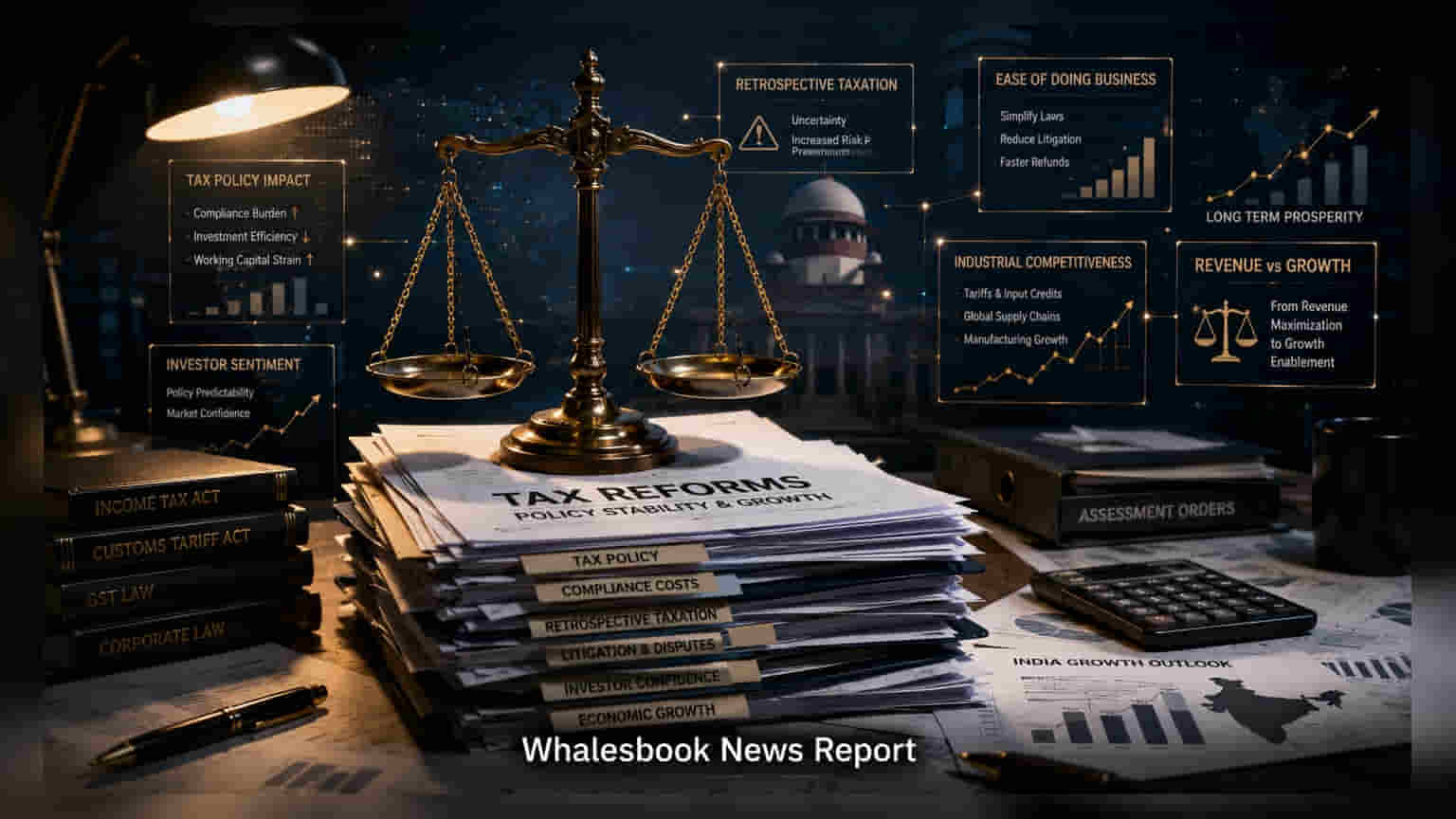
India’s tax policy structure is under discussion as experts urge a shift from revenue-focused administration to growth-friendly reforms. For investors, the primary concerns remain retrospective legislation and administrative complexities. This analysis examines how fiscal stability influences long-term investor confidence and the broader investment climate in India.
For Indian investors and global capital allocators, the stability of tax policy is as important as corporate earnings growth. A recent economic perspective has highlighted a critical debate on India’s tax framework: the need to shift from an administration that prioritizes short-term revenue collection to one that acts as a catalyst for economic expansion.
At the heart of this discussion is the concern that tax policy is often treated as a tool for immediate state convenience rather than a stable foundation for prosperity. When tax systems are designed primarily to maximize collections, they can inadvertently create friction for businesses. For companies, this often manifests as increased compliance costs, delayed tax refunds, and administrative uncertainty, all of which directly impact the working capital available for expansion.
One of the most discussed issues in this context is the concept of retrospective legislation. In the past, the Indian market has seen instances where laws were adjusted following court rulings to change the tax impact on transactions. For investors, this creates a 'heads I win, tails I amend' scenario that injects volatility into the investment climate. Predictability is the bedrock of foreign and domestic investment; when tax rules are subject to change in hindsight, it increases the risk premium that investors attach to the Indian market.
Another major point of focus is the integration of tax policy with industrial strategy. Tax structures, including tariffs and input credit mechanisms, are essential incentives for global supply chains. When tax policies are drafted in a silo—without considering their impact on the competitiveness of Indian manufacturing—it can hinder the ability of local firms to scale. Investors often monitor these policy tweaks closely, as they directly dictate the cost-competitiveness of sectors ranging from textiles to electronics.
The administrative machinery also plays a role in the ease of doing business. Critics of the current tax approach argue that internal career structures within revenue departments sometimes influence policy design more than economic efficiency. For the private sector, every extra layer of complexity adds to the compliance burden. Simplification, such as the reduction of litigious disputes and faster processing of assessments, is widely viewed by industry analysts as a necessary step to free up resources for productive corporate investment.
For investors, the takeaway is clear: the focus is increasingly on policy consistency. Markets generally react positively when regulatory frameworks become more transparent and less prone to sudden, retrospective shifts. The next important steps for the government, as observed by industry stakeholders, will be to further simplify the tax code, reduce the backlog of litigation, and ensure that tax policy supports, rather than constrains, long-term industrial growth.