

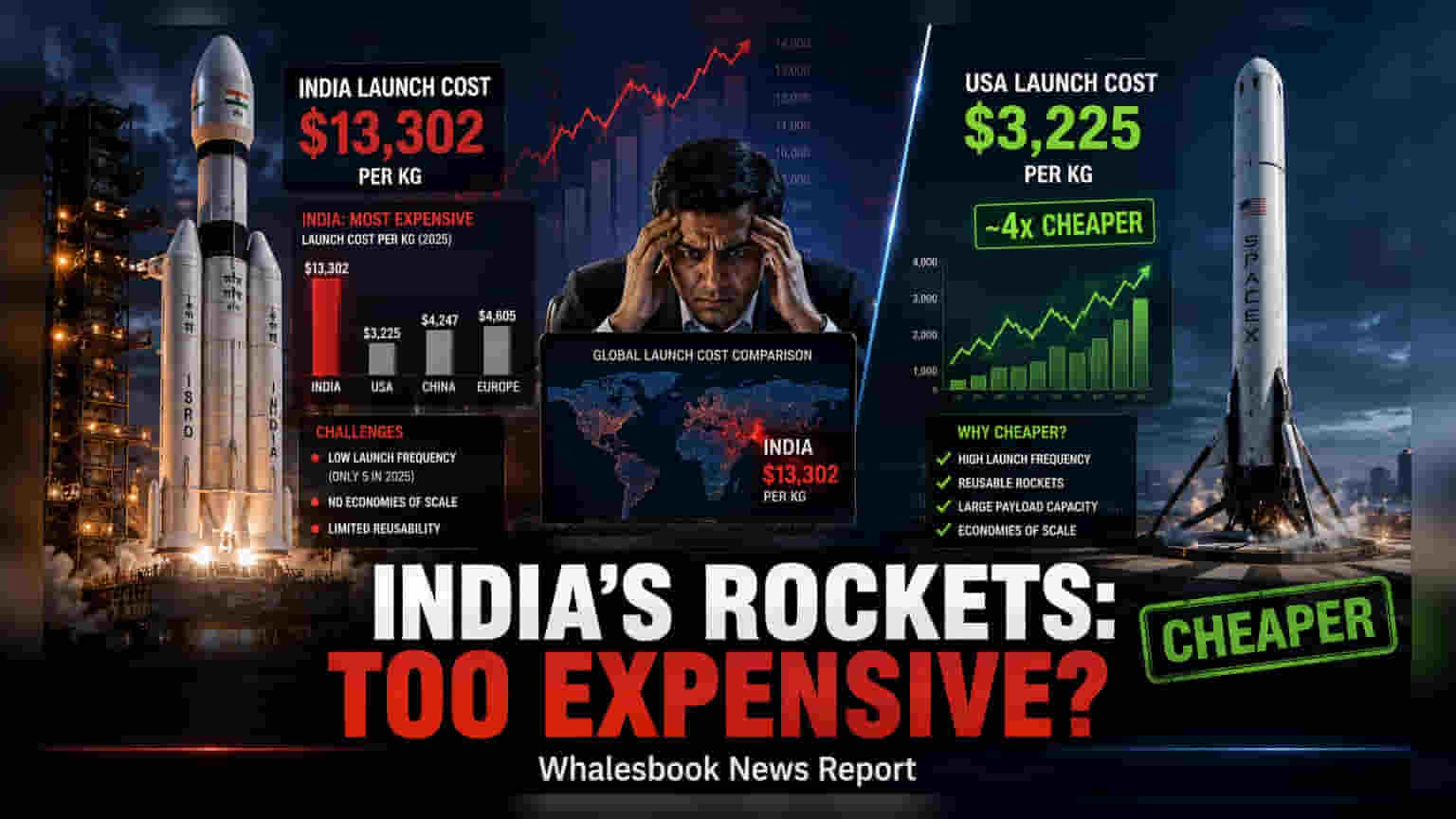
A study in Economics Letters reveals India’s satellite launch cost is $13,302 per kg, significantly higher than the US cost of $3,225 per kg. This reality challenges the narrative of low-cost space missions and poses a hurdle for India’s goal of capturing 8–10% of the global space market by 2030.
India’s ambition to become a major player in the global space industry faces a difficult reality: the cost of launching satellites from India is currently the highest among major spacefaring nations. A peer-reviewed study published in the journal Economics Letters has found that India’s launch cost stands at approximately $13,302 per kilogram as of 2025.
This figure is roughly four times the cost in the United States, where prices are around $3,225 per kg. The data contradicts the long-standing belief that India’s space program is the most cost-effective in the world. For investors and industry observers, this cost structure is a critical factor, as India aims to increase its share of the global space economy to 8–10% by 2030.
Why India’s Launch Costs Remain High
The primary reason for this high cost is the lack of economies of scale. In the space industry, costs drop significantly when rockets are reused and when launch frequency is high. The study highlights that India recorded only five space launches in 2025. This low frequency makes it impossible to spread the heavy fixed costs of infrastructure and research over a large number of missions.
Furthermore, the current generation of Indian rockets, including those managed by NewSpace India Ltd (NSIL) and the Indian Space Research Organisation (ISRO), relies on smaller payloads. Unlike global competitors such as SpaceX, which utilize large, reusable rockets like the Falcon 9 that can carry much heavier loads at a lower price per unit, India has yet to fully adopt reusability at scale. This reliance on smaller, non-reusable vehicles keeps the cost per kilogram high.
Private Sector Impact and Risks
The growth of India's private space sector, marked by milestones like Skyroot Aerospace’s successful orbital launch of the Vikram-1 rocket in July 2026, is a positive development. However, the study suggests that even with private entry, the high cost of launching remains a hurdle for profitability. If private companies cannot lower their costs to compete with international rivals, they may struggle to attract global satellite customers who prioritize price and reliability.
There is also a broader strategic risk. As the demand for heavy-lift satellite launches grows, Indian companies and the government may face pressure to rely on foreign providers like SpaceX. Relying on foreign launch services to send Indian satellites into orbit could create strategic vulnerabilities and reduce the reliance on local launch capabilities.
Looking Ahead
The key monitorable for the industry will be the ability of ISRO and private players to increase launch frequency and develop reusable rocket technology. Without a significant shift toward higher launch volumes and lower-cost designs, capturing a larger share of the global commercial space market will remain difficult. Investors and stakeholders should track updates on rocket reusability tests, the frequency of upcoming launches, and policy changes regarding technology transfer from ISRO to private firms, as these will be essential for reducing costs.