 Whalesbook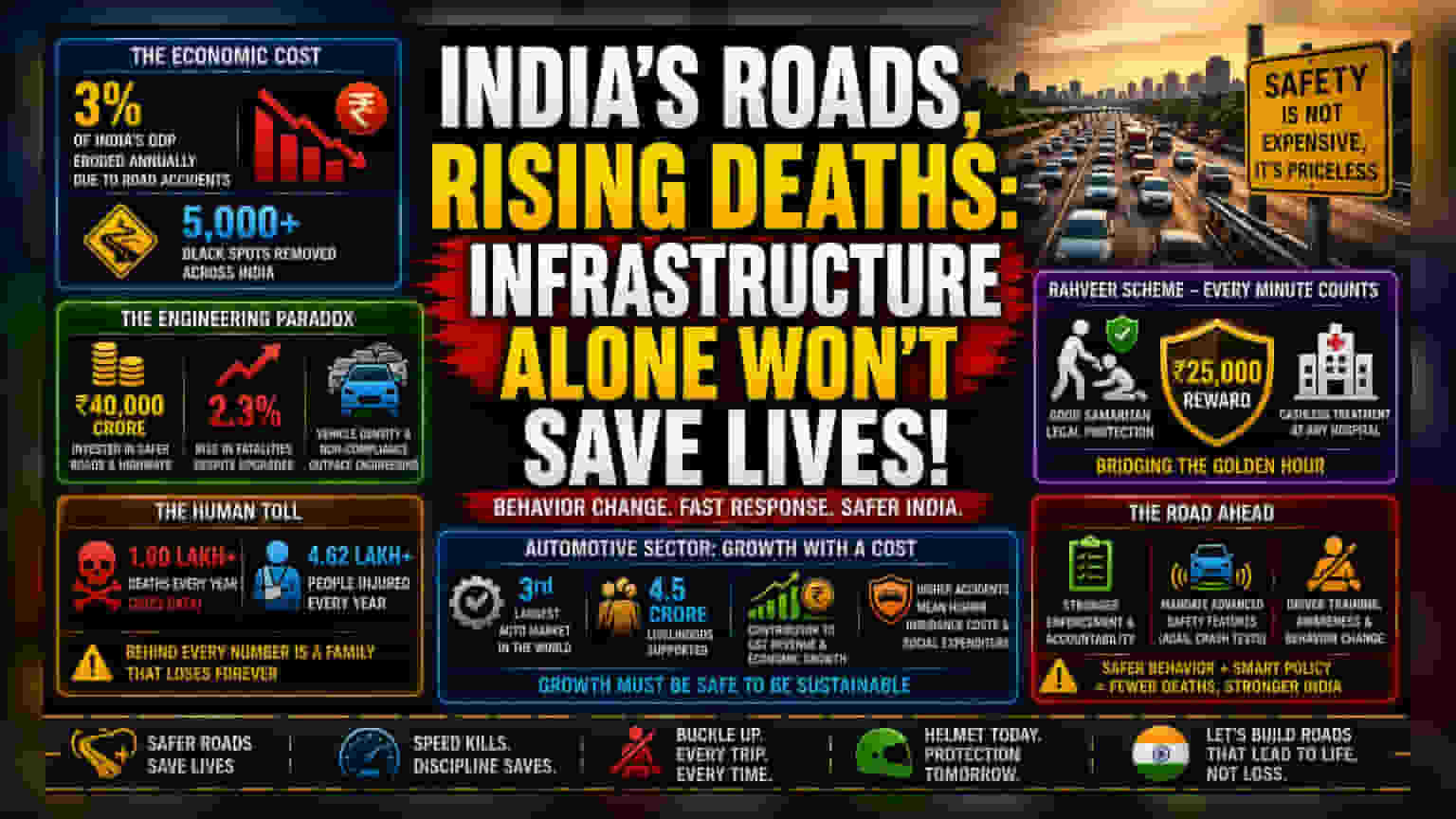


The Economic Friction of Road Fatalities
While the Ministry of Road Transport and Highways continues to pour capital into the expansion of the national highway network, the persistent climb in road fatalities creates a drag on national productivity that physical infrastructure cannot solve alone. The focus on behavioral intervention represents a necessary shift in policy philosophy. Data indicates that approximately 3% of India's GDP is eroded annually due to road accidents, a figure that remains stubbornly high despite the systematic removal of over 5,000 identified 'black spots' across the country.
Dissecting the Engineering Paradox
Investments totaling ₹40,000 crore have significantly upgraded road geometry and safety features, yet the 2.3% uptick in fatalities suggests that vehicle density and driver compliance are outpacing current engineering safeguards. The rapid expansion of India's automobile market, now the world's third-largest, has introduced millions of new, often undertrained, drivers to high-speed corridors. This surge in volume exacerbates the mismatch between modern road design and archaic road-user discipline, rendering even state-of-the-art highways dangerous when enforcement remains fragmented across state jurisdictions.
Incentivized Emergency Response
The introduction of the Rahveer Scheme represents a move to bridge the 'Golden Hour' gap where administrative bureaucracy and fear of legal entanglement previously deterred bystander intervention. By formalizing a ₹25,000 reward and providing legal protection for good samaritans, the government aims to leverage public participation as a decentralized emergency network. This complements the broader cashless treatment policy, which shifts the immediate financial burden of initial trauma care away from the victim, potentially reducing long-term morbidity and the associated strain on public hospital capacity.
The Structural Risk Assessment
From a fiscal and social perspective, the automotive sector remains a double-edged sword. While it contributes substantially to GST revenues and supports 4.5 crore livelihoods, the rising social cost of accidents creates a contingent liability for the state. Insurance premiums are likely to face upward pressure as insurers grapple with the 4.62 lakh annual injury count. Companies within the commercial vehicle and passenger car segments face indirect risks: if the government mandates stricter safety features—such as enhanced crash-test ratings or advanced driver-assistance systems (ADAS) as a reaction to these statistics—margins could compress if manufacturers cannot pass the incremental R&D costs to a highly price-sensitive domestic consumer base. The long-term sustainability of the sector’s growth is therefore tethered not just to vehicle sales, but to the government's ability to lower the aggregate mortality rate through systemic behavioral enforcement.