

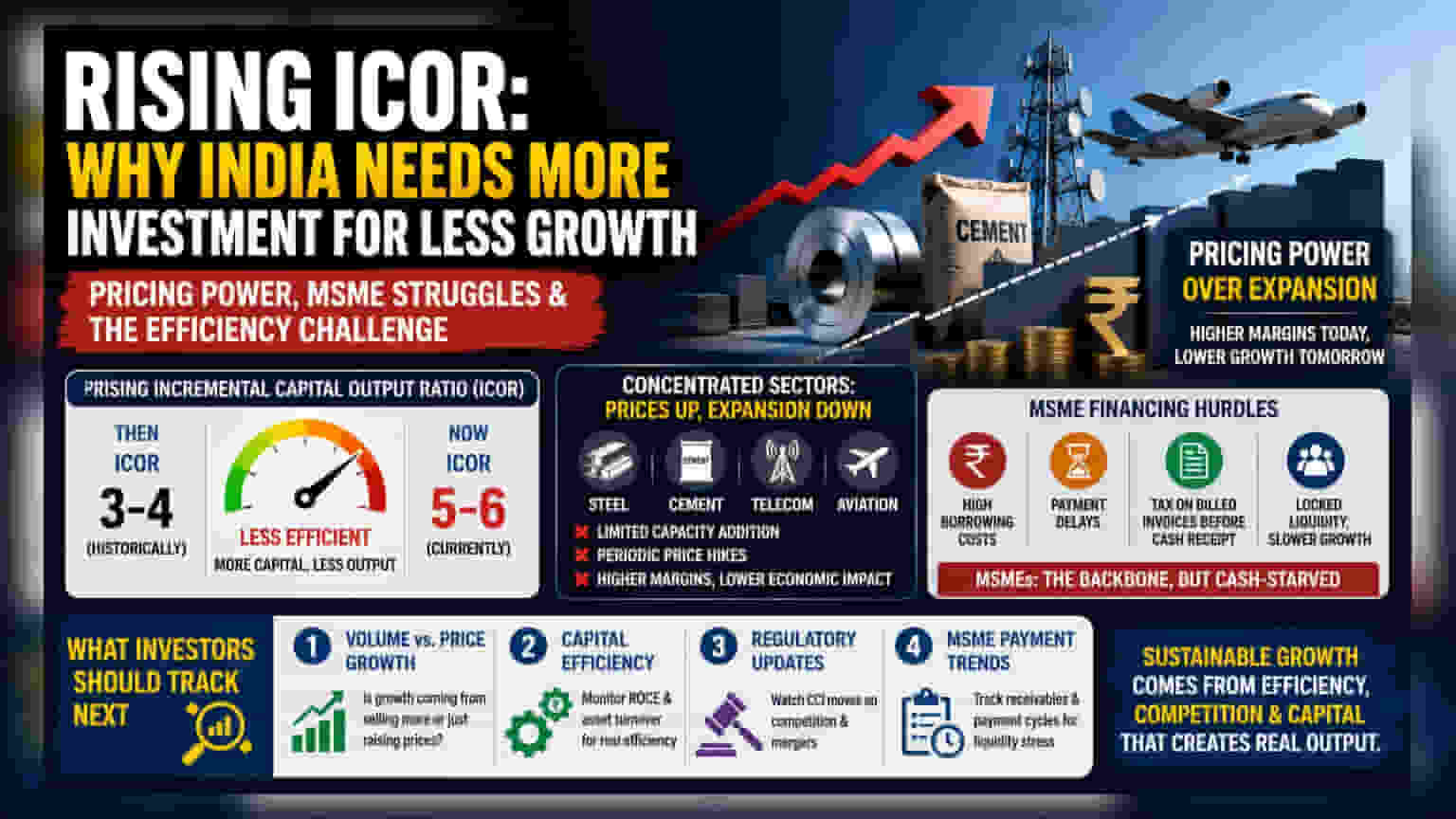
India’s Incremental Capital Output Ratio (ICOR) has climbed to 5-6, meaning the economy now requires more investment to produce the same growth. This trend suggests that concentrated sectors like telecom and cement are prioritizing price hikes over capacity expansion. For investors, this shift highlights a reliance on pricing power rather than volume-driven efficiency, potentially signaling slower long-term economic gains.
What Happened
India’s economic performance is facing a technical challenge known as a rising Incremental Capital Output Ratio (ICOR). In simple terms, ICOR measures how much investment is required to generate one extra unit of output. Historically, India operated with an ICOR in the 3-4 range. Recent data suggests this has climbed to 5-6. This means the economy is becoming less efficient at turning capital into growth; it now takes significantly more money to achieve the same boost in GDP as it did in previous decades.
Why Pricing Power Limits Expansion
Historically, economic growth in manufacturing and services is driven by capacity expansion—building more factories, laying more network, or adding more flight capacity to meet growing demand. However, a shift is occurring in highly concentrated sectors such as steel, cement, telecom, and aviation.
In these industries, where the market is dominated by a few large players, companies have strong pricing power. Instead of investing heavily to expand production capacity to capture market share, these companies are prioritizing higher margins through periodic price hikes. This strategy protects their immediate profits but limits the broader economic impact. When companies limit supply to keep prices high, the economy gains less production, less job creation, and lower overall efficiency, contributing to the rising ICOR.
The MSME Financing Hurdle
Small and medium-sized enterprises (MSMEs) are the backbone of job creation, but they are struggling to keep pace. The rising ICOR also reflects their difficulty in accessing capital efficiently. High borrowing costs and payment delays continue to drain their working capital. Furthermore, the shift toward formalization, while positive for tax compliance, has also locked up liquidity for smaller firms, which now face tax obligations on billed invoices before they actually receive cash from their customers. This creates a drag on the smaller, more agile parts of the economy.
Why This Matters for Investors
For investors, the distinction between price-led growth and volume-led growth is critical. In a healthy, competitive economy, growth is typically driven by higher volumes (selling more units). If a company’s revenue growth is driven primarily by price increases, it may be a sign of market power, but it also carries risks—namely, the risk of demand destruction if prices become too high for the consumer.
Investors may want to examine whether the companies they hold are expanding capacity to meet future demand or simply relying on industry consolidation to raise prices. High profitability in a sector where capacity expansion is stagnant may look good on a quarterly earnings report but could signal a lack of long-term sustainable growth potential.
What Investors Should Track Next
Investors may want to watch several key indicators to assess the health of their portfolio companies:
Volume Growth vs. Price Growth: Check if revenue increases in results are coming from selling more products or just raising prices.
Capital Efficiency: Metrics like Return on Capital Employed (ROCE) and asset turnover ratios help show if the company is using its capital to generate real output or just maintaining margins.
Regulatory Updates: Monitor the Competition Commission of India (CCI) for any shifts in how it handles anti-competitive practices or mergers, which could impact the pricing power of dominant players.
MSME Payment Trends: Management commentary on trade receivables and industry-wide payment cycles can provide clues on whether the broader supply chain is facing liquidity stress.