 Whalesbook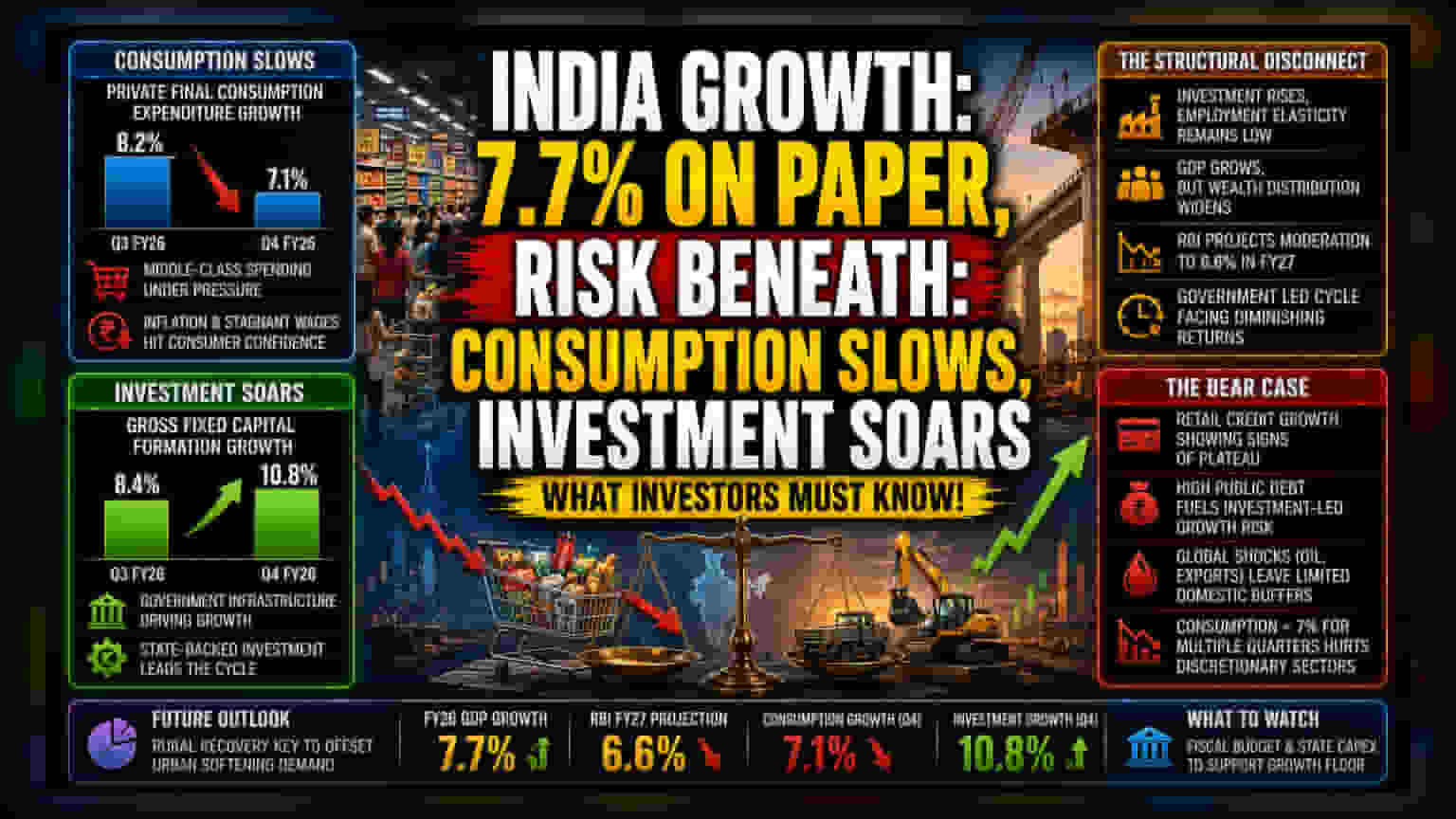


The Consumption-Investment Paradox
While the headline 7.7% annual growth figure provides a veneer of fiscal strength, the underlying mechanics of the Indian economy are shifting toward a precarious reliance on capital expenditure. The deceleration in Private Final Consumption Expenditure—dropping from 8.2% in the third quarter to 7.1% in the fourth—is more than a quarterly hiccup. It reflects a narrowing base of consumer spending that is increasingly sensitive to inflationary pressures and stagnant wage growth in key service sectors. By contrast, the acceleration in Gross Fixed Capital Formation to 10.8% indicates that the primary engine of growth has shifted from the middle-class shopper to public infrastructure projects and state-backed initiatives.
The Structural Disconnect
Comparing this cycle to historical benchmarks, the current dependence on state-led investment creates a distinct vulnerability. Unlike in previous expansionary cycles where consumption acted as the lead indicator, current data reveals a divergence between industrial capacity utilization and retail demand. As investment rises in capital-intensive sectors, the employment elasticity of this growth remains low. This means that while GDP figures remain elevated, the ability of this expansion to distribute wealth efficiently through the broader economy is waning. Market participants should note that the Reserve Bank of India’s projected moderation to 6.6% for FY27 is not merely a statistical correction but a recognition that the government-led investment cycle is reaching a point of diminishing marginal returns.
The Forensic Bear Case
The primary structural risk lies in the exhaustion of the domestic debt cycle. As high-frequency indicators for credit growth in retail segments show signs of plateauing, the transition from consumption-led growth to investment-led growth lacks a secondary buffer. Furthermore, the reliance on Gross Fixed Capital Formation to drive GDP carries a heavy weight of public debt. If global macro conditions tighten—specifically regarding crude oil volatility or export demand—the lack of robust household consumption will leave the economy with limited domestic buffers. Past cycles suggest that when consumption growth drops below the 7% threshold for multiple quarters, discretionary sectors suffer significant margin compression, as firms are unable to pass on input costs to a price-sensitive population.
Future Outlook and Analyst Sentiment
Market expectations for the coming quarters hinge on whether a rural recovery can offset the softening urban demand. Analysts suggest that unless there is a meaningful pivot in monetary policy or a substantial easing in food inflation, the headline growth will continue its descent toward the 6.6% RBI projection. Investors are closely watching the upcoming fiscal budget for signals of continued state-led capital expenditure, which serves as the primary floor for current market valuations.