

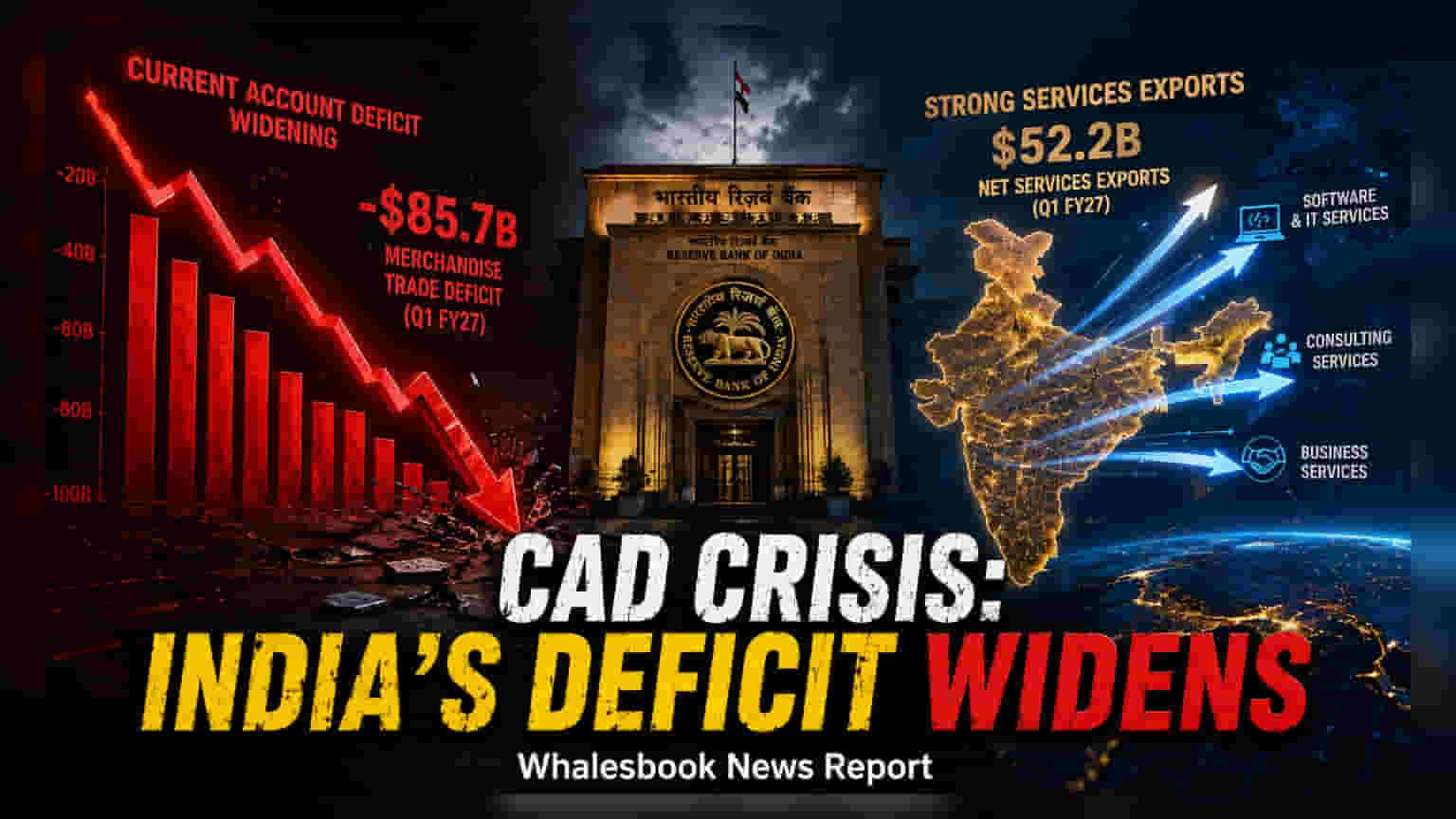
India’s current account deficit stood at $3.1 billion in the first quarter of fiscal 2027. While a surge in crude oil costs pushed the goods trade deficit to $85.7 billion, strong growth in services exports acted as a vital buffer. Investors are now tracking how these trade dynamics and changing foreign inflows influence the currency and overall financial stability.
India’s current account deficit (CAD) remained contained at $3.1 billion for the first quarter of the 2027 fiscal year, marking only a marginal change from the $2.9 billion recorded in the same period last year. This outcome comes despite a significant widening in the country’s merchandise trade deficit, which rose to $85.7 billion compared to $68.9 billion in the year-ago period.
Energy Costs Drive Trade Gap
The primary reason for the sharp increase in the trade gap is the rising cost of crude oil imports. Global geopolitical tensions, particularly the ongoing disruptions surrounding the Strait of Hormuz, have suppressed energy shipping traffic and kept global crude prices elevated throughout the quarter. As a major importer of energy, these higher global prices directly impact the national trade balance, creating pressure on the total import bill.
Services Sector Provides Resilience
The country’s services sector acted as the primary shield against this widening goods deficit. Net services exports reached $52.2 billion in the April-June 2026 quarter, a notable increase from the $47.9 billion recorded a year earlier. This strong performance in software, consulting, and other service exports continues to be a crucial financial buffer, effectively narrowing the impact of the high goods import costs.
Capital Flows and Investor Sentiment
The balance of payments also reflected a shift in the capital account, which recorded a net outflow of $5 billion for the quarter, reversing the $7.4 billion surplus seen in the same period last year. This reversal was largely driven by a period of caution among foreign portfolio investors (FPIs) earlier in the year. However, market data for July and August 2026 suggests that FPIs have started returning to Indian equities, following some regulatory adjustments made earlier in the summer.
Investor Monitorables
For investors, the key factor to track remains the stability of the external sector. While the current account deficit remains manageable, its future path will depend heavily on energy prices and the global demand for Indian services. Ongoing disruptions in maritime routes, such as the Strait of Hormuz, remain a persistent risk to energy costs. Additionally, investors will be monitoring monthly FPI flow data to see if the recent return of foreign capital continues to support the overall balance of payments, helping to stabilize the currency against global economic volatility.