 Whalesbook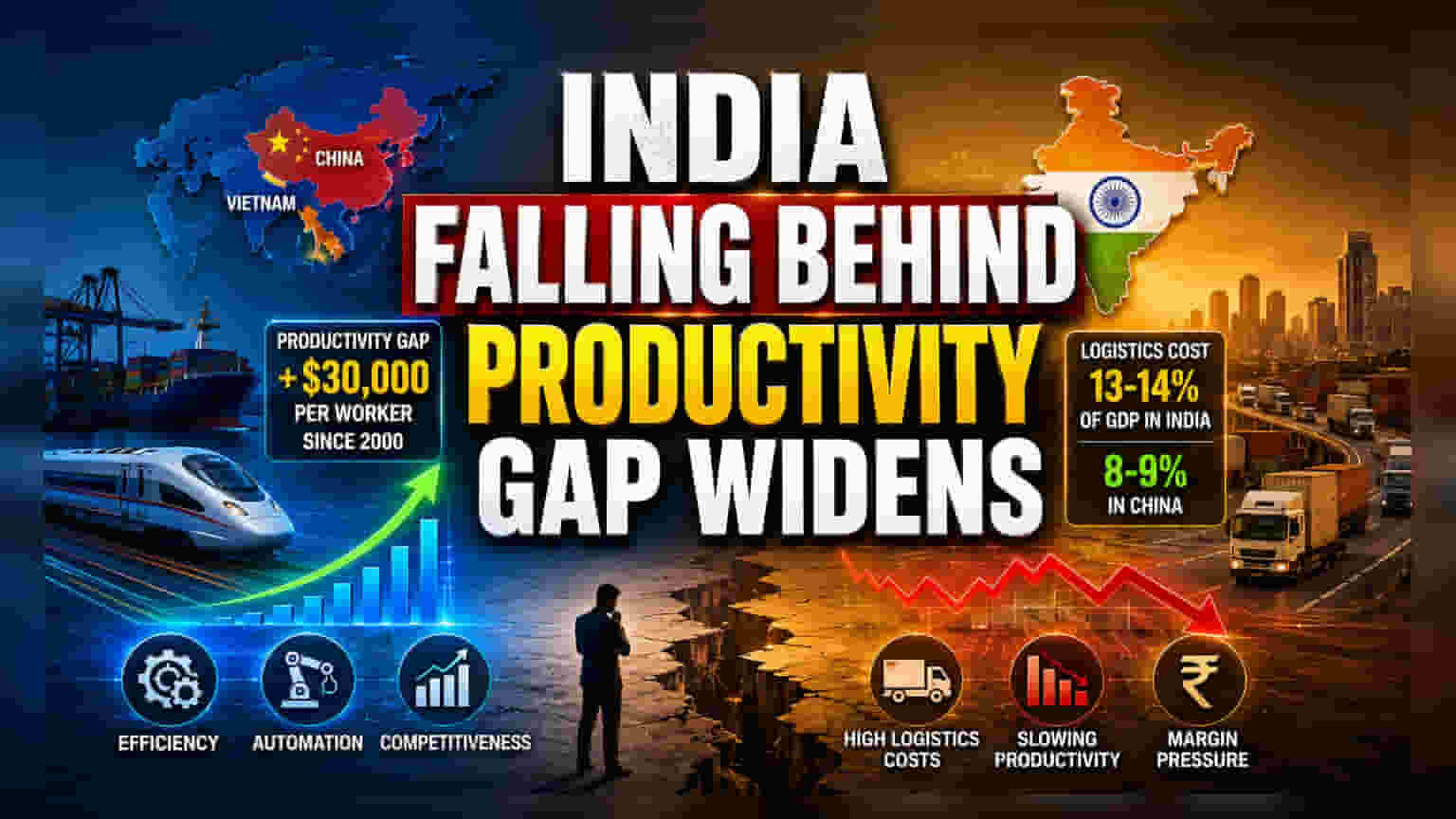


India's labor productivity gap with China has widened by over $30,000 per worker since 2000. While India's economy is growing, a report indicates that structural issues like high logistics costs and a heavy reliance on the informal sector have slowed productivity gains. For investors, this gap is crucial: it highlights the difference between top-line growth and efficient, margin-accretive performance. Understanding these bottlenecks is essential for evaluating which companies can truly scale profitability in the current economic landscape.
What Happened
A recent research report has highlighted a growing divergence in labor productivity between India and major Asian economies, including China and Vietnam. The data shows that the productivity gap between Indian and Chinese workers has expanded by more than $30,000 per worker since the year 2000. Despite India achieving triple-digit growth in GDP per worker since 1995, the pace of these gains has slowed, particularly during the 2010s, when annual productivity growth decelerated to 3.4% from 5.3% in the previous decade.
Why This Matters For Investors
For stock market investors, labor productivity is more than just an economic statistic; it is a direct measure of corporate efficiency. Productivity growth essentially reflects how much value a company generates for every unit of labor cost. When national productivity growth slows or trails behind global competitors, companies often struggle with higher operating costs. If a company cannot improve its productivity through automation, better processes, or scale, it faces pressure on profit margins. This is particularly important for manufacturing and goods-producing companies, where global competitiveness relies heavily on efficiency.
The Logistics And Structural Hurdle
The report identifies logistics costs as a significant barrier. India’s logistics costs currently hover around 13-14% of its GDP, compared to 8-9% in China. For investors, this is a clear sign of an operational disadvantage. High logistics expenses act as a hidden tax on Indian manufacturers, eroding their ability to compete with global peers on price and delivery speed. While the government has introduced policies aimed at improving infrastructure and efficiency, the gap remains a structural challenge that companies must navigate.
The Impact of Economic Disruptions
India’s productivity journey has faced several hurdles, including the 2016 demonetisation, the implementation of the Goods and Services Tax (GST), and liquidity issues in the financial sector. The COVID-19 pandemic further exacerbated these issues, causing a sharp 12.3% drop in productivity in 2020. This volatility underscores the risk of relying on an economy with a large informal sector, which often lacks the resilience of formal, automated, and digitized businesses. Companies that have successfully transitioned to formal, digitized operations tend to show better stability during such economic shifts.
Where The Opportunities Lie
Despite these challenges, there are clear tailwinds. The government’s Production Linked Incentive (PLI) schemes and the broader 'China+1' strategy have provided a boost to high-value sectors such as electronics, pharmaceuticals, and auto components. These initiatives aim to drive output gains and improve the manufacturing sector's contribution to GDP, which has remained relatively flat for years. Investors should monitor companies that are not just growing revenue, but are successfully leveraging these schemes to improve their own internal productivity and Return on Invested Capital (ROIC).
What Investors Should Track
Investors should focus on how individual companies manage these macro challenges. Key monitorables include management’s commentary on operational efficiency, the successful integration of technology to reduce labor dependency, and the ability to maintain or expand profit margins despite sector-wide pressure. Tracking a company’s performance relative to its peers in terms of margin expansion and capital efficiency often provides a better picture of long-term sustainability than looking at revenue growth alone. Finally, observing the progress of national infrastructure projects remains important, as improvements in logistics and supply chain efficiency will directly benefit the bottom lines of the manufacturing and export-oriented sectors.