

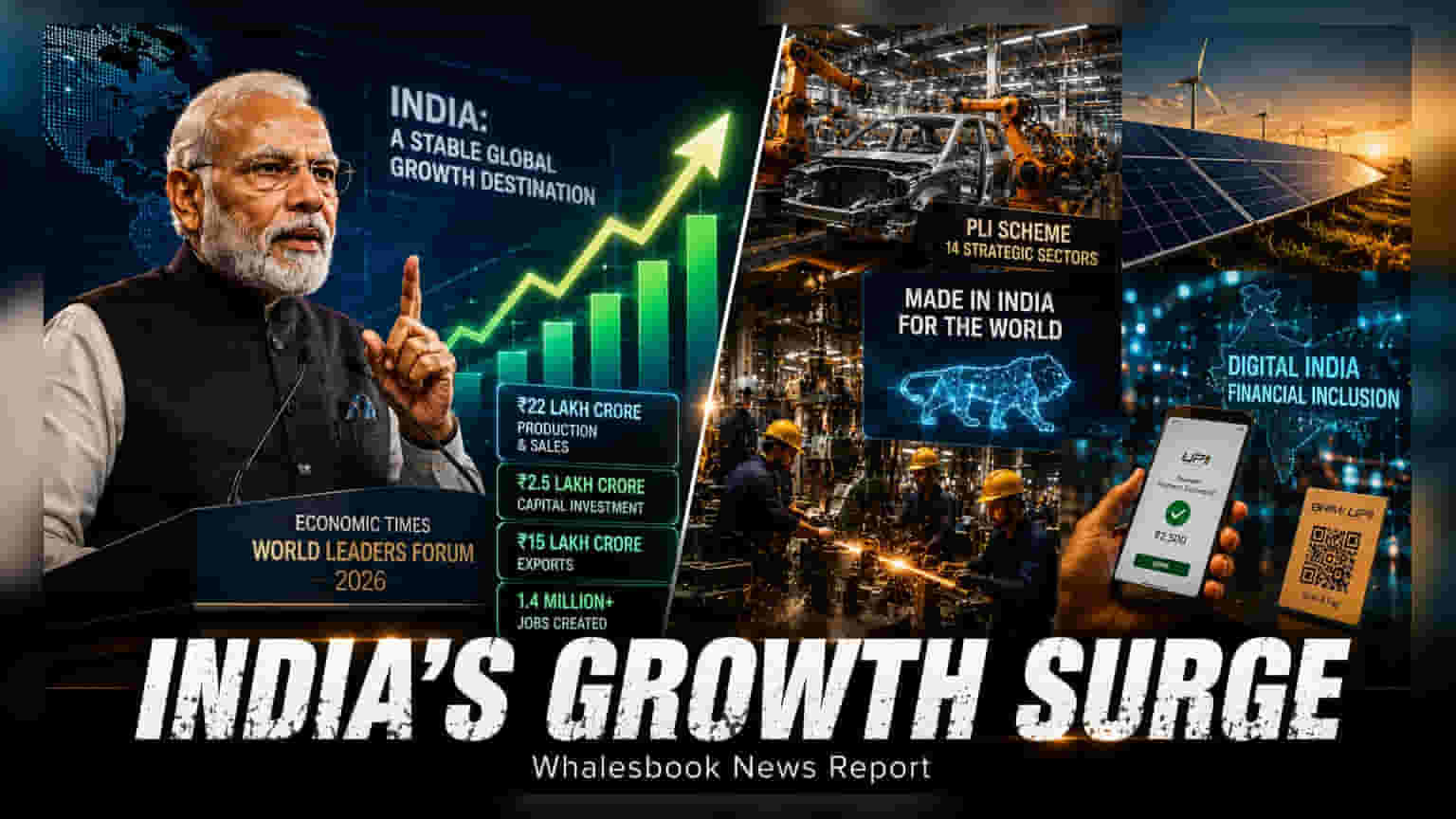
Prime Minister Narendra Modi announced that the PLI scheme has generated ₹22 lakh crore in production and ₹2.5 lakh crore in investment. The initiative covers 14 strategic manufacturing sectors. For investors, the long-term impact of these incentives on company profitability and export capacity remains a key indicator of the manufacturing sector's health.
Prime Minister Narendra Modi, while addressing the Economic Times World Leaders Forum on August 21, 2026, positioned India as a stable global growth destination. He highlighted the progress of the Production Linked Incentive (PLI) scheme, revealing that the initiative has already driven ₹22 lakh crore in total production and sales across the country.
The PLI scheme, which targets 14 strategic manufacturing sectors—including electronics, pharmaceuticals, and automobiles—has emerged as a central pillar of India's industrial strategy. Beyond production figures, the Prime Minister noted that the initiative has attracted ₹2.5 lakh crore in actual capital investment and contributed ₹15 lakh crore in exports, while generating over 1.4 million jobs.
Impact on Manufacturing and Compliance
This update is significant for investors as it points to a continued government focus on scaling domestic manufacturing capabilities. The Prime Minister contrasted the current incentive-led framework with the historical "Licence Raj" era, which he described as a period of restrictive growth. To support this industrial expansion, the administration has focused on reducing administrative friction, claiming to have removed over 40,000 compliance requirements and repealed 1,500 obsolete laws. These regulatory changes are designed to improve the ease of doing business, which could theoretically enhance the operational efficiency of large-scale manufacturing firms.
Sector Variations and Investment Outlook
While the aggregate numbers present a positive trend, the practical application of the PLI scheme has not been uniform across all 14 targeted sectors. Investors generally observe that sectors like electronics and pharmaceuticals have seen faster adoption and production ramp-ups compared to others. The effectiveness of these incentives often depends on specific localization thresholds, production timelines, and the ability of companies to manage global supply chain complexities.
Furthermore, the long-term success of these manufacturing initiatives faces risks from global economic uncertainties, including geopolitical shifts and potential disruptions in the export market. While the PLI scheme provides a financial boost, the final benefit to shareholders depends on the ability of individual companies to execute projects efficiently, manage debt, and maintain profit margins amidst competitive global pricing.
What Investors Should Monitor Next
For investors monitoring this space, the key to evaluating the success of the PLI scheme lies beyond the overall production numbers. The most important data points to track in upcoming quarters include company-specific utilization of these incentives, progress on localization targets, and export performance in global markets. Analysts and stakeholders will likely monitor management commentary regarding capital spending and the potential for these incentives to translate into sustainable revenue and earnings growth for beneficiaries in the manufacturing sector.