

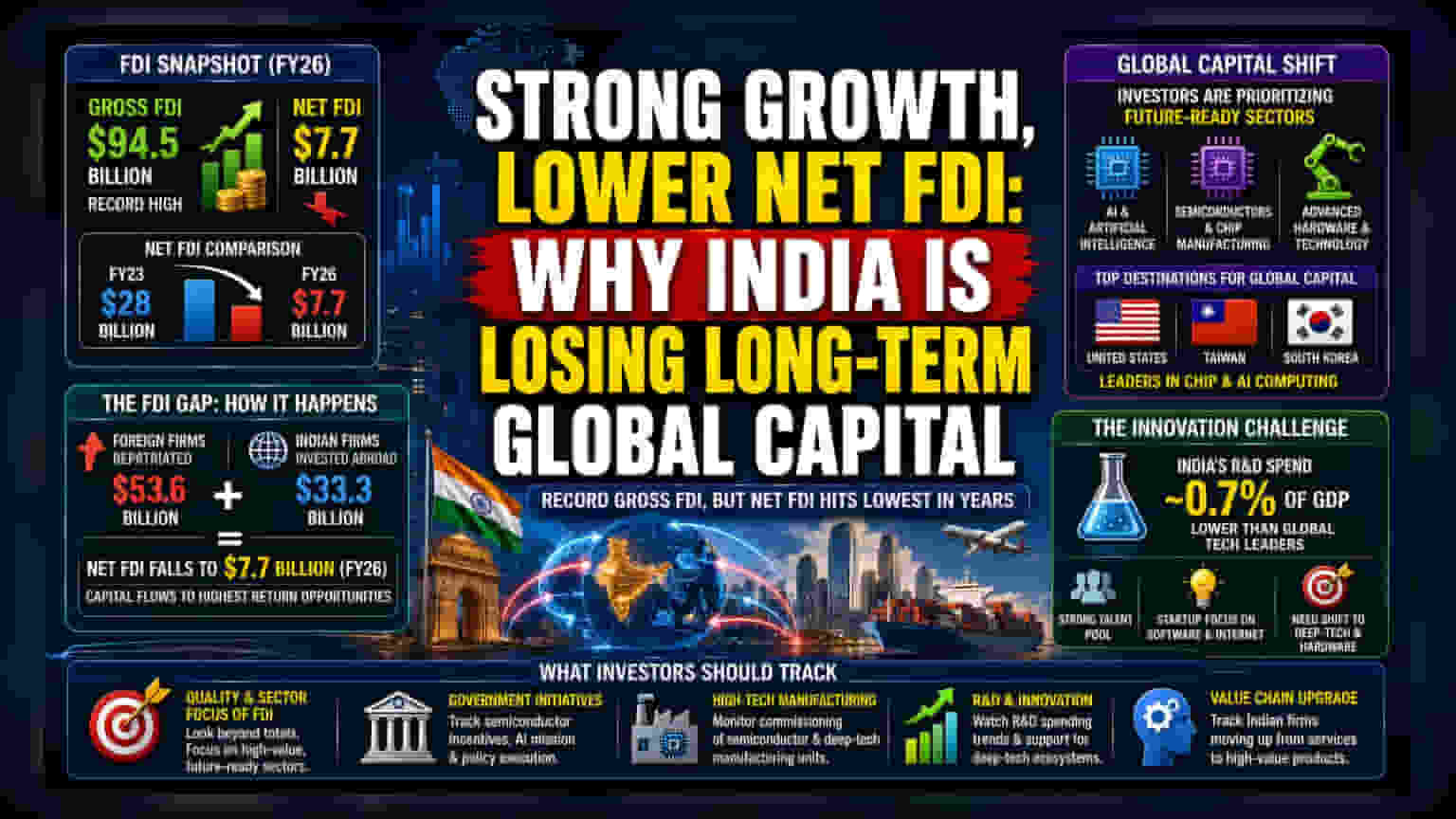
While India remains a fast-growing economy, its net foreign direct investment (FDI) has slowed to $7.7 billion in FY26. Investors are prioritizing AI and semiconductor-led growth in markets like the US and Taiwan over traditional expansion. This shift highlights the need for India to bolster its R&D and deep-tech capabilities to attract high-value global capital.
What Happened
India is experiencing a unique trend where strong economic growth is not automatically translating into high net foreign direct investment (FDI). While the country reported a record gross FDI of $94.5 billion in FY26, the net FDI—which accounts for money leaving the country—fell to $7.7 billion. This is a significant decline compared to the $28 billion recorded in FY23. This data suggests that while new money is still coming into India, large amounts are also flowing out, signaling that global capital is becoming more selective about where it parks long-term funds.
The Shift Toward AI And Hardware
Global investors are currently prioritizing sectors like artificial intelligence, semiconductors, and advanced hardware over general emerging market exposure. Countries like the United States, Taiwan, and South Korea have become primary destinations for this capital because they lead in chip manufacturing and AI computing. Unlike previous decades where investors were satisfied with broad economic growth in developing nations, today’s global capital is heavily focused on future profitability and technological leadership. This has created a competitive environment where nations without a strong foothold in deep-tech ecosystems may find it harder to retain long-term foreign investment.
The Mechanics Of The FDI Gap
To understand why net FDI is significantly lower than gross FDI, investors must look at capital outflows. In FY26, foreign firms repatriated $53.6 billion, meaning they moved their capital back to their home countries or other investments. Simultaneously, Indian companies themselves invested $33.3 billion abroad. This combination of foreign companies pulling out returns and domestic firms expanding internationally accounts for the sharp difference between gross inflows and net investment. It indicates that capital is moving toward the highest-return opportunities, regardless of geographical borders.
The R&D And Innovation Challenge
Economists have pointed to a gap in India’s innovation infrastructure as a barrier to attracting this new wave of tech-focused FDI. India’s research and development spending stands at approximately 0.7% of GDP, which is lower than many of the nations currently dominating the tech landscape. While India has a massive engineering talent pool, much of the startup success has historically been focused on software services and consumer-facing internet businesses. Transitioning toward cutting-edge hardware, semiconductors, and deep-tech research requires longer timelines and higher capital commitment, which is now the focus of global investors.
What Investors Should Track
For investors, the key monitorable is not just the total FDI figure, but the quality and sector focus of the investments. The government’s ongoing semiconductor incentive schemes and AI mission are attempts to bridge the gap in deep-tech capabilities. Tracking the progress of these initiatives, along with the actual commissioning of high-tech manufacturing units, will be critical. Additionally, investors should watch for any changes in R&D spending and the ability of Indian firms to move up the value chain from software services to high-value product manufacturing.