 Whalesbook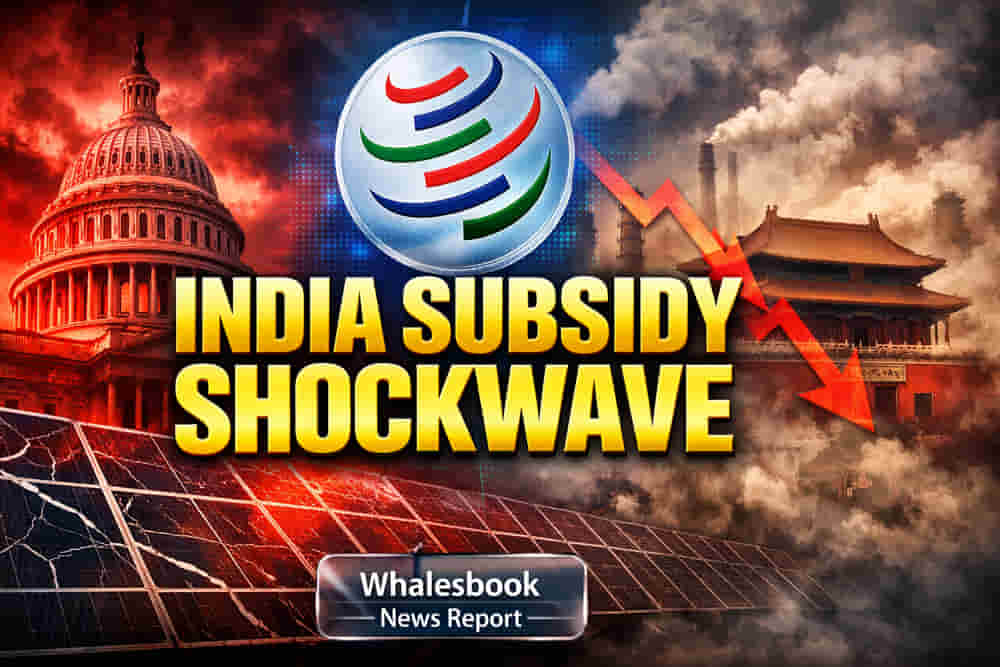
Growth Ambition Faces Global Scrutiny
India's ambitious push to become a global manufacturing superpower is encountering significant friction with key trading partners. The nation's flagship Production-Linked Incentive (PLI) scheme, designed to bolster domestic production across 14 sectors with an outlay of ₹1.91 lakh crore ($21 billion), is now under international fire. On February 25, 2026, the World Trade Organization's dispute settlement body agreed to establish a panel examining China's challenge to these incentive programs. Beijing contends that India's schemes in automotive and renewable energy unfairly advantage domestic goods over imports, creating disadvantages for Chinese products. This comes just after the U.S. Department of Commerce imposed preliminary duties of 126% on solar cells and modules imported from India, citing unfair subsidization of domestic manufacturing that undercuts American producers.
Trade Actions Disrupt Key Export Sectors
The U.S. solar tariffs are poised to effectively block Indian solar panel manufacturers, including prominent names like Waaree Energies Ltd, from the lucrative American market. This move follows a pattern of U.S. trade enforcement actions, notably a 2016 WTO ruling against India's solar localization rules. The U.S. imposed these preliminary duties after determining that Indian exporters, benefiting from subsidies, were disrupting market competitiveness. India, Indonesia, and Laos collectively represented 57% of U.S. solar module imports in the first half of 2025, with India alone seeing exports surge nine-fold to $792.6 million in 2024. The impact is already being felt, with reports suggesting that a lack of viable export markets may force Indian solar PV module makers to flood the domestic market, potentially leading to oversupply, as installed capacity (over 160 GW) far outstrips domestic demand (40-45 GW).
The WTO panel established at China's request will scrutinize whether India's PLI measures, particularly those linking incentives to domestic value addition (DVA), align with global trade rules. While India maintains that DVA measures economic value creation and is WTO-compliant, China argues it indirectly mandates the use of local components, violating national treatment principles.
Company Valuations Amidst Trade Tensions
Key beneficiaries of India's PLI scheme are facing increased market scrutiny. Waaree Energies, India's largest solar module manufacturer and exporter with a 21% market share in FY24, saw its stock price at ₹2,708.50 on February 24, 2026, with a market capitalization of ₹87,017 crore and a P/E ratio of 38.8. Despite a year-on-year gain of 35.41%, its stock has declined 5.18% over the last six months. Analyst ratings for Waaree are divided, with 69.23% recommending 'Buy' and 30.77% suggesting 'Sell'. Adani Enterprises, trading around ₹2,210.70 with a market cap near ₹2.5-2.8 lakh crore and P/E ratios fluctuating between 21 and 44, has seen modest year-on-year growth of 4.78% but a 3.09% decline in the past six months. Reliance Industries, India's largest conglomerate by market cap (~₹19.35 lakh crore), traded at ₹1,398.50 with a P/E ratio ranging from 22.7 to 48.9. It shows a year-on-year gain of 16.15% but a 1.00% dip in the last six months. Analyst sentiment for Reliance remains strongly positive, with 91.18% recommending 'Buy'.
The Structural Weakness Case
Beyond the immediate trade disputes, structural challenges and uneven performance within India's manufacturing sector persist. While flagship schemes have spurred significant investment, exceeding ₹2.16 lakh crore across 14 sectors, some areas, including solar modules, have lagged behind targets. Reports suggest that a uniform incentive structure may not adequately address sector-specific needs, particularly for capital-intensive industries. Furthermore, in the mobile manufacturing sector, a substantial portion of domestic PLI firms have not met their performance thresholds, raising questions about the efficacy of output-linked incentives. India's historical manufacturing export growth has been robust, with engineering exports reaching a record $116.67 billion in FY24-25, and total merchandise exports valued at $374.1 billion in FY24-25. However, these gains are now at risk from protectionist measures and ongoing trade disputes.
Shifting Industrial Policy Outlook
India's aspiration to raise manufacturing's share in GDP from approximately 17% to 25% faces a critical juncture. The mounting pressure from global trading partners could complicate New Delhi's economic strategy. While schemes like PLI are considered vital for manufacturing revival, trade economists suggest exploring alternative support mechanisms, such as increased investment in technology and innovation. The government is reportedly exploring options like factory construction subsidies, signaling a potential evolution in its industrial policy approach. The long-term success of India's manufacturing surge hinges on navigating these complex trade waters while fostering deeper integration into global value chains and adapting policies to sector-specific dynamics.