

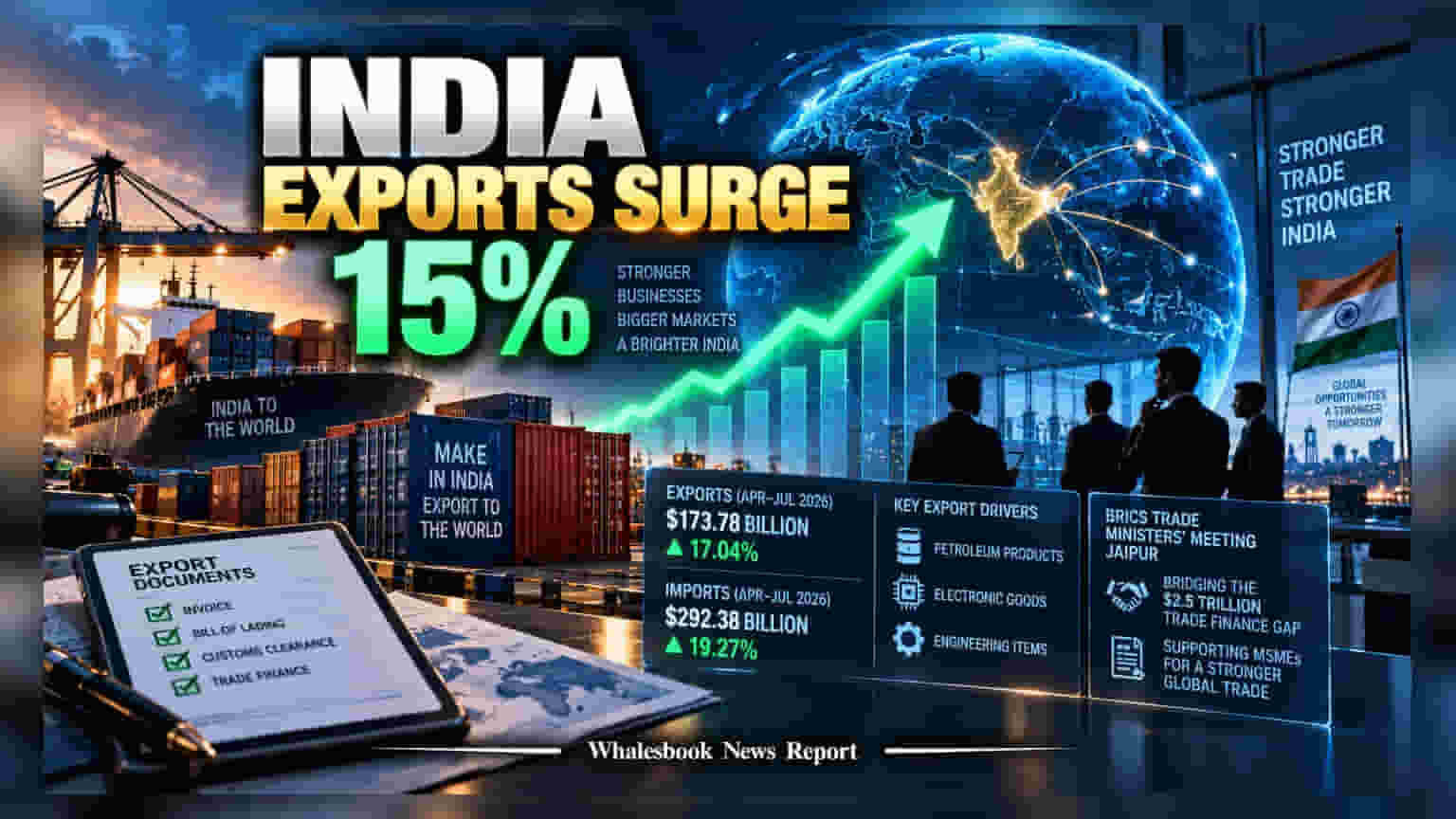
India's merchandise exports grew by over 15% in the first five months of the current fiscal year despite global economic volatility. While sectors like electronics and engineering remain strong, investors should note that imports are also rising, leading to a wider trade deficit. The government is now pushing for deeper trade finance solutions through BRICS to support exporters.
India’s merchandise exports have shown resilience, recording a growth of over 15% during the first five months of the fiscal year 2026-27, which spans from April to August. This performance comes despite significant global hurdles, including geopolitical tensions and supply chain disruptions that have impacted trade routes and slowed growth in many major economies.
Data from the April-July 2026 period highlights the scale of this activity. Exports reached $173.78 billion, representing a 17.04% increase. However, imports during the same period also climbed, rising 19.27% to $292.38 billion. For investors and market observers, this indicates a widening trade deficit, which is a key area to monitor as it affects the country's current account balance and overall financial stability.
Growth in the export sector has been primarily driven by high-demand categories such as petroleum products, electronic goods, and engineering items. These sectors have helped maintain momentum even as other global regions struggle with inflation and restrictive monetary policies.
To further support this growth and protect businesses from future uncertainty, the government is focusing on structural improvements in trade finance. At the recent 16th BRICS Trade Ministers' Meeting in Jaipur, India advocated for the 'Jaipur Consensus.' A major goal of this initiative is to bridge the trade finance gap, estimated at $2.5 trillion globally, which often restricts small and medium enterprises (MSMEs) from entering international markets. The proposed solution involves implementing a BRICS-wide invoice discounting mechanism. This would allow smaller exporters to receive payments faster by turning their pending invoices into immediate cash, reducing the reliance on traditional, slower credit lines.
While the export growth trend is positive, the broader economic context remains complex. Geopolitical conflicts have made traditional maritime routes less predictable, and there is a continued risk of global demand slowing down. Additionally, the rapid rise in import costs compared to export earnings requires careful monitoring, as it places pressure on the balance of payments. Looking ahead, investors should keep an eye on the official trade data release scheduled for September 15, 2026, which will provide further clarity on the trade deficit trend and the performance of key sectors.