

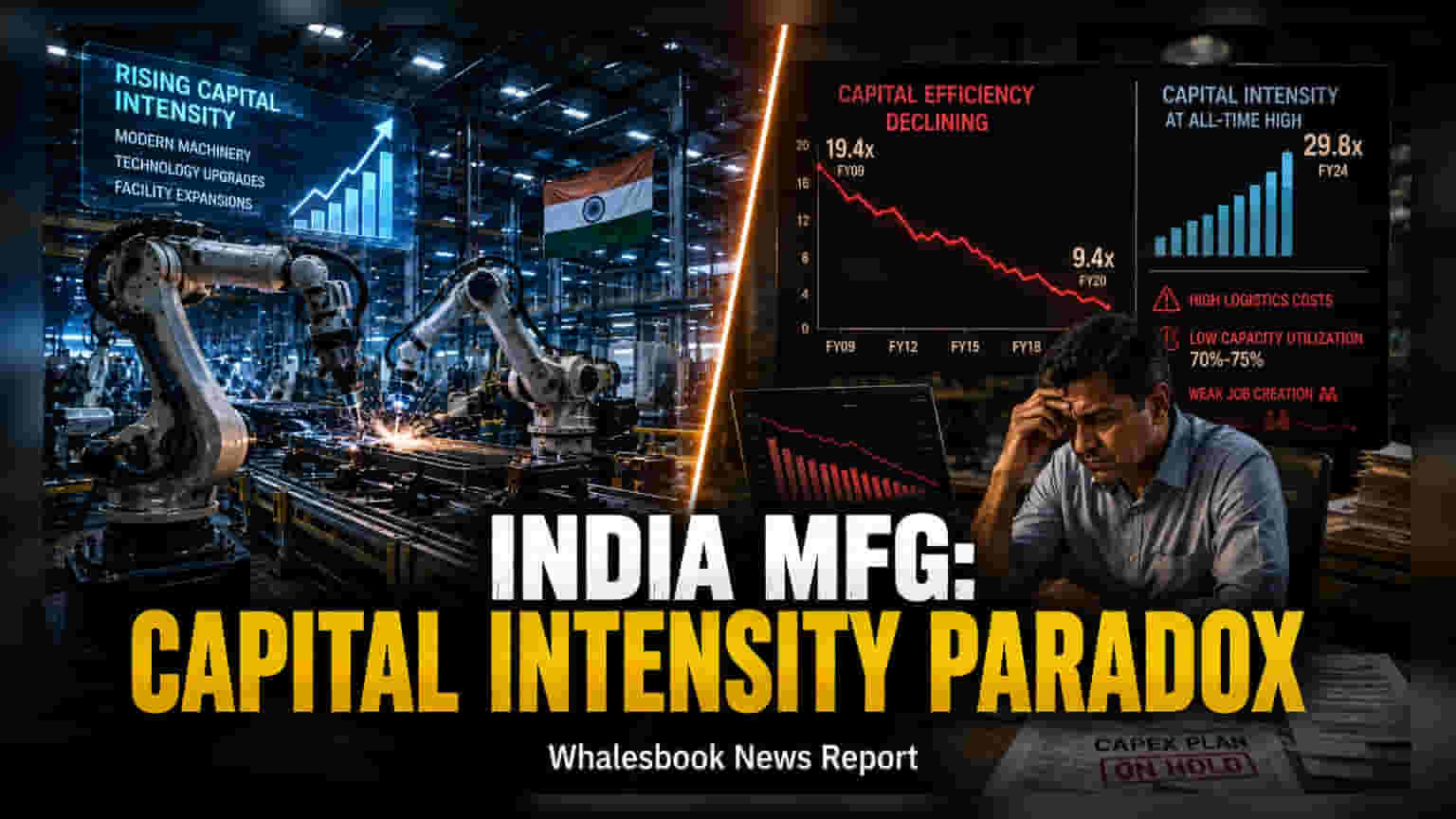
India’s manufacturing sector is witnessing a trend where companies are spending more on capital equipment, but receiving lower returns in efficiency. This shift is creating a cycle that limits new large-scale projects and impacts job growth. Understanding this trend is important for assessing the long-term health and investment appetite of India’s industrial sector.
India’s manufacturing sector is currently navigating a structural challenge often described by economists as a 'capital intensity paradox.' While companies are investing heavily in new machinery, technology, and facility upgrades, the efficiency with which this capital generates output has been trending downward for nearly two decades. This trend, highlighted by recent industry data, is reshaping how businesses approach expansion and investment decisions.
Why Capital Efficiency Is Falling
Recent analysis shows that the capital intensity of the Indian manufacturing sector—the amount of money spent on fixed assets relative to the size of the business—reached an all-time high of 29.8x in FY24. While this indicates a commitment to modernization, it has not translated into proportional growth in output. In fact, capital efficiency, which measures the return generated from invested capital, dropped from 19.4x in FY09 to 9.4x by FY20.
This gap suggests that structural hurdles, such as high operational costs and logistical inefficiencies, are forcing companies to deploy more capital just to maintain their current competitive position. Simply put, manufacturers are having to spend more to produce the same amount, which squeezes profit margins and reduces the effectiveness of new investments.
Impact On Business Expansion
This phenomenon has led to a noticeable shift in corporate strategy. Despite healthy balance sheets in many sectors, there is a visible hesitation toward broad-based greenfield capital expenditure—investing in entirely new factories or greenfield projects. Instead, companies are increasingly choosing brownfield expansions, which involve upgrading or expanding existing facilities.
This preference for brownfield expansion is a direct result of the diminishing returns on capital. When the expected efficiency of a new, large-scale project is low due to logistical costs or market dynamics, businesses are more likely to minimize risk by sticking to existing sites where infrastructure and supply chains are already established.
The Cycle Of Consumption And Jobs
There is also a broader economic link between this trend and domestic consumption. As manufacturing becomes more capital-intensive, it often requires fewer workers per unit of output. This limits the growth of formal employment in the sector. When job growth is constrained, household income and overall consumer demand may not rise fast enough to absorb the production capacity of these manufacturing plants.
Reserve Bank of India (RBI) data supports this, with capacity utilization in the manufacturing sector hovering between 70% and 75% since FY16. This creates a feedback loop: companies hesitate to build new capacity because consumer demand is moderate, and demand remains moderate partly because the sector is not generating enough new, high-quality jobs to support consumption.
Looking Ahead
For the industry to break this cycle, the focus is shifting toward productivity and structural reforms. While government initiatives like the Production Linked Incentive (PLI) scheme and Atmanirbhar Bharat aim to boost capacity, the long-term sustainability of the sector depends on increasing total factor productivity.
Investors and market participants should track whether future capital spending leads to genuine gains in efficiency or if companies continue to struggle with the 'paradox' of high spending without proportionate output growth. Real progress will likely require businesses to move beyond simple capacity expansion and focus on innovation and technology that improves how capital is utilized across the entire value chain.