India's Labour Codes Unleashed: Are Worker Protections Vanishing as Corporate Power Soars?

Overview
India has enacted four new Labour Codes, consolidating 29 central laws. While promoted as simplification for business, critics argue these codes deliberately shift regulatory power from states to private capital. They significantly weaken pillars of labour protection, including state enforcement, job security, and collective bargaining power, prioritizing corporate flexibility over workers' constitutional guarantees.
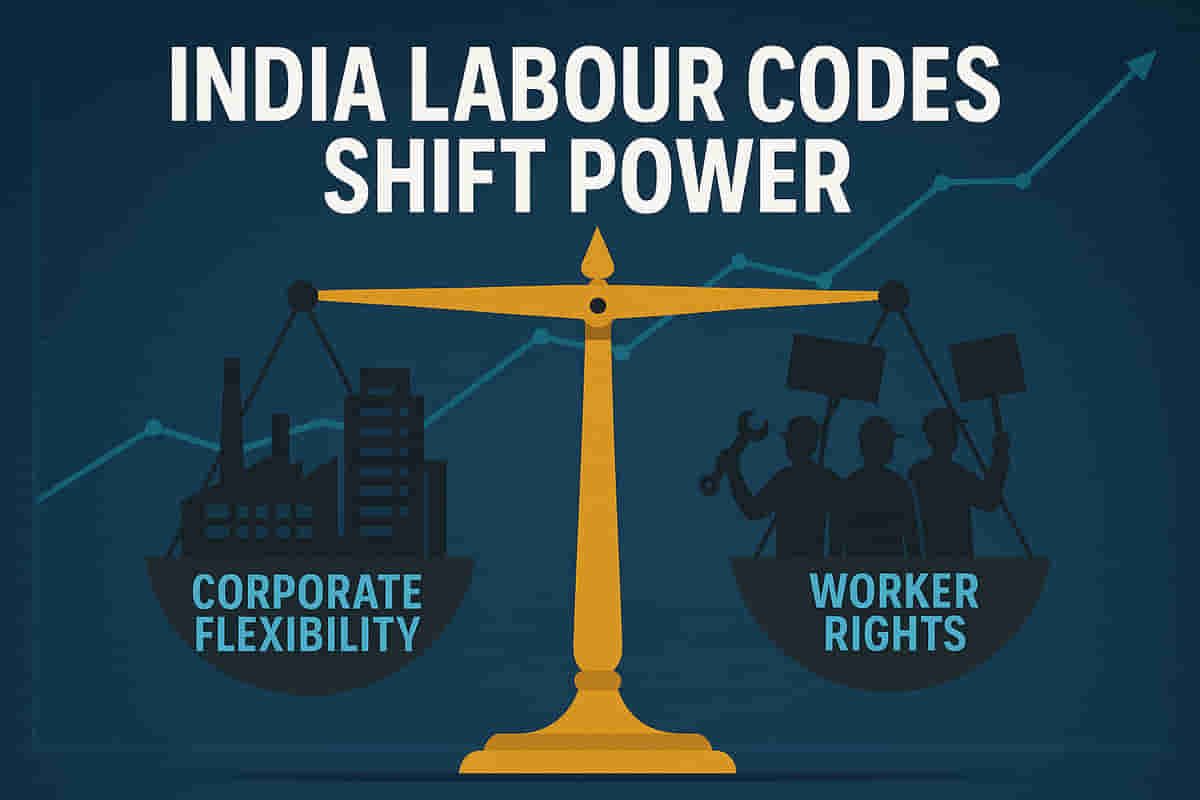
India has officially brought into force four new Labour Codes: the Code on Wages, 2019; the Industrial Relations Code, 2020; the Code on Social Security, 2020; and the Occupational Safety, Health and Working Conditions Code, 2020. These codes consolidate 29 central enactments into a unified framework, intended to simplify regulations and boost investment.
However, a closer analysis suggests a significant shift in legislative priorities, favouring private capital and corporate flexibility over established labour protections.
State Enforcement Weakened
- The traditional role of the labour inspector, empowered to conduct unannounced checks and initiate prosecutions, has been significantly altered under the Occupational Safety, Health and Working Conditions (OSH) Code, 2020.
- Inspectors are now redesignated as "inspector-cum-facilitators," with a primary role of advising employers. Inspections follow a randomized schedule, eliminating the element of surprise critical for detecting covert violations.
- For many first-time offences, facilitators must provide employers an opportunity to comply before prosecution, effectively turning violations like non-payment of wages or safety breaches into administrative issues rather than criminal wrongs.
- This approach contrasts with ILO Convention No. 81, which India ratified, emphasizing empowered, unannounced inspections.
- The Code on Wages, 2019, introduces compounding for first-time offenders, allowing them to settle violations by paying up to 75% of the maximum fine, and decriminalizes offenses like non-payment of minimum wages, replacing potential imprisonment with monetary penalties.
Rise of 'Hire-and-Fire'
- The Industrial Relations Code, 2020, raises the threshold for requiring prior government permission for layoffs, retrenchment, or closures from 100 to 300 workers under Section 77.
- This exemption impacts a large segment of formal-sector establishments, potentially leading to unilateral employer decisions on workforce size.
- Furthermore, Section 77(2) allows the government to increase this threshold further through notification without parliamentary oversight, risking a "race to the bottom" among states seeking investment.
- The result is a move towards a "just-in-time" workforce, where human labour is treated as a flexible input.
Collective Bargaining Under Pressure
- The Industrial Relations Code, 2020, introduces significant procedural hurdles for exercising the right to strike and collective bargaining.
- A mandatory 14–60 day notice is now required for all industrial establishments before a strike, and any strike during conciliation proceedings is deemed illegal, removing the tactical advantage of surprise.
- Union recognition requirements, mandating 51% support for sole negotiating agent status, can lead to fragmentation in workplaces with multiple small unions, making it harder for workers to form a cohesive bargaining unit.
- Penalties for "illegal strikes" have been dramatically increased, creating a chilling effect on industrial action.
Gig Worker Protections and Deregulation
- While the Code on Social Security, 2020, includes gig and platform workers, substantive protections are minimal, with schemes being optional ("may frame") and contribution mechanisms left to future notification.
- Gig workers are not classified as employees, excluding them from protections against retrenchment, trade union rights, and access to industrial tribunals.
- The OSH Code, 2020, expands thresholds for applicability, such as allowing 12-hour workdays (while retaining the 48-hour weekly cap) and raising the threshold for contract labour applicability from 20 to 50 workers.
- The repeal of the Inter-State Migrant Workmen Act, 1979, eliminates specific entitlements for migrant workers, increasing their precarity.
A Coherent Design for Flexibility
- Taken together, the Labour Codes reflect a deliberate legislative philosophy focused on maximizing corporate flexibility by weakening enforcement, diluting job security, fragmenting collective power, and offering only symbolic recognition to gig workers.
- This redesign subordinates human dignity and worker rights to market efficiency, raising constitutional questions about the cost of economic growth.
Impact
- The new Labour Codes are expected to significantly alter the industrial landscape in India. Businesses may benefit from increased operational flexibility and reduced compliance burdens, potentially attracting investment. However, workers could face diminished job security, weaker bargaining power, and reduced enforcement of safety and wage standards. This shift could lead to increased industrial disputes if not managed carefully, and potentially impact overall labour productivity and social equity. The long-term effects on the Indian economy and its workforce remain to be seen.
- Impact Rating: 9/10
Difficult Terms Explained
- Labour Codes: A set of four new laws passed in India that consolidate and reform various existing labour and industrial laws, aiming to simplify regulations.
- Central enactments: Laws passed by the national government of India.
- Regulatory framework: A system of rules, laws, and guidelines established by an authority to govern a specific area.
- Private capital: Funds or assets owned by individuals or corporations, not the government.
- Industrial jurisprudence: The body of laws, legal principles, and court decisions related to industrial relations and labour matters.
- State enforcement: The process by which government agencies ensure that laws and regulations are obeyed.
- Security of tenure: The right of an employee to keep their job and not be dismissed unfairly.
- Collective bargaining: A process of negotiation between employers and a group of employees aimed at reaching agreements to regulate working conditions.
- Corporate flexibility: The ability of a company to adapt its operations, workforce, and strategies quickly in response to market changes.
- Constitutional guarantees: Fundamental rights and protections provided by a country's constitution.
- Articles 21, 39, 41, 42 and 43: Specific articles in the Constitution of India that relate to the right to life and personal liberty, directive principles of state policy concerning adequate means of livelihood, right to work, education, public assistance, just and humane conditions of work, and living wages.
- Factories Act, 1948: An Indian law that regulates working conditions in factories.
- Occupational Safety, Health and Working Conditions (OSH) Code, 2020: One of the new Labour Codes focusing on workplace safety, health, and working conditions.
- Inspector-cum-facilitator: A redesigned role for labour inspectors, focusing more on advice and facilitation rather than strict enforcement.
- ILO Convention No. 81: An International Labour Organization convention promoting effective labour inspection systems.
- Decriminalisation: The process of removing criminal penalties for certain acts, often replacing them with fines or other civil sanctions.
- Code on Wages, 2019: One of the new Labour Codes, consolidating laws related to wages, bonus, and payment of wages.
- Compounding: A legal process where a case is settled by the offender paying a sum of money, typically a fine, to avoid prosecution or further proceedings.
- Minimum Wages Act, 1948: An Indian law that ensures minimum wages are paid to workers in scheduled employments.
- Monetary penalties: Fines or financial punishments imposed for violations of laws or regulations.
- Industrial Disputes Act, 1947: An Indian law that governs industrial relations and dispute resolution.
- Layoffs: Temporary or permanent cessation of employment due to business reasons.
- Retrenchment: Termination of employment by the employer for reasons other than misconduct, often due to redundancy.
- Closure: The permanent shutting down of a business or establishment.
- Public scrutiny: Examination or review by the public or media.
- Industrial Relations Code, 2020: One of the new Labour Codes, dealing with trade unions, conditions of employment, and industrial disputes.
- Appropriate government: Refers to the government (Central or State) that has jurisdiction over a particular matter under law.
- Parliamentary oversight: The review or monitoring of government actions by the legislature (Parliament).
- Race to the bottom: A situation where governments reduce standards (e.g., environmental, labour) to attract or retain businesses.
- Executive notifications: Official announcements or orders issued by the executive branch of government.
- Just-in-time workforce: A labour model where workers are hired or utilized only when needed, akin to just-in-time manufacturing.
- Lean manufacturing: A production strategy focused on minimizing waste and maximizing efficiency.
- Article 19(1)(c): Article in the Indian Constitution that guarantees freedom of association.
- Freedom of association: The right of individuals to form or join groups, unions, or organizations.
- Supreme Court: The highest judicial court in India.
- Industrial democracy: A system where workers have a say in the decision-making processes of their workplace.
- Public utility services: Services essential to the public, often subject to special regulations (e.g., water supply, electricity).
- Conciliation proceedings: A process where a neutral third party attempts to help parties in a dispute reach a voluntary settlement.
- Negotiating agent: An entity (usually a trade union) authorized to represent workers in collective bargaining.
- Negotiating council: A body formed to represent workers in negotiations when no single union has majority support.
- Code on Social Security, 2020: One of the new Labour Codes, aiming to provide social security benefits to workers.
- Gig workers: Independent contractors who are paid for individual tasks or 'gigs'.
- Platform workers: Workers who find work through online platforms (e.g., ride-sharing, delivery services).
- Social protection: Measures taken to reduce poverty and vulnerability, such as social insurance, social assistance, and labour market policies.
- Aggregators: Companies that provide a platform connecting service providers (like drivers or delivery personnel) with customers.
- Industrial tribunals: Quasi-judicial bodies established to adjudicate industrial disputes.
- Standing orders: Rules relating to the terms and conditions of employment that an industrial establishment must get certified and display.
- Welfarist containment zone: A hypothetical state where limited welfare measures are provided without granting substantive enforceable rights.
- Inter-State Migrant Workmen Act, 1979: An old law that provided specific protections and entitlements to workers migrating between states for employment.
- Displacement allowance: Compensation paid to workers for the costs associated with relocating for employment.
- Journey allowance: Payment to workers to cover travel expenses.
- Grey zones: Areas where regulations are unclear or absent, creating ambiguity in legal protections.
- $5-trillion economy: India's stated economic goal of reaching a Gross Domestic Product (GDP) of $5 trillion.
Other Sector

Rupee Breaches 90! Can RBI's Move Save India's Currency?
Personal Finance Sector