

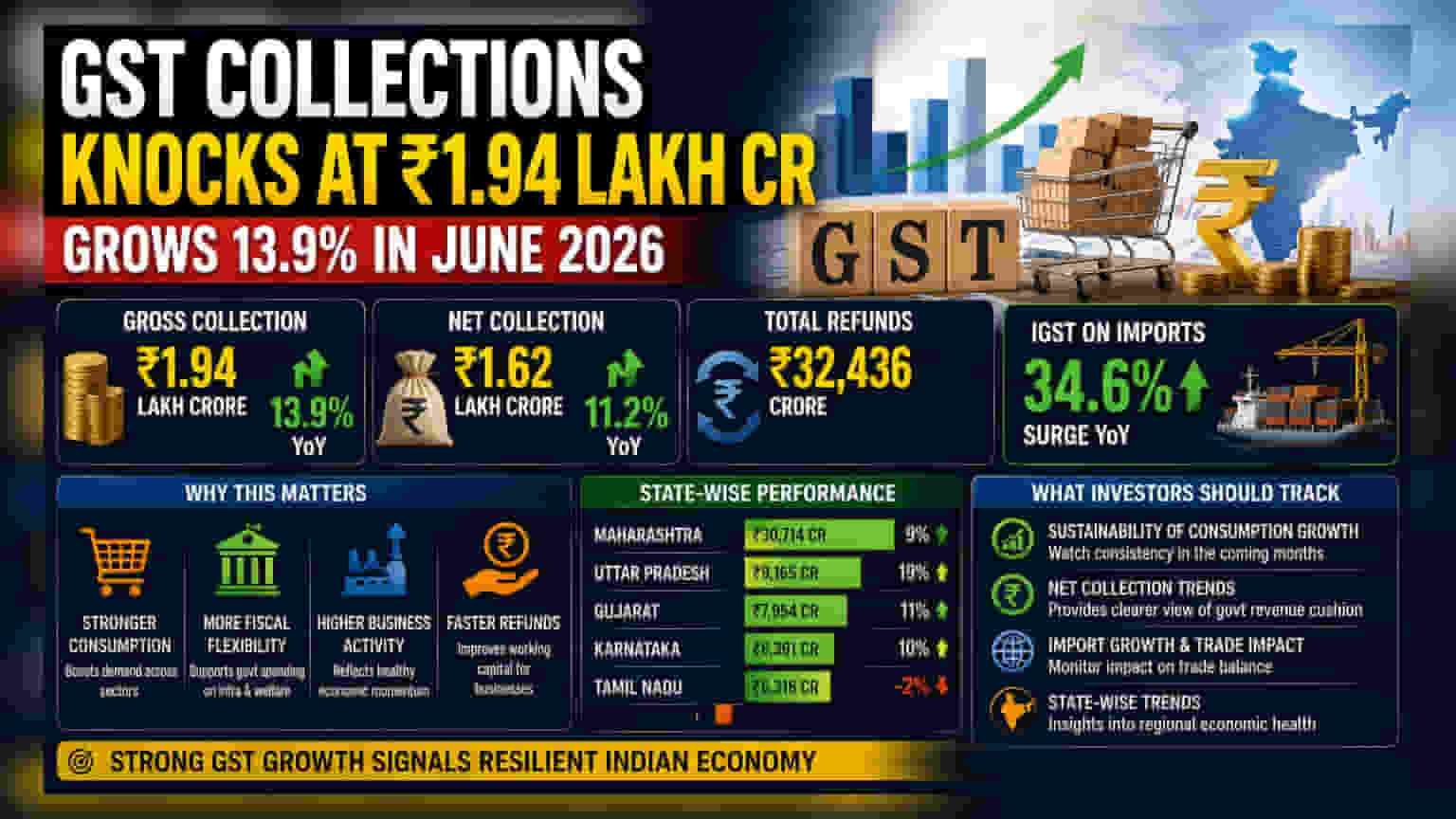
India’s GST collections reached ₹1.94 lakh crore in June, a 13.9% year-on-year increase, signaling resilient domestic consumption. Net revenue after refunds climbed 11.2% to ₹1.62 lakh crore. The data highlights strong domestic demand, though a sharp rise in tax refunds suggests faster processing of business claims.
What Happened
India’s Goods and Services Tax (GST) collections for June 2026 stood at ₹1.94 lakh crore, recording a 13.9% growth compared to the same month last year. The gross collection figure reflects a steady pace in tax revenue for the government. After accounting for tax refunds, which are payments returned to businesses, the net revenue collected was ₹1.62 lakh crore, an 11.2% increase year-on-year. This data, released by the Finance Ministry, serves as a high-frequency indicator of domestic economic activity.
Why This Matters For The Economy
For investors, rising GST collections are often viewed as a proxy for the health of the Indian consumer. When GST revenue grows, it typically implies that the purchase of goods and services is increasing across the country. This trend is relevant for companies in sectors like automotive, fast-moving consumer goods (FMCG), and retail, as it suggests that domestic demand remains intact despite global economic pressures. Consistent tax intake also provides the government with the fiscal flexibility to continue its spending on infrastructure and social projects, which supports the broader economic cycle.
The Import And Refund Dynamics
A notable highlight in the June data is the 34.6% surge in Integrated GST (IGST) collected on imports. This sharp increase points to higher demand for imported goods or capital machinery within the country. While this indicates business activity, it also bears watching for its impact on the trade balance. Additionally, the 29.1% spike in total refunds, which reached ₹32,436 crore, is a significant operational detail. Faster processing of refunds is generally positive for corporate cash flows, especially for export-oriented sectors or businesses with large accumulated input tax credits, as it improves their working capital position.
State Performance Trends
The regional breakdown shows varied growth across states. Maharashtra maintained its position as the largest contributor, with collections reaching ₹30,714 crore, reflecting a 9% rise. Uttar Pradesh stood out among major states by recording the highest growth rate at 19%, collecting ₹9,165 crore. Other key states like Gujarat and Karnataka also reported double-digit growth. Conversely, Tamil Nadu saw a 2% decline in collections, a figure that analysts often examine to understand local sector-specific slowdowns or base-effect anomalies.
What Investors Should Track
Going forward, the key factor for investors is the sustainability of this consumption growth. While the headline growth numbers are strong, it is important to monitor whether this pace continues in the coming months without being skewed by import volatility. Investors may also look for trends in the 'net' collection figures in future reports, as these provide a clearer picture of the government’s actual revenue cushion. Any changes in compliance patterns or shifts in state-wise growth will provide further insights into regional economic health.