

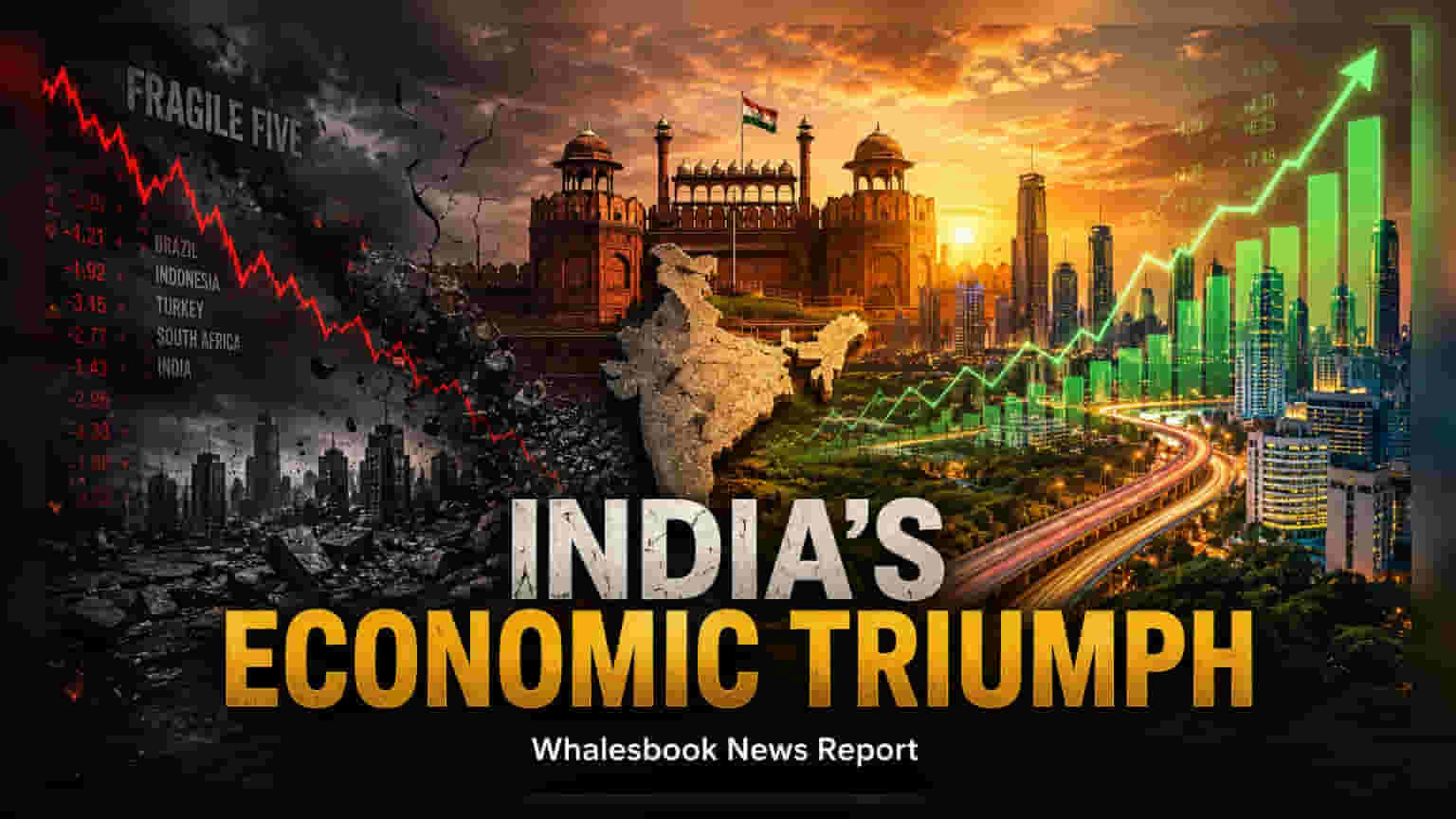
India’s shift from the 'Fragile Five' to the world's fastest-growing major economy marks a significant 12-year economic transition. As Prime Minister Modi highlights this progress on the 80th Independence Day, investors are balancing the strong 7.7% GDP growth against current hurdles like rupee depreciation and future growth forecasts.
On India’s 80th Independence Day, Prime Minister Narendra Modi reflected on the country’s economic evolution over the past 12 years. The government’s narrative centers on India’s transition from being labeled one of the 'Fragile Five' economies in 2013—a group identified by Morgan Stanley as vulnerable to global financial shocks—to holding the position of the world's fastest-growing major economy.
Financial data supports this growth momentum, with India’s real GDP estimated to have expanded by 7.7% in FY2025-26. This has pushed India’s nominal GDP to approximately $3.92 trillion, keeping it among the largest economies globally. The Prime Minister noted that this progress, characterized by significant jumps in defense, electronics, and digital transactions, aligns with the long-term vision of becoming a developed nation by 2047.
While the headline growth numbers reflect strength, market participants and investors are also assessing the current economic environment, which includes several complexities. A primary focus area for the markets is the stability of the Indian rupee. In the first half of 2026, the currency faced depreciation, crossing the ₹95 mark against the US dollar by April. This movement impacts import costs and inflation, which directly affects profit margins for various domestic sectors, particularly those reliant on global supply chains or raw materials denominated in foreign currency.
Furthermore, while the 7.7% growth rate for the current fiscal year highlights resilience, economic forecasts suggest a period of moderation. Projections for FY2026-27 currently range between 6.6% and 7.2%. This expected cooling reflects the natural cycle of growth, where temporary policy-driven boosts begin to normalize and global economic uncertainties, such as fluctuating oil prices and geopolitical tensions, exert pressure on the domestic economy.
For investors, the contrast between the long-term growth story and short-term volatility is crucial. The 'Viksit Bharat' or Developed India roadmap emphasizes domestic manufacturing and self-reliance, which may benefit specific industrial sectors over time. However, the immediate challenge remains the interplay between high growth, currency value, and the government's ability to maintain a fiscal balance while pushing for structural reforms.
The key monitorables for the coming quarters will be how domestic demand sustains against a potential moderation in growth, how the Reserve Bank of India manages currency volatility, and whether the planned legal and institutional reforms can provide the necessary support for private investment. Investors may track these variables to understand how the broader economic transition impacts sector-specific performance in the near term.