

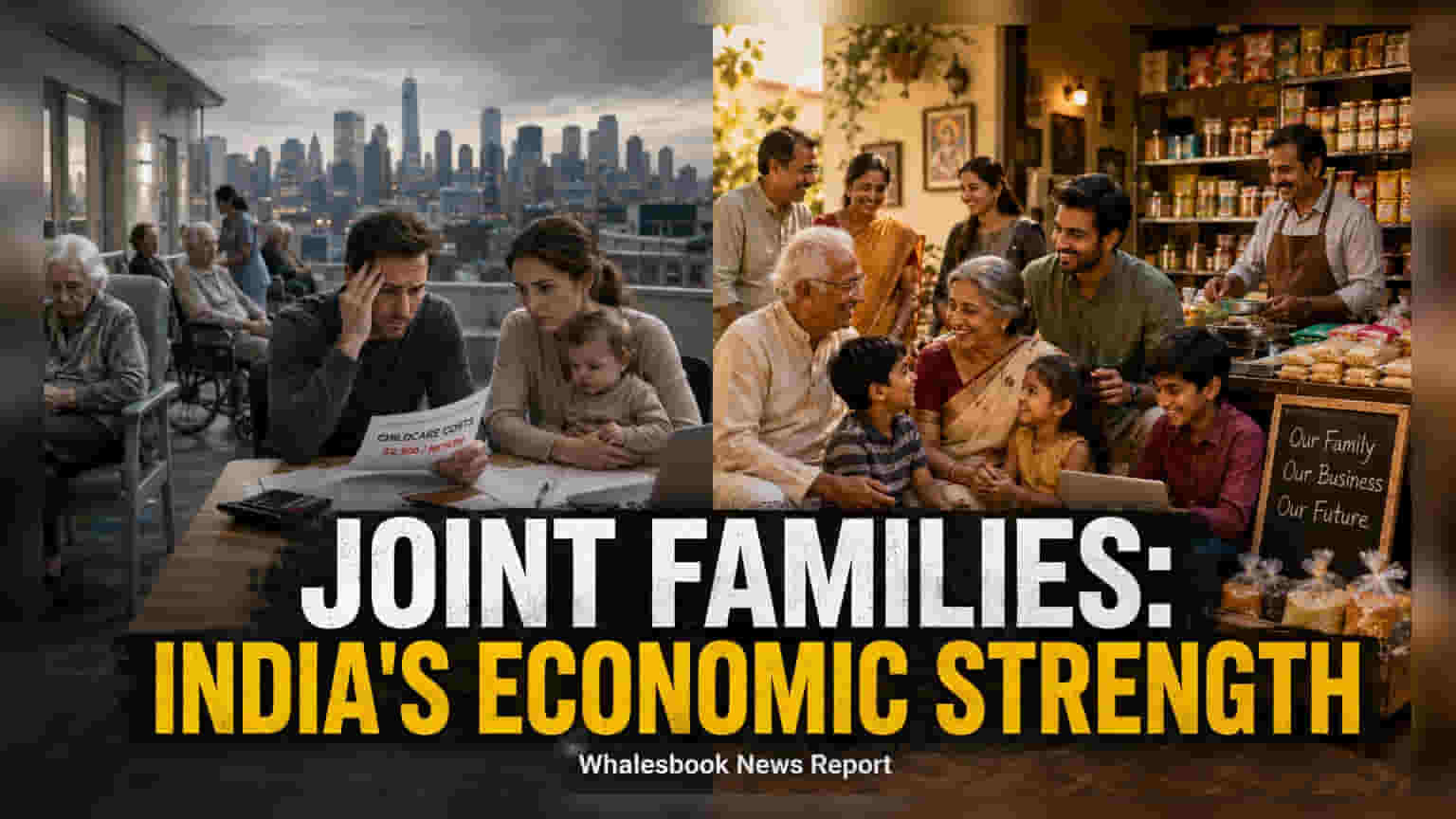
A recent economic discourse highlights the 'Kutumb' system as a vital safety net that reduces state fiscal pressure by sharing caregiving costs. This model contrasts with Western individualistic systems where essential services are often monetized. For the broader economy, understanding this structure is essential as it influences consumption patterns, real estate demand, and household spending power.
A new economic debate is gaining traction, focusing on whether India's traditional joint family system, or 'Kutumb', acts as a significant shock absorber for the national economy. The core argument suggests that this structure provides a unique, cost-free safety net for childcare and eldercare, services that otherwise place a heavy financial burden on state infrastructure in countries that have shifted toward nuclear or individualistic models.
In Western economic frameworks, tasks like raising children or caring for the elderly are often outsourced to commercial providers. This shift monetizes everyday life but also creates long-term state liabilities, as governments are frequently required to subsidize these essential social services through welfare programs. Proponents of the 'Kutumb' model argue that India’s ability to keep these responsibilities within the family unit helps preserve fiscal resources and allows for a different, more localized form of economic stability.
This perspective has moved beyond theoretical discussion into institutional focus. The Rashtriya Swayamsevak Sangh (RSS) has actively promoted the 'Kutumb Prabodhan' initiative, aiming to reinforce these traditional family structures as part of its wider organizational agenda. Simultaneously, the Indian Council of Social Science Research (ICSSR) has launched dedicated research into the 'Family and Family System in India,' signaling that policymakers and academics are increasingly interested in how these social units function as ecosystems of economic and emotional interdependence.
For investors and market analysts, the persistence of the joint family system has tangible impacts on consumption behavior. Large households often drive demand for different types of goods compared to nuclear families. For instance, joint families tend to favor bulk purchases and value packs, which is a critical trend for FMCG companies. In the real estate sector, the preference remains for larger, multi-room living spaces, whereas the shift toward nuclear families often accelerates the demand for multiple smaller, individual residential units. Financial services also see a ripple effect, as family-based credit and support networks can sometimes reduce the immediate reliance on institutional loans for early-stage entrepreneurial ventures.
However, the viability of this model is not without significant pressure. Rapid urbanization and the necessity for internal migration are causing a natural shift toward nuclear households. Many younger Indians are moving to cities for work, which physically separates them from the joint family unit. This change in living arrangements is putting a strain on the traditional caregiving model, potentially increasing the demand for professional childcare and eldercare services in the coming years. Investors and companies must track these demographic shifts, as the transition away from joint families could lead to a structural change in how Indian households allocate their income, impacting sectors from insurance and healthcare to retail and housing.