

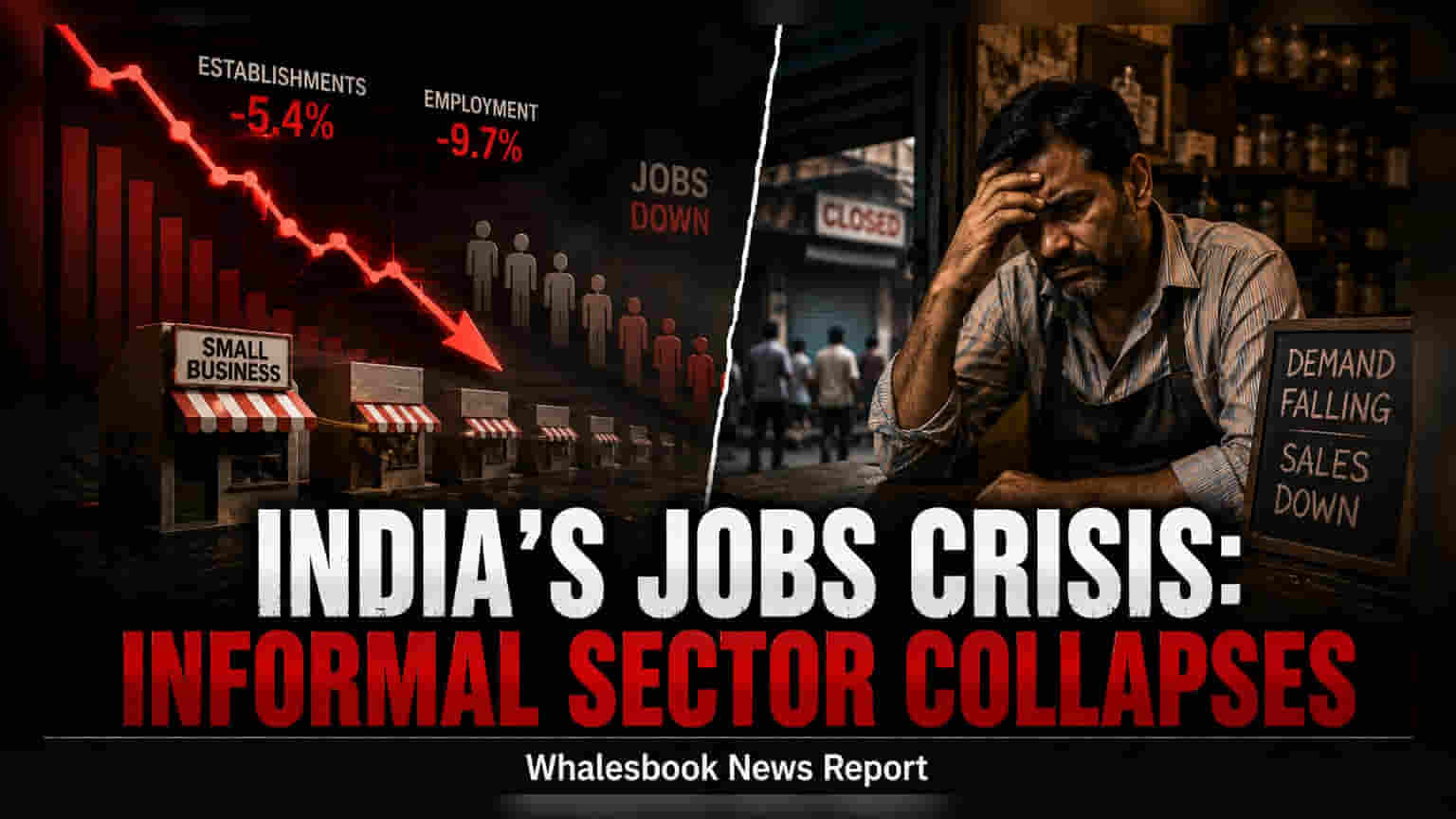
The National Statistics Office reported that India's unincorporated non-farm sector grew year-on-year in the April-June 2026 quarter, with establishments up 9.2%. However, the sector faced a sharp sequential contraction compared to the March 2026 quarter. Investors are tracking this data as a signal for potential cooling in rural consumption and trade activity.
The National Statistics Office (NSO) recently released its Quarterly Bulletin on Unincorporated Sector Enterprises (QBUSE), revealing a mixed picture for India's massive informal economy for the April-June 2026 period. On a year-on-year basis, the sector demonstrated growth, with the total number of non-agricultural establishments rising by 9.2% to 8.67 crore. Total employment also climbed 6.55% to 13.70 crore compared to the same period last year.
However, a deeper look at the data shows a different trend when compared to the immediate previous quarter. From January-March 2026 to April-June 2026, the sector experienced a sequential contraction. The number of establishments fell by 5.4%, and total employment dropped by 9.7%. This cooling, coming right after a robust March quarter, suggests a temporary slowdown in grassroots economic activity.
Rural India felt the pressure more than urban areas. The sequential decline was more pronounced in rural regions, where business counts and job numbers dropped significantly. In contrast, urban areas remained relatively more stable. For investors, this rural weakness is a key monitorable. Many listed consumer goods, retail, and two-wheeler companies rely heavily on rural demand. A softening in small-scale rural trade and manufacturing can often act as an early indicator of shifting consumer spending power in these regions.
The data also highlights changes in how these businesses operate. There is a notable shift toward self-employment, with working owners now making up roughly 62% of the workforce, while the share of regular hired workers has decreased. On the positive side, digital adoption remains high. About 82.2% of these small establishments report using the internet, and nearly 80% have adopted cashless transaction methods. This digital integration is an important business advantage, allowing even the smallest enterprises to remain connected to the formal financial system.
The sequential dip in the manufacturing and trade segments—two critical pillars of the informal economy—highlights the sector's sensitivity to market demand and input costs. When these smaller enterprises face problems, it can ripple through the broader supply chain. For the stock market, the impact is generally indirect but significant. If the informal sector remains under pressure, it may influence the volume growth and margins of listed companies that cater to these segments or compete with them.
Looking ahead, investors may watch upcoming quarterly results from companies with high rural exposure to see if this trend is reflected in their sales volume. The key for the economy will be whether the sequential contraction in the April-June quarter was a seasonal adjustment or a sign of broader demand issues that might persist in the coming months.