 Whalesbook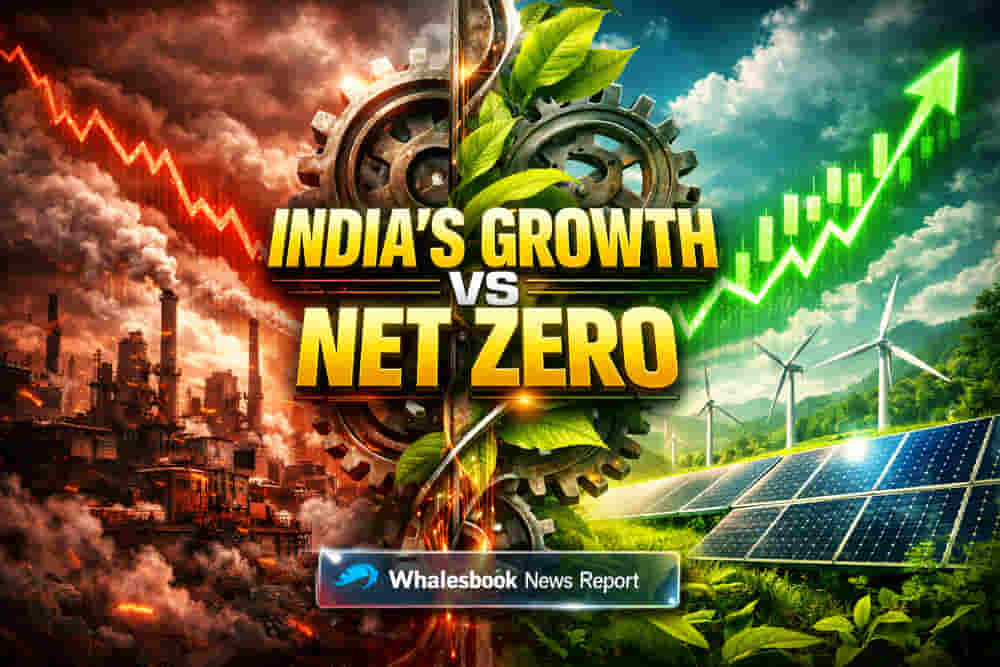
The Growth-Climate Conundrum
India's economic ambition faces a critical juncture where rapid industrial expansion must be reconciled with stringent net-zero emissions targets. Chief Economic Advisor Anantha Nageswaran has articulated this as a unique structural challenge, contrasting India's path with that of advanced economies that industrialized before modern environmental awareness. The nation must simultaneously grow its manufacturing base, which contributes approximately 18% to GDP, while aggressively lowering its carbon footprint. This dual imperative, underscored by the Niti Aayog's 'Scenario Towards Viksit Bharat and Net Zero' report, complicates India's journey to net-zero emissions by 2070.
Renewable Energy's Hidden Material Demands
The transition to clean energy, while essential, carries its own significant material and energy costs. Generating renewable power, particularly solar and wind, requires vast quantities of specific minerals such as silver, polysilicon, aluminum, copper, and rare earth elements. The expansion of electricity grids alone necessitates substantial increases in copper and aluminum demand. This dependency highlights a potential vulnerability, as scaling supply of critical materials like lithium, nickel, cobalt, and copper rapidly enough to meet projected demand by 2030 could prove challenging without significant advancements in efficiency, recycling, and mining expansion. The energy-intensive nature of extracting and processing these minerals further complicates the net-zero equation, suggesting that renewable energy's environmental footprint begins long before the power generation stage.
Strategic Investment in Decarbonization Technologies
Recognizing these complexities, India has made substantial budgetary commitments to address industrial emissions. The Union Budget 2026-27 allocated ₹20,000 crore (approximately $2.2 billion) over five years to accelerate Carbon Capture, Utilisation, and Storage (CCUS) technologies. This funding targets heavily polluting sectors like power, steel, cement, refineries, and chemicals—industries crucial for India's economic growth and global competitiveness, but which often lack cost-effective alternatives for deep emission cuts. The CCUS push aligns with India's net-zero by 2070 goal and aims to bridge the gap between pilot projects and scalable industrial systems, signalling an approach to decarbonize without deindustrializing. Additionally, the government is investing in critical minerals, establishing 'Rare Earth Corridors' to boost domestic processing and reduce import reliance, especially amidst geopolitical tensions and supply chain disruptions.
The Bear Case: Navigating Costs and Gaps
Despite policy advancements, significant risks and challenges persist. While CCUS is positioned as a core technological pillar, some experts suggest its role in mitigating industrial emissions may be overestimated compared to energy efficiency or electrification measures. Furthermore, integrating CCUS with existing power plants could significantly increase operational costs, potentially rendering it economically unviable in the short term. The heavy reliance on domestic resources for financing the transition, while necessary due to geopolitical pressures, places considerable strain on national savings and economic growth. A notable concern is the lack of specific adaptation measures in recent budgets, leading some climate experts to describe this as a "missed opportunity" given the escalating impacts of climate change on India's development. The challenge of securing sufficient critical minerals and managing their supply chains also presents a persistent risk.
Future Outlook: Innovation and Domestic Focus
India's approach to its energy transition emphasizes domestic innovation and resource mobilization. The Niti Aayog's report is intended as a dynamic "living document" to guide future policy as technologies and economic conditions evolve. The significant investment in CCUS and critical mineral supply chains reflects a strategy to foster indigenous technological capabilities and ensure energy security in an increasingly uncertain global environment. This focus on developing "moonshot technologies" and strengthening domestic capacity is deemed crucial for navigating the complex interplay between manufacturing expansion, economic development, and ambitious climate goals.