 Whalesbook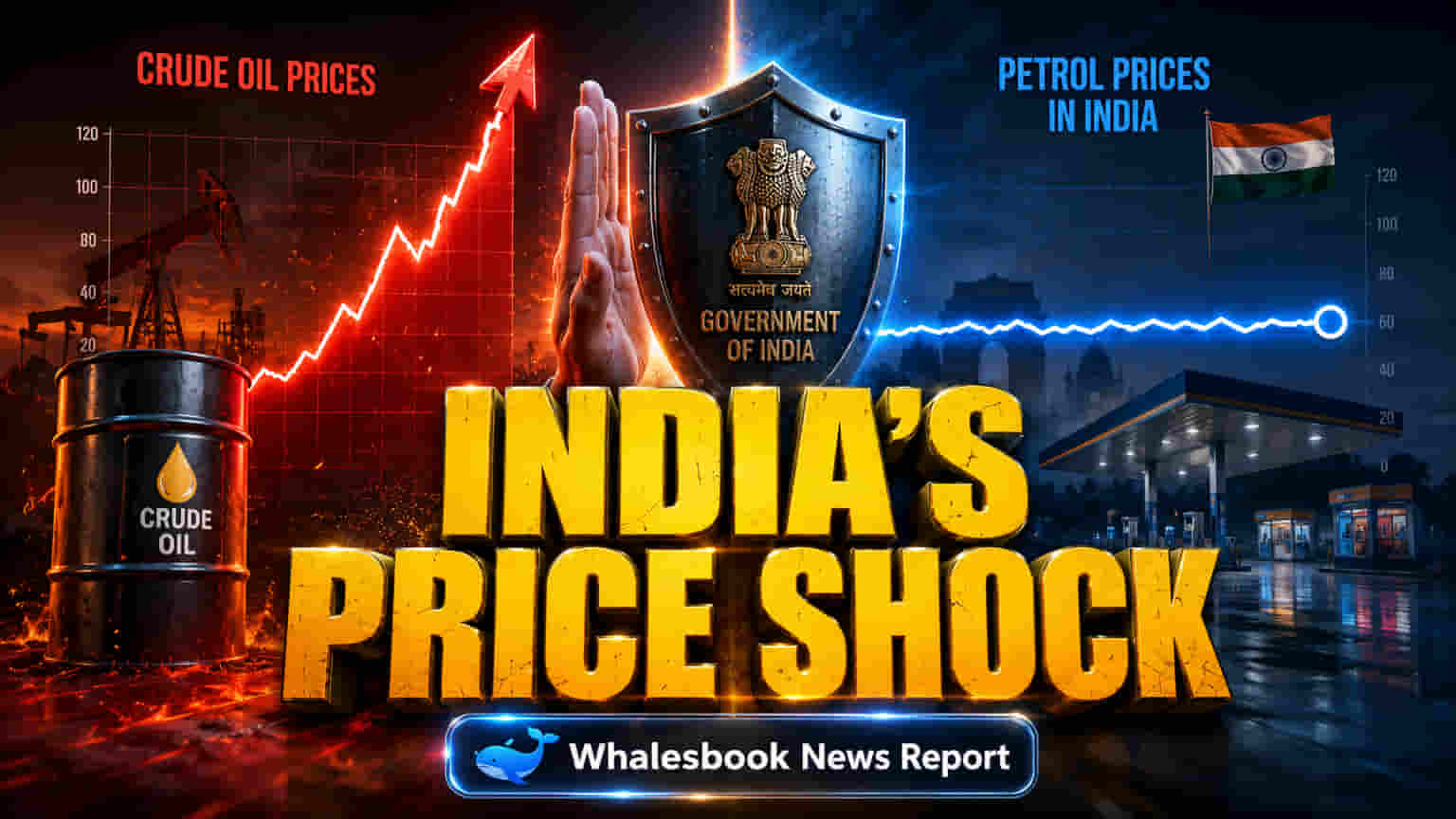


India's decision to shield consumers from a sharp 36% rise in crude oil prices, a consequence of the West Asia conflict's escalation since February 2026, is straining the nation's finances and currency. While petrol prices remain unchanged domestically, unlike the 41% surge in the United States, this stability comes at a significant cost. Government interventions, including fuel duty cuts and absorbing higher shipping costs, have led to substantial financial under-recoveries for state-owned refineries, highlighting a mismatch between global market prices and domestic energy policy.
The Cost of Stability
India's state-run oil marketing companies (OMCs) are reportedly absorbing losses of approximately ₹30,000 crore monthly. These under-recoveries stem from a prolonged freeze on retail price revisions, shielding consumers from global crude oil prices that jumped from around $70 to nearly $120 per barrel recently. For instance, daily under-recoveries in April 2026 alone reached ₹700-1,000 crore. This financial pressure on companies like Indian Oil Corporation, Bharat Petroleum, and Hindustan Petroleum raises concerns about their balance sheets and future investment plans, despite efforts to manage refinery margins. The government's excise duty cuts, which reduced diesel excise to zero and petrol excise to ₹3 per litre, aim to mitigate these losses but could result in a revenue shortfall of approximately ₹1.7 lakh crore.
Navigating Economic Headwinds
India's strategy of maintaining static fuel prices, while politically popular in the short term, carries significant economic risks. The nation's heavy reliance on imported crude, meeting nearly 90% of its demand, makes it highly vulnerable to global price shocks. Analysts project that sustained crude oil prices of $82-$87 per barrel, considered plausible given current geopolitical conditions, could widen India's current account deficit (CAD) to 2.0% of GDP in fiscal 2027, up from 1.5% in its base case. Historically, oil price shocks have directly impacted India's external balance; the 2008 oil peak saw the CAD reach 11% of GDP. Furthermore, higher oil import bills consistently pressure the Indian Rupee. The currency recently hit record lows against the US Dollar, trading around 95.33, a 12.07% depreciation over the past year. This weakness exacerbates import costs and fuels inflation.
The Bear Case: Unsustainability and Dependency
The current policy is not a sustainable long-term solution. The continuous strain on state-owned refineries acts as a hidden subsidy that distorts market signals and drains public money. Unlike energy-independent nations such as the United States, where domestic production buffers consumers from global price surges, India's import dependency leaves it exposed. Moody's notes India's resilience in absorbing shocks compared to more fragile emerging markets like Turkey or Argentina. However, its relatively high debt levels and weak fiscal balance limit its ability to manage repeated external pressures. Moreover, historical analysis of fuel subsidies in India indicates they are often regressive, disproportionately benefiting wealthier households rather than those most in need. The current approach assumes a swift resolution to the West Asia conflict, a gamble that could backfire if tensions persist, leading to further price escalations and deeper economic challenges.
The Path Forward: Domestic Production
Long-term energy security for India depends on enhancing domestic production across oil, gas, renewables, and nuclear power. State energy firms are uniquely positioned to lead this transition, with the potential to redirect over ₹2 trillion annually from fossil fuel investments towards clean energy initiatives. Accelerating renewable energy deployment, increasing efficiency, and diversifying the energy basket are crucial steps to build a resilient system that balances growth, autonomy, and sustainability, mitigating the vulnerabilities exposed by the current geopolitical climate.